
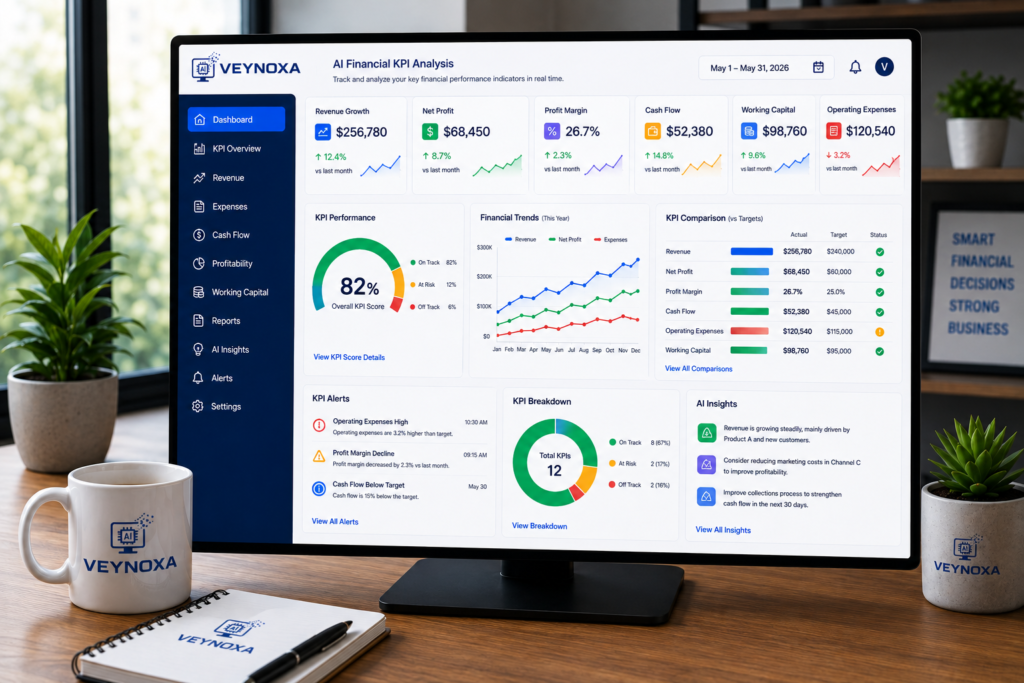
Introduction
Financial Key Performance Indicators (KPIs) help small businesses understand whether their financial performance is improving, declining, or remaining stable. However, monitoring multiple financial KPIs manually can become difficult as a business grows and financial data becomes more complex.
Business owners may need to review revenue, profit margins, expenses, cash flow, customer payments, operating costs, and other financial indicators across different periods. When this information is spread across spreadsheets, accounting systems, and financial reports, identifying important changes can take considerable time.
Artificial intelligence (AI) is transforming financial KPI analysis by automatically analyzing financial data, comparing performance indicators, identifying trends, detecting unusual changes, and generating useful insights.
Instead of reviewing financial KPIs only at the end of each month or quarter, businesses can use AI to monitor important financial indicators continuously and understand their financial performance more effectively.
In this guide, you’ll learn how AI financial KPI analysis helps small businesses monitor performance, identify financial trends, improve profitability, detect potential problems, and make better business decisions in 2026.
What Is AI Financial KPI Analysis?
AI financial KPI analysis uses artificial intelligence, machine learning, and predictive analytics to monitor and analyze key financial performance indicators.
Financial KPIs can include:
- Revenue growth
- Net profit
- Gross profit margin
- Operating expenses
- Cash flow
- Customer acquisition cost
- Customer lifetime value
- Accounts receivable
- Accounts payable
- Working capital
- Inventory turnover
- Return on investment
- Operating efficiency
AI can analyze these indicators together instead of examining each metric separately.
As new financial data becomes available, AI can update KPI analysis and highlight important changes that may require attention.
Why Financial KPIs Matter
Financial KPIs provide businesses with measurable information about their financial health and operational performance.
Without effective KPI monitoring, small businesses may struggle to identify:
- Declining profitability
- Increasing expenses
- Slower revenue growth
- Cash flow pressure
- Inefficient operations
- Poor financial performance
- Changes in customer behavior
- Increasing financial risks
Monitoring financial KPIs regularly helps business owners understand where the business is performing well and where improvements may be necessary.
AI makes this process more efficient by automatically processing financial information and identifying important patterns.
1. Monitoring Revenue Growth
Revenue growth is one of the most important financial indicators for a growing business.
AI can compare revenue across different periods and identify patterns in:
- Monthly revenue
- Quarterly revenue
- Product revenue
- Service revenue
- Customer revenue
- Sales channels
- Seasonal performance
Businesses can use these insights to understand whether revenue is growing consistently or whether specific periods are showing signs of weakness.
AI can also identify unusual revenue changes and help business owners investigate the reasons behind them.
2. Tracking Profit Margins
Revenue alone does not show whether a business is becoming more profitable.
AI can monitor gross and net profit margins by analyzing revenue alongside operating costs, production expenses, pricing, and other financial data.
Businesses can identify:
- Improving profit margins
- Declining profit margins
- High-cost products
- Unprofitable services
- Increasing operating expenses
- Pricing problems
This information helps business owners focus on improving profitability rather than simply increasing sales.
3. Monitoring Operating Expenses
Operating expenses can gradually increase without business owners immediately noticing the impact.
AI can analyze spending patterns and compare current expenses with historical financial data.
It can identify:
- Increasing software costs
- Higher supplier expenses
- Rising payroll costs
- Unusual spending
- Recurring expenses
- Areas of unnecessary spending
Businesses can then review these expenses and determine whether they are contributing enough value to justify their cost.
4. Measuring Cash Flow Performance
Cash flow is another critical financial KPI.
A business can be profitable while still experiencing cash flow difficulties if customers pay slowly or large expenses become due at the wrong time.
AI can monitor:
- Incoming payments
- Outgoing expenses
- Cash balances
- Outstanding invoices
- Upcoming obligations
- Historical cash flow patterns
This gives business owners better visibility into their available cash and helps them identify potential cash flow pressure earlier.
5. Monitoring Working Capital
Working capital helps businesses understand whether they have enough short-term resources to support daily operations.
AI can analyze:
- Cash
- Accounts receivable
- Accounts payable
- Inventory
- Short-term obligations
By monitoring these indicators together, AI can identify situations where too much capital may be tied up in inventory or unpaid customer invoices.
This can help businesses improve liquidity and use available resources more efficiently.
6. Comparing Actual Results With Targets
Financial KPIs are most useful when businesses compare actual performance with predefined targets.
AI can compare:
- Actual revenue vs. revenue targets
- Actual expenses vs. budgets
- Actual profit vs. profit targets
- Actual cash flow vs. forecasts
- Actual sales vs. business goals
These comparisons help business owners understand whether financial performance is meeting expectations.
If a KPI moves significantly away from its target, AI can highlight the difference and help identify areas that require attention.
7. Detecting Financial KPI Trends
AI can analyze financial KPI data over time to identify trends that may not be immediately visible.
For example, AI may identify that:
- Revenue is growing slowly
- Expenses are increasing faster than revenue
- Profit margins are declining
- Customer payments are becoming slower
- Cash availability is decreasing
Recognizing these trends early gives business owners more time to investigate and take corrective action.
8. Identifying Financial Performance Problems
AI can monitor multiple financial KPIs simultaneously and identify combinations of indicators that may signal a financial problem.
For example, declining revenue combined with increasing expenses and weaker cash flow may indicate increasing financial pressure.
AI can bring these changes together instead of requiring business owners to discover them individually.
This creates a more comprehensive view of financial performance.
9. Supporting Better Financial Decisions
Financial KPI insights can help business owners make more informed decisions about:
- Hiring
- Marketing investments
- Pricing
- Inventory purchases
- Equipment
- Expansion
- Cost reduction
- Business investments
Instead of relying only on intuition, business owners can use financial KPIs to understand the potential impact of different decisions.
10. Improving Financial Planning
AI financial KPI analysis can support future planning by identifying historical trends and current performance patterns.
Businesses can use KPI insights when preparing:
- Financial budgets
- Growth plans
- Investment strategies
- Expense plans
- Hiring plans
- Expansion strategies
Better KPI monitoring helps businesses align financial decisions with measurable performance.
11. Creating Automated Financial Alerts
One advantage of AI-powered KPI analysis is the ability to generate automated alerts.
Businesses can configure alerts for significant changes such as:
- Revenue falling below a target
- Expenses exceeding a budget
- Profit margins declining
- Cash balances becoming too low
- Customer payments slowing
- Working capital deteriorating
These alerts can help business owners respond to financial problems before they become more serious.
12. Saving Time on Financial Monitoring
Manual KPI monitoring often requires collecting financial information, updating spreadsheets, calculating ratios, comparing periods, and preparing reports.
AI can automate many of these processes.
Instead of spending hours preparing financial KPI reports, business owners can receive automatically generated insights and focus more of their time on managing and growing the business.
Comparison Table
| Traditional Financial KPI Analysis | AI Financial KPI Analysis |
|---|---|
| Manual KPI calculations | Automated KPI calculations |
| Periodic monitoring | Continuous KPI monitoring |
| Manual financial comparisons | Automated performance comparisons |
| Static reports | Dynamic financial insights |
| Manual trend identification | AI-powered trend detection |
| Limited alerts | Automated KPI alerts |
| Time-consuming analysis | Faster financial analysis |
| Reactive monitoring | Proactive financial monitoring |
Best Practices
To maximize AI financial KPI analysis:
- Choose KPIs that directly support business goals.
- Keep financial data accurate and updated.
- Monitor KPIs consistently.
- Compare actual results with targets.
- Review significant KPI changes.
- Investigate unusual financial trends.
- Avoid focusing on a single financial indicator.
- Combine financial KPIs with operational information.
- Review AI-generated insights regularly.
- Combine AI analysis with professional financial judgment.
Common Mistakes to Avoid
Avoid these common financial KPI mistakes:
- Tracking too many KPIs.
- Focusing only on revenue.
- Ignoring profitability.
- Ignoring cash flow.
- Using outdated financial data.
- Failing to compare results with targets.
- Ignoring negative KPI trends.
- Making decisions based on a single metric.
- Treating AI recommendations as automatically correct.
- Failing to review important financial changes.
Frequently Asked Questions
What is AI financial KPI analysis?
AI financial KPI analysis uses artificial intelligence to monitor, compare, and analyze important financial performance indicators such as revenue, expenses, profitability, cash flow, and working capital.
Can small businesses use AI financial KPIs?
Yes. Small businesses can use AI-powered financial tools to monitor important KPIs, identify trends, detect financial problems, and support better decision-making.
Which financial KPIs can AI monitor?
AI can monitor KPIs such as revenue growth, profit margins, operating expenses, cash flow, working capital, accounts receivable, accounts payable, inventory turnover, and return on investment.
How does AI identify financial KPI trends?
AI analyzes historical and current financial data to identify patterns, changes, and unusual movements in financial KPIs.
Can AI alert businesses about financial problems?
Yes. AI-powered systems can generate alerts when important financial KPIs move significantly outside predefined targets or normal patterns.
How can financial KPIs improve business decisions?
Financial KPIs provide measurable information about business performance, helping owners make more informed decisions about expenses, pricing, investments, hiring, and growth.
Does AI replace accountants?
No. AI supports accountants and business owners by automating KPI monitoring and financial analysis, while humans remain responsible for reviewing financial information and making strategic decisions.
What are the benefits of AI financial KPI analysis?
Businesses can benefit from better financial visibility, faster analysis, automated monitoring, earlier problem detection, improved profitability tracking, and more informed financial decisions.
Conclusion
AI financial KPI analysis gives small businesses a more efficient way to monitor and understand their financial performance. By continuously analyzing revenue, expenses, profit margins, cash flow, working capital, and other important indicators, AI can identify trends and potential problems earlier.
Better financial KPI monitoring helps business owners compare actual performance with targets, improve profitability, control expenses, manage cash more effectively, and make decisions based on reliable financial information.
As AI-powered financial management continues to evolve throughout 2026, small businesses that adopt intelligent KPI analysis can improve financial visibility, respond to performance changes faster, and build a stronger foundation for sustainable long-term growth.