
Introduction
Pricing is one of the most important decisions a small business makes. Set prices too high, and customers may choose a competitor. Set them too low, and the business may generate sales without earning enough profit to cover its costs.
For many small businesses, pricing decisions are based on experience, competitor prices, and occasional calculations. These methods can be useful, but they may overlook changes in customer demand, purchasing behavior, operating costs, and market conditions.
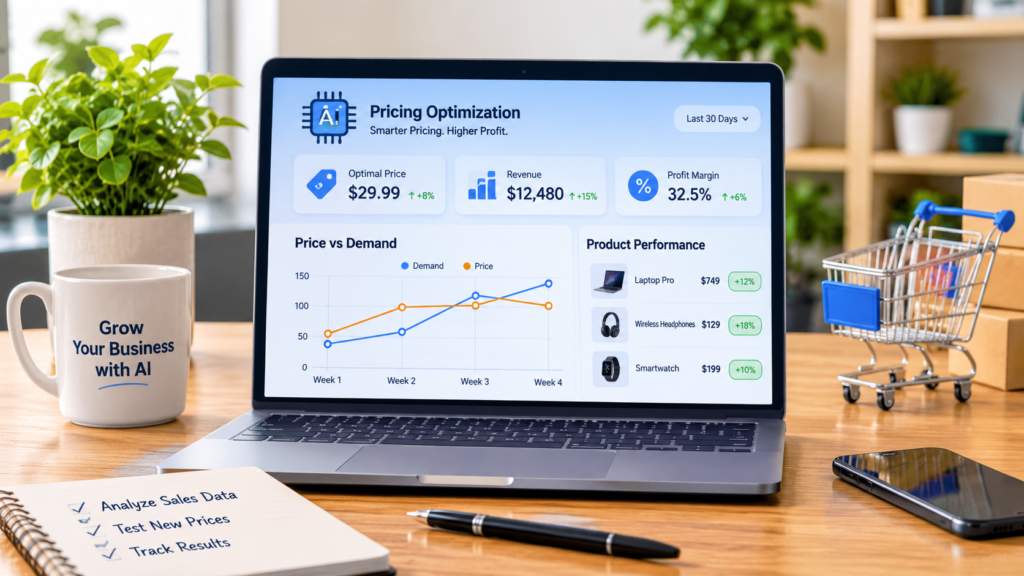
Artificial intelligence (AI) offers another way to approach pricing. By analyzing sales data, customer behavior, costs, and market information, AI-powered tools can help business owners identify pricing opportunities, evaluate different scenarios, and make more informed decisions.
AI pricing optimization does not simply mean charging customers more. It means finding prices that balance customer value, competitiveness, sales performance, and profitability.
In this guide, we explain how AI pricing optimization works, why it matters for small businesses, which tools and techniques can help, and how to implement a practical pricing strategy.
What Is AI Pricing Optimization?
AI pricing optimization is the use of artificial intelligence, machine learning, and data analysis to help businesses evaluate and improve their pricing decisions.
Traditional pricing often relies on fixed formulas, historical experience, or competitor comparisons. AI-based approaches can analyze larger datasets, identify patterns, and estimate how different pricing decisions might affect demand and revenue.
For example, a small online retailer might use an AI tool to analyze:
- Historical sales and product prices.
- Changes in customer demand.
- Product costs and profit margins.
- Competitor pricing information.
- Seasonal purchasing patterns.
- Discounts, promotions, and conversion rates.
The system can then provide recommendations, such as reviewing a price that may be too low, testing a discount, or investigating a product whose sales decline after a price change.
AI recommendations are estimates, not guarantees. Their reliability depends on data quality, the model used, and whether the business’s market conditions are represented accurately.
Why AI Pricing Optimization Matters for Small Businesses
Small businesses often operate with limited budgets and fewer resources for market research. A pricing mistake can therefore have a significant impact on cash flow and profitability.
AI can help address several common challenges.
1. Protecting Profit Margins
A product that sells frequently is not necessarily profitable. Discounts, shipping expenses, payment fees, and rising supplier costs can reduce the money a business earns from each sale.
AI tools can help analyze the relationship between selling prices, costs, and margins. Business owners can use these insights to identify products that may need a pricing review.
For a broader understanding of profitability, businesses can also use AI profit margin analysis to investigate which products and services contribute most to their financial performance.
2. Understanding Customer Demand
Customers do not respond to every price change in the same way. Some compare prices closely, while others prioritize convenience, quality, availability, or customer service.
AI can analyze historical purchasing patterns to estimate how demand may change at different price levels.
These estimates can help businesses identify products for which a small price adjustment may have a meaningful effect on sales.
3. Staying Competitive
Competitor prices can influence customer expectations, especially in crowded markets.
AI-powered tools can help businesses organize available competitor pricing information and identify significant differences between their prices and the market.
However, matching the lowest competitor price is not always the best strategy. A small business may compete through quality, service, convenience, specialization, or a stronger customer experience instead.
4. Making Pricing Decisions Faster
Manual pricing reviews can take considerable time, particularly for businesses that sell many products.
AI can help summarize sales patterns, flag unusual changes, and prioritize products that deserve attention. This allows business owners to spend less time reviewing spreadsheets and more time evaluating the decisions that matter.
1. Analyzing Historical Sales Data
Historical sales data provides an important starting point for pricing optimization.
AI systems can analyze information such as units sold, selling prices, order frequency, discounts, returns, and seasonal changes. They can then identify patterns that might not be obvious from individual transactions.
For example, a retailer might discover that a particular product sells well at its regular price during certain months but requires promotional support during quieter periods.
This does not automatically mean that the business should change its price. It provides evidence that the owner can investigate before making a decision.
To improve the analysis, businesses should organize their data by product, date, price, sales volume, and relevant costs.
2. Estimating Price Sensitivity
Price sensitivity describes how strongly customers respond when a product’s price changes.
AI models can help estimate this relationship by analyzing historical price changes alongside sales volumes and other relevant factors.
Suppose a business notices that sales fall whenever it raises the price of a particular product. The owner can investigate whether the change reflects genuine price sensitivity or other factors, such as reduced advertising, seasonal demand, or a competitor’s promotion.
Reliable estimates require enough relevant data. When prices and other conditions change simultaneously, it can be difficult to determine which factor caused the change.
For small businesses, controlled price tests and careful comparisons can provide additional evidence.
3. Monitoring Competitor Prices
Competitor monitoring can help businesses understand their position in the market.
Depending on the tools and data available, AI can help collect, organize, or summarize competitor pricing information and flag meaningful changes.
A small online store might use these insights to identify products priced substantially above or below comparable offers.
Before changing a price, the business should compare equivalent products and consider differences in:
- Product quality and specifications.
- Shipping costs and delivery times.
- Warranty and return policies.
- Customer support.
- Bundled products and promotional conditions.
Competitor data should support a pricing strategy, not replace it. A lower price does not always create a sustainable competitive advantage.
4. Supporting Dynamic Pricing Decisions
Dynamic pricing means adjusting prices in response to changing conditions, such as demand, availability, or market circumstances.
AI can help businesses evaluate whether a price adjustment may be appropriate under particular conditions.
For example, a service business may experience higher demand during certain periods. A retailer may also need to review prices when inventory becomes limited or supplier costs change.
However, dynamic pricing is not suitable for every small business. Frequent changes can confuse customers, weaken trust, or create operational complexity.
Businesses should establish clear pricing rules, review recommendations before implementation, and ensure that their practices comply with applicable consumer protection and pricing laws.
5. Optimizing Discounts and Promotions
Discounts can attract customers, but they can also reduce profitability if they are poorly designed.
AI can help businesses compare promotional results by examining sales volume, average order value, acquisition costs, and profit margins.
For example, a business might discover that a smaller discount combined with free delivery generates better overall results than a larger discount applied to every order.
Useful questions include:
- Did the promotion attract new customers?
- Did it increase total profit or only sales volume?
- Would customers have purchased without the discount?
- Did the promotion encourage repeat purchases?
- Were additional operating costs covered?
These questions help businesses evaluate promotions according to their actual results rather than revenue alone.
6. Connecting Pricing With Sales Forecasting
Pricing decisions are closely connected to expected demand.
If a business anticipates a seasonal increase in sales, it may need to review stock availability, staffing, supplier orders, and promotional plans before changing prices.
AI-based forecasting can help estimate future demand from historical sales and relevant external factors.
Businesses can combine these insights with AI sales forecasting to understand how different pricing scenarios might affect expected sales and operational requirements.
Forecasts remain uncertain, so business owners should compare multiple scenarios rather than relying on a single prediction.
7. Improving Revenue and Pricing Decisions
A pricing decision affects more than the amount charged for one product. It can influence order volume, customer retention, product mix, and total revenue.
AI can help business owners evaluate these relationships by comparing different pricing scenarios and highlighting possible trade-offs.
For example, reducing the price of one product might increase sales but also reduce the profit earned from each unit. Alternatively, a modest price increase might improve margins while having little effect on demand.
The outcome depends on the product, customers, competitors, and costs.
Businesses can complement pricing analysis with AI revenue optimization to understand how pricing decisions fit into a broader strategy for improving business revenue.
8. Comparing Traditional Pricing With AI Pricing Optimization
| Area | Traditional pricing | AI-supported pricing |
|---|---|---|
| Data analysis | Often relies on manual calculations | Can analyze larger datasets |
| Demand estimation | Uses experience and simple historical trends | Can identify patterns and estimate scenarios |
| Competitor monitoring | Requires manual research | Can organize and summarize available data |
| Price reviews | Often performed periodically | Can flag changes that deserve attention |
| Discounts | May rely on broad rules | Can compare promotional results |
| Decision-making | Depends heavily on owner judgment | Combines analytical recommendations with human judgment |
| Implementation costs | May be low with spreadsheets | Can involve subscriptions and setup costs |
AI is not automatically better for every business. A spreadsheet and a clear pricing formula may be sufficient for a small product range. AI becomes more useful when the business has enough reliable data and faces pricing decisions that are difficult to manage manually.
9. How to Implement AI Pricing Optimization Step by Step
Small businesses do not need to implement a complex pricing system immediately. A gradual approach makes it easier to evaluate the benefits and avoid unnecessary costs.
Step 1: Define a Clear Pricing Objective
Decide what the business wants to improve.
Possible objectives include increasing contribution margin, reducing unprofitable discounts, improving conversion rates, or responding more effectively to changes in demand.
Avoid pursuing several conflicting objectives without deciding which matters most.
Step 2: Collect Reliable Data
Gather historical prices, sales volumes, product costs, discounts, returns, and other relevant information.
Check for missing values, inconsistent product names, and outdated costs before using the data in an AI system.
Step 3: Choose a Suitable Tool
Select a tool that matches the size and complexity of the business.
Some businesses may benefit from AI-assisted spreadsheet analysis, while others may need a pricing platform integrated with their e-commerce or inventory system.
Start with a limited set of products rather than investing immediately in a complex solution.
Step 4: Establish Pricing Rules
Define minimum acceptable margins, maximum permitted price changes, discount limits, and any restrictions on automated price updates.
These rules help ensure that AI recommendations remain consistent with the business’s financial objectives and customer commitments.
Step 5: Test Recommendations
Before changing prices across the entire business, test recommendations on a small and appropriate group of products.
Compare the results with a baseline or a suitable control group when possible. Account for seasonality, advertising, and other factors that may affect sales.
Step 6: Measure Results
Track the metrics that correspond to the original objective.
Evaluate profitability as well as sales volume, and include the cost of the tool and implementation when calculating the overall benefit.
Step 7: Review and Improve
Pricing models can become less reliable when market conditions change.
Review recommendations regularly, investigate unexpected results, and update the data and assumptions when necessary.
10. Best Practices for Successful AI Pricing Optimization
A practical pricing strategy combines data analysis with business judgment.
- Prioritize profit, not revenue alone. Higher sales do not necessarily mean better financial results.
- Use accurate cost data. Outdated supplier prices and missing expenses can produce misleading recommendations.
- Keep pricing transparent. Ensure that customers understand relevant fees, discounts, and conditions.
- Protect customer information. Use data responsibly and follow applicable privacy requirements.
- Monitor competitor information carefully. Compare equivalent offers rather than relying on headline prices alone.
- Review recommendations before deployment. Human oversight is particularly important for unusual or high-impact changes.
- Test gradually. Begin with a limited scope and expand only when results justify it.
- Document pricing decisions. Keep records of changes, reasons, and measured outcomes.
11. Common Mistakes to Avoid
Relying on Incomplete Data
A pricing model may recommend an unsuitable price if it does not account for shipping, returns, supplier costs, or discounts.
How to avoid it: Review the underlying data before trusting the recommendation.
Competing Only on Price
Repeatedly lowering prices can reduce margins and make it harder for a small business to sustain its operations.
How to avoid it: Consider product quality, service, convenience, and the value customers receive.
Automating Every Price Change
Automatic changes without suitable controls can lead to unexpected prices, customer complaints, or inconsistent offers.
How to avoid it: Set limits, test changes, and require approval for significant adjustments.
Ignoring Customer Trust
A pricing strategy that feels confusing or unfair can damage long-term relationships.
How to avoid it: Communicate pricing clearly and review the effect of changes on customer satisfaction.
Measuring Sales Instead of Profit
A successful promotion may increase order volume while generating less profit.
How to avoid it: Measure contribution margin and total costs alongside sales.
Expecting Immediate Results
AI recommendations may need testing and adjustment before they produce measurable benefits.
How to avoid it: Set realistic targets and evaluate results over an appropriate period.
12. How to Measure the ROI of AI Pricing Optimization
Return on investment (ROI) helps a business determine whether its pricing system creates enough financial value to justify its cost.
Useful metrics include:
| Metric | What it measures |
|---|---|
| Gross profit margin | The share of revenue remaining after the cost of goods sold |
| Contribution margin | Revenue remaining after relevant variable costs |
| Conversion rate | The proportion of relevant visitors who complete a purchase |
| Average order value | The average value of completed orders |
| Discount rate | The proportion of sales revenue given up through discounts, depending on the chosen definition |
| Repeat purchase rate | How frequently customers return to purchase |
| Pricing tool cost | Software, setup, integration, and ongoing operating expenses |
A simple ROI calculation is:
\[ \text{ROI}=\frac{\text{Net Benefit}}{\text{Total Investment}}\times100\% \]
For this calculation, net benefit should represent the additional financial benefit attributable to the pricing initiative after accounting for relevant incremental costs. Avoid counting the same benefit twice.
For example, if a pricing initiative generates an estimated additional net benefit of \$1,500 and costs \$500 to implement, the ROI is 300%.
The business should compare results against a reasonable baseline and account for other factors that may have affected performance.
13. The Future of AI Pricing Optimization for Small Businesses
AI pricing tools are likely to become more accessible as software providers integrate data analysis, forecasting, and recommendations into everyday business applications.
Small businesses may increasingly be able to evaluate pricing scenarios without building their own complex models.
Potential developments include more personalized demand estimates, better integration with inventory and sales systems, and easier analysis of promotional performance.
However, technology alone will not determine successful pricing. Businesses will still need accurate information, a clear understanding of their customers, and policies that support fair and sustainable commercial decisions.
The most effective approach is likely to combine AI-generated insights with human judgment, practical experimentation, and regular performance reviews.
Frequently Asked Questions
What is AI pricing optimization?
AI pricing optimization uses artificial intelligence and data analysis to help businesses evaluate prices, estimate demand, compare scenarios, and make more informed pricing decisions.
Can small businesses use AI for pricing?
Yes. Small businesses can begin with AI-assisted spreadsheet analysis or affordable software that analyzes sales and cost data. The appropriate solution depends on the business’s needs, data quality, and budget.
Does AI pricing optimization automatically increase profits?
No. AI can identify opportunities and estimate possible outcomes, but profitability depends on customer demand, costs, competition, implementation, and the quality of the recommendations.
Is dynamic pricing suitable for every small business?
No. Dynamic pricing may be useful when demand or availability changes frequently, but frequent price changes can confuse customers or damage trust in some markets.
What data is needed for AI pricing optimization?
Useful data includes historical prices, sales volumes, product costs, discounts, returns, and relevant demand or competitor information. The exact requirements depend on the tool and business model.
How can a small business measure pricing optimization success?
Businesses can compare profit margins, contribution margins, conversion rates, average order value, and overall financial results against a reasonable baseline, while accounting for implementation costs.
Is AI pricing optimization expensive?
Costs vary. Some businesses can start with tools they already use, while advanced pricing platforms may require subscriptions, integrations, and ongoing maintenance. A small pilot can help determine whether a larger investment is justified.
Conclusion
AI pricing optimization can help small businesses make better-informed decisions about product and service prices. By analyzing sales data, estimating demand, evaluating discounts, and comparing pricing scenarios, AI tools can reveal opportunities that may be difficult to identify manually.
The best results come from combining reliable data with clear business objectives, appropriate pricing rules, and human oversight.
Rather than changing every price at once, small businesses should start with a focused test, measure the financial impact, and expand their approach when the evidence supports it.
The goal is not simply to charge the highest possible price. It is to find sustainable prices that reflect customer value, support profitability, and help the business compete effectively.