
Introduction
Running a small business often means every employee wears multiple hats. From answering emails and managing schedules to handling customer requests and preparing reports, daily tasks can quickly consume valuable working hours.
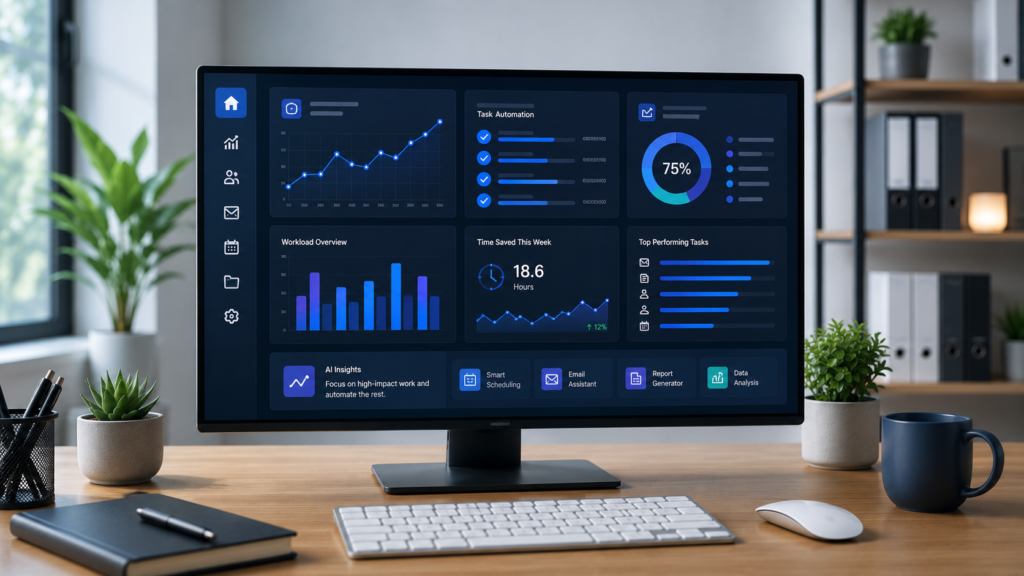
Artificial intelligence (AI) is helping businesses solve this challenge by reducing repetitive work and allowing employees to focus on more valuable activities. Rather than replacing people, AI acts as a productivity assistant that supports better decision-making, faster communication, and improved efficiency.
In this guide, you’ll discover how AI improves employee productivity, the best ways to implement it, and why small businesses are increasingly adopting AI-powered workflows.
Why Employee Productivity Matters
Productivity is one of the biggest factors that determines whether a small business grows successfully.
When employees spend less time on repetitive administrative work, they can dedicate more attention to customers, sales, creativity, and business development.
Higher productivity often results in:
- Faster project completion
- Better customer satisfaction
- Lower operating costs
- Reduced employee stress
- Increased business profitability
AI helps achieve these improvements without requiring businesses to hire additional staff.
How AI Eliminates Repetitive Tasks
Many daily activities follow predictable patterns that AI can automate.
Examples include:
- Email organization
- Calendar scheduling
- Meeting summaries
- Data entry
- Invoice processing
- Document creation
- CRM updates
- File organization
Automating these tasks allows employees to focus on work that requires creativity, experience, and human judgment.
AI Improves Team Communication
One common productivity challenge is communication delays.
AI-powered collaboration tools help teams by:
- Summarizing meetings automatically
- Creating action lists
- Tracking project progress
- Organizing shared documents
- Managing internal knowledge bases
- Translating messages when working internationally
This reduces misunderstandings and saves significant administrative time.
How AI Helps Employees Make Better Decisions
Employees often need quick access to accurate information before making decisions. AI tools can analyze large amounts of business data in seconds, providing useful insights that would normally take hours to gather manually.
For example, AI can:
- Analyze sales trends
- Predict customer demand
- Identify slow-moving products
- Highlight business opportunities
- Generate easy-to-read reports
Instead of relying on guesswork, employees can make faster and more informed decisions.
AI Supports Better Customer Service
Customer support teams often spend hours answering similar questions every day.
AI helps by:
- Answering common customer questions instantly
- Routing requests to the correct department
- Suggesting responses for support agents
- Organizing customer conversations
- Tracking customer satisfaction
Employees can then focus on solving more complex problems that require human attention.
AI Reduces Workplace Errors
Manual work increases the risk of mistakes.
Common errors include:
- Incorrect invoices
- Missing customer information
- Duplicate records
- Scheduling conflicts
- Typing mistakes
AI automatically checks information, flags inconsistencies, and reduces repetitive manual input, leading to more accurate business operations.
Best AI Productivity Tools for Small Businesses
Several AI-powered tools can improve employee productivity without requiring a large budget.
Popular categories include:
- AI writing assistants
- Meeting transcription software
- Project management platforms
- AI chatbots
- AI marketing tools
- Email assistants
- Workflow automation software
- CRM systems with AI features
Choosing tools that integrate with existing workflows usually delivers the fastest results.
Tips for Successfully Introducing AI to Employees
Implementing AI should improve the employee experience rather than complicate it.
Follow these best practices:
- Start with one repetitive process.
- Train employees before introducing new tools.
- Monitor productivity improvements.
- Collect employee feedback regularly.
- Protect sensitive business data.
- Continue improving workflows over time.
Gradual adoption typically produces better long-term results than changing everything at once.
Popular AI Tools That Improve Employee Productivity
Before choosing an AI solution, it’s helpful to understand how different tools support everyday business operations. The table below highlights some popular AI tools and the productivity benefits they offer for small businesses.
| AI Tool | Productivity Benefit |
|---|---|
| ChatGPT | Speeds up writing, brainstorming, and content creation |
| Microsoft Copilot | Assists with documents, spreadsheets, and presentations |
| Grammarly | Improves writing quality and reduces grammar mistakes |
| Notion AI | Organizes notes, tasks, and project documentation |
| Zapier AI | Automates repetitive business workflows |
After selecting the right AI tools, businesses should start with one or two solutions, measure their impact on daily operations, and gradually expand AI adoption as employees become more comfortable using the technology.
Frequently Asked Questions
Does AI replace employees?
No. AI is designed to automate repetitive tasks while employees focus on work that requires creativity, communication, and decision-making.
Is AI affordable for small businesses?
Yes. Many AI tools offer free plans or affordable subscriptions suitable for small teams.
What tasks can AI automate?
AI can automate scheduling, emails, reports, customer support, data entry, document generation, meeting summaries, and many repetitive administrative tasks.
Can AI improve teamwork?
Yes. AI helps organize projects, summarize meetings, improve communication, and keep teams aligned on priorities.
Is AI difficult to use?
Most modern AI tools are designed for beginners and require little technical knowledge.
Can AI improve employee productivity?
Yes. AI helps employees complete repetitive tasks faster, improves communication, reduces manual work, and allows teams to focus on higher-value activities that require creativity and problem-solving.
Is AI difficult to implement in a small business?
No. Many AI tools are designed for beginners and can be integrated gradually without requiring advanced technical skills or large budgets.
Conclusion
Artificial intelligence is becoming one of the most effective ways for small businesses to improve employee productivity. By automating repetitive tasks, supporting smarter decisions, reducing errors, and improving collaboration, AI allows employees to spend more time creating value for customers and growing the business.
Businesses that adopt AI gradually and strategically are more likely to build efficient teams, improve customer experiences, and remain competitive in an increasingly digital marketplace.