
Introduction
Managing inventory is one of the biggest challenges for small businesses. Ordering too much stock increases costs, while ordering too little can lead to lost sales and unhappy customers.
Artificial intelligence helps businesses predict demand, monitor inventory in real time, and automate purchasing decisions. As a result, companies reduce waste, improve cash flow, and make better business decisions.
AI helps businesses save time every day.
This guide explains how AI inventory management works and why it has become an essential tool for modern small businesses.
What Is AI Inventory Management?
AI inventory management uses machine learning and data analysis to monitor stock levels, forecast future demand, and recommend purchasing decisions automatically.
Instead of relying on manual spreadsheets, businesses receive real-time recommendations based on customer behavior, seasonal trends, and historical sales.
This allows owners to spend less time managing inventory and more time growing their business.
Why Inventory Management Matters
Poor inventory management creates several common problems:
- Overstocked products
- Out-of-stock items
- Higher storage costs
- Slow-moving inventory
- Lost revenue
- Manual tracking errors
AI helps eliminate many of these issues through automation and predictive analytics.
How AI Improves Inventory Management
Demand Forecasting
AI analyzes previous sales, seasonal patterns, holidays, and customer buying habits.
This allows businesses to order products before demand increases while avoiding unnecessary purchases.
Automatic Stock Monitoring
Modern AI systems continuously monitor inventory levels.
When stock reaches a predefined limit, the software can automatically notify staff or generate purchase recommendations.
Supplier Optimization
AI evaluates supplier performance by comparing:
- Delivery speed
- Product availability
- Pricing
- Order accuracy
This helps businesses choose reliable suppliers and reduce delays.
Sales Trend Analysis
Instead of simply counting inventory, AI identifies which products:
- Sell quickly
- Sell slowly
- Become seasonal
- Are becoming more popular
Business owners can adjust purchasing strategies accordingly.
Benefits of AI Inventory Management
Businesses that adopt AI inventory management often experience measurable improvements in efficiency, cost control, and inventory accuracy.
Businesses using AI often experience:
| Benefit | Business Impact |
|---|---|
| Better demand prediction | Fewer stock shortages |
| Lower storage costs | Reduced expenses |
| Automated inventory tracking | Saves time |
| Improved cash flow | Better financial planning |
| Reduced waste | Higher profitability |
| Faster purchasing decisions | Increased efficiency |
AI inventory management becomes even more powerful when combined with broader business automation that connects purchasing, reporting, inventory updates, and customer orders into one intelligent workflow.
Practical Example
A small retail store can use AI inventory management to monitor stock levels automatically, predict seasonal demand, and generate purchase recommendations before products run out. Instead of manually checking inventory every day, the owner receives real-time alerts and can make faster purchasing decisions while reducing storage costs.
Industries That Benefit Most
AI inventory management is useful across many industries, including:
- Retail stores
- Restaurants
- E-commerce businesses
- Fashion brands
- Grocery stores
- Electronics retailers
- Pharmacies
- Manufacturing companies
Almost any business that manages physical products can benefit from AI automation.
Common AI Inventory Features
Most AI inventory software includes:
- Real-time inventory tracking
- Automatic stock alerts
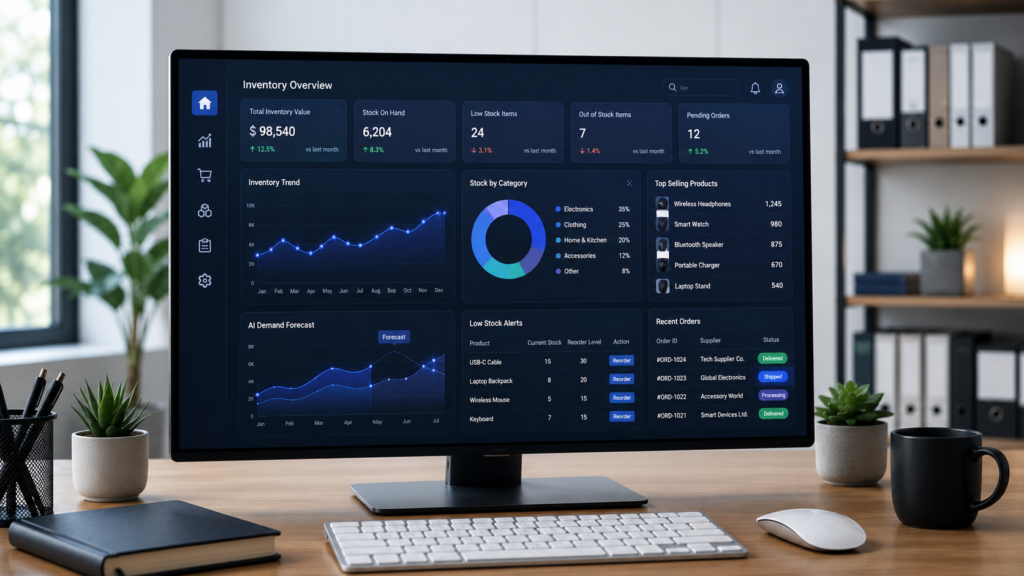
- Sales forecasting
- Barcode integration
- Multi-location inventory management
- Purchase order automation
- Supplier management
- Business analytics dashboards
AI analytics dashboards help business owners identify inventory trends and make smarter purchasing decisions using real-time business data.
Challenges to Consider
Although AI offers many advantages, businesses should also prepare for:
- Initial software setup
- Employee training
- Well-trained employees are more likely to use AI inventory systems effectively and maintain accurate inventory records.
- Data accuracy requirements
- Integration with existing systems
- Monthly software costs
Choosing the right platform and maintaining accurate inventory data are essential for achieving the best results.
Businesses that regularly update inventory data and review AI recommendations usually achieve more accurate forecasts and better long-term inventory performance.
Best Practices for Successful Implementation
To maximize results:
- Organize your existing inventory data.
- Start with one product category before expanding.
- Regularly review AI recommendations.
- Train employees on the new system.
- Successful inventory implementation also requires clear project planning, realistic timelines, and regular progress monitoring.
- Monitor reports and adjust purchasing strategies.
Small improvements made consistently often deliver the greatest long-term benefits.
Frequently Asked Questions
Can small businesses afford AI inventory software?
Yes. Many cloud-based platforms offer affordable monthly subscriptions designed specifically for small businesses.
Does AI completely replace inventory managers?
No. AI provides recommendations and automation, while business owners still make strategic decisions.
Is AI inventory management useful for online stores?
Absolutely. E-commerce businesses often benefit the most because AI can quickly respond to changing customer demand.
How quickly can businesses see results?
Many companies notice improvements within a few weeks after implementing AI inventory management correctly.
Conclusion
AI inventory management helps small businesses reduce waste, improve purchasing decisions, and maintain optimal stock levels without relying on manual processes.
By combining automation, forecasting, and real-time analytics, businesses can save money while delivering a better customer experience. As AI technology continues to evolve, inventory management will become even more accurate and efficient.
Start with one inventory process, measure the results, and gradually expand AI across your entire business.
As your business grows, AI inventory management can scale with your operations, helping you maintain accurate stock levels, improve profitability, and respond more quickly to changing customer demand.