
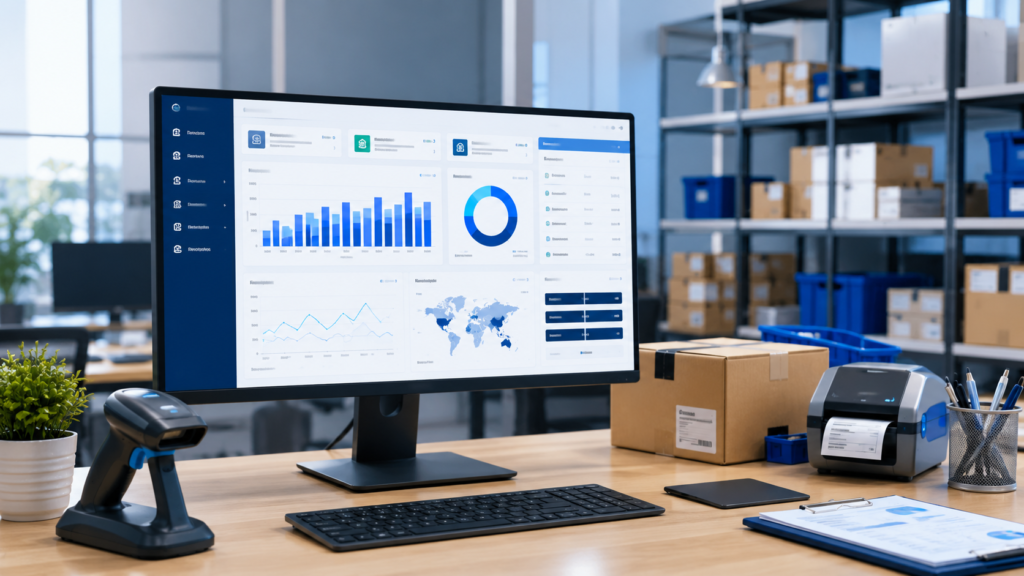
Introduction
AI inventory management helps small businesses reduce stock shortages, improve demand forecasting, automate inventory tracking, and lower operating costs. Businesses using AI inventory tools can make smarter purchasing decisions while improving profitability.
Managing inventory is one of the biggest challenges for small businesses. Overstocking ties up valuable cash, while running out of products can lead to lost sales and unhappy customers.
Artificial intelligence is transforming inventory management by helping businesses predict demand, monitor stock levels in real time, automate reordering, and reduce costly mistakes.
AI also improves cash flow by helping businesses purchase the right products at the right time, reducing unnecessary inventory costs while maintaining product availability.
In this guide, you’ll discover how AI inventory management works, its key benefits, practical use cases, and how small businesses can start using AI without investing in expensive enterprise software.
What Is AI Inventory Management?
AI inventory management uses artificial intelligence to analyze sales data, purchasing trends, customer behavior, and inventory movements.
Instead of relying on manual spreadsheets or guesswork, AI continuously learns from business data and provides recommendations that improve inventory decisions.
Modern AI systems can:
- Track inventory automatically
- Predict future demand
- Detect unusual purchasing patterns
- Recommend reorder quantities
- Reduce stock shortages
- Prevent excess inventory
Why Inventory Management Matters
Poor inventory management often causes:
- Lost revenue from unavailable products
- Excess inventory storage costs
- Cash flow problems
- Human errors
- Slow order fulfillment
- Customer dissatisfaction
Even small improvements in inventory accuracy can significantly increase profitability.
How AI Improves Inventory Management
1. Demand Forecasting
AI analyzes historical sales, seasonal trends, holidays, promotions, and customer behavior to predict future demand.
Instead of ordering based on assumptions, businesses can make data-driven purchasing decisions.
Benefits include:
- Better planning
- Lower waste
- Improved product availability
2. Automatic Stock Monitoring
AI continuously tracks inventory levels across warehouses or stores.
Business owners receive alerts before products become critically low.
This helps prevent:
- Stockouts
- Emergency purchases
- Lost sales
3. Smart Reordering
AI calculates:
- Sales velocity
- Supplier lead times
- Seasonal demand
- Current inventory
It can recommend the ideal reorder quantity and timing.
This reduces both shortages and excess stock.
Businesses that automate inventory management often use AI solutions to save time across multiple daily operations.
4. Identifying Slow-Moving Products
AI quickly identifies products that sell slowly.
Businesses can then:
- Launch promotions
- Bundle products
- Reduce future purchasing
- Free warehouse space
5. Reducing Human Errors
Manual inventory updates often lead to:
- Duplicate entries
- Counting mistakes
- Incorrect stock levels
AI-powered automation minimizes these errors and keeps inventory records accurate.
Inventory Tasks AI Can Automate
| Manual Task | AI Improvement |
|---|---|
| Stock counting | Automatic monitoring |
| Demand forecasting | Predictive analytics |
| Purchase planning | Smart recommendations |
| Reordering | Automated reorder alerts |
| Inventory reports | Real-time dashboards |
| Product performance | Continuous analysis |
Practical Example
A small clothing store can use AI inventory management to predict seasonal demand, monitor stock levels in real time, and receive automatic reorder recommendations. This helps reduce stock shortages, avoid excess inventory, and improve cash flow without spending hours on manual inventory tracking.
AI Inventory Management and Cash Flow
One of the biggest advantages of AI inventory management is its impact on cash flow. By accurately forecasting demand and preventing overstocking, businesses avoid tying up money in products that may take months to sell.
AI also helps maintain optimal inventory levels, ensuring that capital remains available for marketing, expansion, hiring, or other business investments. For small businesses with limited budgets, better inventory decisions often lead to healthier cash flow and stronger financial stability.
Industries That Benefit Most
AI inventory management is valuable for:
- Retail stores
- E-commerce businesses
- Restaurants
- Pharmacies
- Electronics stores
- Fashion brands
- Wholesale distributors
- Manufacturing companies
Choosing the Right AI Inventory Tool
When selecting inventory software, look for:
- Easy setup
- Cloud access
- Sales forecasting
- Barcode support
- Inventory alerts
- Reporting dashboards
- Integration with accounting software
- Affordable pricing
Small businesses rarely need complex enterprise solutions.
Common Mistakes to Avoid
Avoid these inventory management mistakes:
- Ignoring sales data
- Ordering based on intuition
- Updating inventory manually
- Skipping inventory audits
- Overstocking seasonal products
- Using outdated software
AI helps reduce these risks through continuous analysis.
Future of AI Inventory Management
Inventory systems are becoming increasingly intelligent.
Future AI solutions will likely include:
- Autonomous purchasing
- Supplier performance analysis
- Dynamic pricing recommendations
- Warehouse robotics integration
- Predictive supply chain management
Small businesses adopting AI today will be better prepared for future market changes.
Better inventory management also improves employee productivity by reducing repetitive manual tasks and minimizing operational errors.
Frequently Asked Questions
Can small businesses use AI inventory software?
Yes. Many affordable cloud-based inventory platforms now include AI features designed specifically for small businesses.
Does AI replace inventory managers?
No. AI supports decision-making by automating repetitive tasks while business owners maintain full control.
Is AI inventory management expensive?
Not necessarily. Many solutions offer affordable monthly subscriptions suitable for startups and small businesses.
Can AI predict future sales?
Yes. AI analyzes historical data and market trends to generate increasingly accurate demand forecasts.
Can AI reduce inventory costs?
Yes. AI reduces inventory costs by preventing overstocking, minimizing stock shortages, improving purchasing decisions, and automating inventory management tasks. Many small businesses use AI to lower storage expenses while improving product availability.
Conclusion
AI inventory management helps small businesses reduce waste, improve forecasting, automate repetitive tasks, and make smarter purchasing decisions.
By replacing manual processes with intelligent automation, businesses can lower costs, improve customer satisfaction, and operate more efficiently. As AI technology continues to evolve, inventory management will become even more accurate and accessible for businesses of every size.
Businesses that start with simple AI inventory tools today can gradually expand automation as they grow, creating a more efficient and scalable inventory management system over time.