
Introduction
Financial planning is one of the biggest challenges for small businesses. Managing budgets, forecasting revenue, tracking expenses, and preparing for unexpected costs require accurate data and careful decision-making.
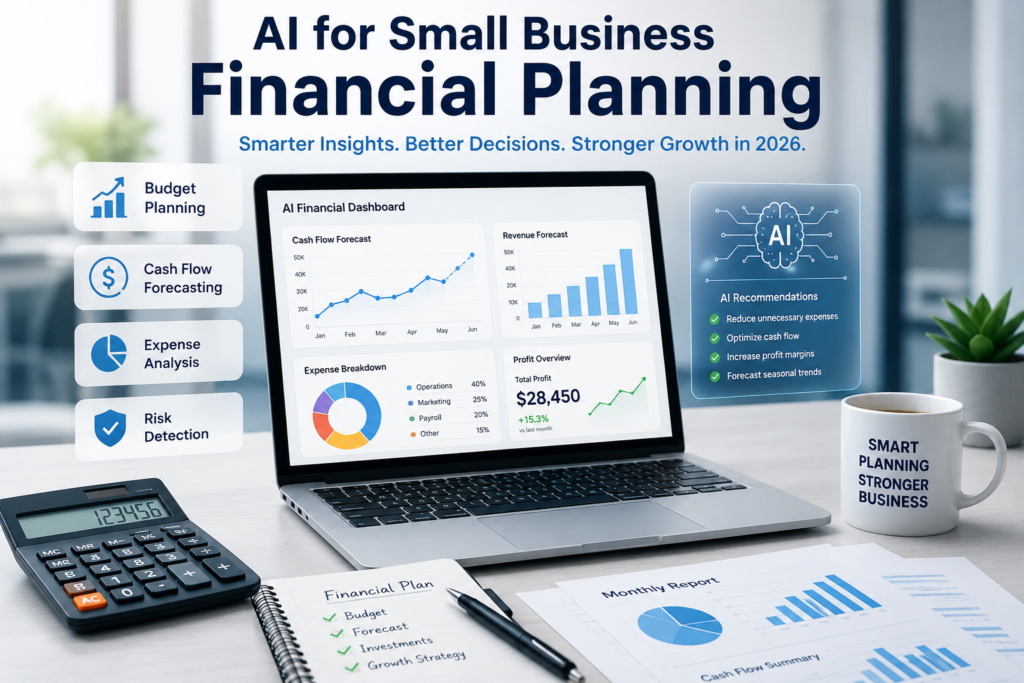
Artificial intelligence (AI) is transforming financial planning by helping businesses analyze financial information faster and make smarter predictions. Instead of relying only on spreadsheets, AI can identify trends, reduce errors, and provide valuable financial insights.
In this guide, you’ll learn how AI improves financial planning for small businesses and why it has become an essential business tool in 2026.
What Is AI Financial Planning?
AI financial planning uses machine learning and data analysis to help businesses manage their finances more efficiently.
AI systems analyze:
- Income
- Expenses
- Cash flow
- Sales performance
- Customer payments
- Business trends
The system then provides recommendations that support better financial decisions.
Why Financial Planning Matters
Without proper financial planning, businesses often experience:
- Cash shortages
- Overspending
- Poor budgeting
- Unexpected financial risks
- Slow business growth
AI helps reduce these risks through accurate forecasting and continuous financial monitoring.
1. Smarter Budget Planning
AI analyzes historical spending patterns and recommends realistic budgets based on business performance.
Business owners can:
- Allocate resources more efficiently
- Reduce unnecessary expenses
- Improve profitability
2. Better Cash Flow Forecasting
Cash flow is one of the most important indicators of business health.
AI predicts future cash inflows and outflows, helping businesses prepare for:
- Supplier payments
- Payroll
- Seasonal sales fluctuations
- Large investments
3. Faster Expense Analysis
AI automatically categorizes expenses and identifies spending trends.
Business owners can quickly discover:
- Unnecessary subscriptions
- High operating costs
- Spending anomalies
- Cost-saving opportunities
4. Improved Revenue Forecasting
Using historical sales data and market trends, AI predicts future revenue with greater accuracy.
This helps businesses:
- Set realistic financial goals
- Plan investments
- Manage growth strategies
5. Financial Risk Detection
AI continuously monitors financial data and detects unusual activity.
Examples include:
- Unexpected expense increases
- Declining profit margins
- Cash flow problems
- Customer payment delays
Early detection allows businesses to respond before small issues become major financial problems.
6. Better Investment Decisions
AI helps evaluate potential investments by analyzing historical performance and projected returns.
Small businesses can make more informed decisions when purchasing equipment, expanding operations, or launching new products.
7. Automated Financial Reporting
Preparing financial reports manually can take hours.
AI automatically generates reports including:
- Profit and loss
- Cash flow summaries
- Expense reports
- Revenue analysis
- Budget performance
This saves time while improving reporting accuracy.
Comparison Table
| Traditional Financial Planning | AI Financial Planning |
|---|---|
| Manual budgeting | Automated budgeting |
| Spreadsheet analysis | Real-time analytics |
| Static reports | Dynamic reports |
| Manual forecasting | AI-powered forecasting |
| Slow financial reviews | Instant insights |
| Higher error risk | Greater accuracy |
Best Practices
To maximize AI financial planning:
- Keep financial records updated.
- Connect accounting software with AI tools.
- Review financial reports regularly.
- Monitor cash flow weekly.
- Combine AI recommendations with professional financial advice.
Common Mistakes to Avoid
Avoid these mistakes:
- Using outdated financial data
- Ignoring AI alerts
- Failing to review budgets
- Depending entirely on automation
- Not monitoring cash flow regularly
FAQ
Can AI help small businesses with financial planning?
Yes. AI automates budgeting, forecasting, expense tracking, and financial reporting, making planning more accurate and efficient.
Is AI financial forecasting accurate?
AI significantly improves forecasting accuracy by analyzing historical financial data and identifying trends, although human oversight remains important.
Does AI replace accountants?
No. AI supports accountants by automating repetitive tasks while professionals continue making strategic financial decisions.
What are the biggest benefits of AI financial planning?
Businesses benefit from better budgeting, improved cash flow management, faster reporting, smarter investment decisions, and reduced financial risk.
Conclusion
AI financial planning gives small businesses the ability to make smarter financial decisions using real-time insights and predictive analytics. From budgeting and forecasting to expense management and financial reporting, AI helps businesses improve efficiency while reducing financial uncertainty.
Companies that integrate AI into their financial planning processes today will be better prepared to manage growth, improve profitability, and remain competitive in 2026.