
Introduction
Accurate sales forecasting is essential for every small business. Knowing how much you are likely to sell helps you manage inventory, plan budgets, hire employees, and make better business decisions.
Unfortunately, traditional forecasting methods often rely on guesswork or outdated spreadsheets. Artificial intelligence (AI) changes this by analyzing large amounts of business data and identifying patterns that humans might miss.
In this guide, you’ll learn how AI improves sales forecasting for small businesses, why it matters, and how companies can use AI to predict future sales more accurately.
What Is AI Sales Forecasting?
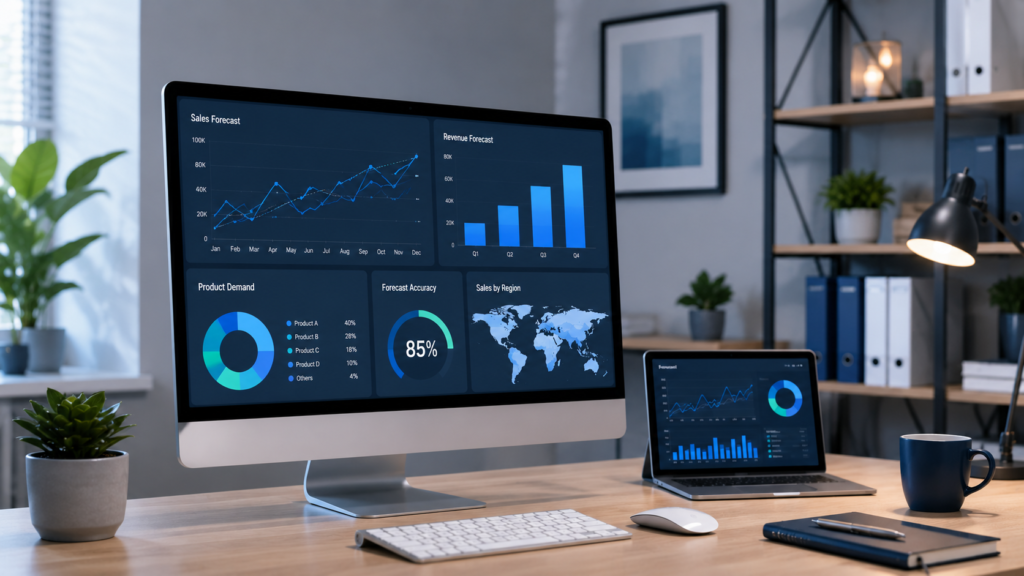
AI sales forecasting uses machine learning algorithms to analyze historical sales, customer behavior, seasonal trends, market conditions, and business performance.
Instead of making predictions based only on previous sales, AI continuously learns from new data to generate increasingly accurate forecasts.
Small businesses can use AI to predict:
- Future sales revenue
- Product demand
- Seasonal buying trends
- Customer purchasing behavior
- Inventory requirements
Why Sales Forecasting Matters
Without accurate forecasting, businesses often experience:
- Overstocked inventory
- Stock shortages
- Poor budgeting
- Cash flow problems
- Missed sales opportunities
AI helps reduce these risks by providing data-driven forecasts instead of relying on assumptions.
1. More Accurate Revenue Predictions
AI analyzes multiple data sources simultaneously, including:
- Previous sales
- Customer orders
- Website traffic
- Marketing campaigns
- Seasonal trends
- Economic indicators
This creates much more reliable revenue forecasts.
2. Better Inventory Planning
Sales forecasts directly impact inventory management.
AI predicts future demand so businesses can maintain the right stock levels without overbuying or running out of products.
Accurate sales predictions also improve inventory management by helping businesses maintain optimal stock levels throughout the year.
Benefits include:
- Lower storage costs
- Fewer stockouts
- Reduced waste
- Improved customer satisfaction
3. Smarter Marketing Decisions
AI forecasting helps businesses understand when customers are most likely to buy.
Marketing teams can schedule promotions during high-demand periods and reduce advertising during slower seasons.
This improves marketing ROI while lowering unnecessary advertising costs.
4. Improved Cash Flow Planning
Predicting future sales also improves cash flow management.
Business owners can prepare for:
- Slow seasons
- High-demand periods
- Large customer orders
- Supplier payments
- Payroll expenses
Better planning reduces financial uncertainty.
Combining accurate sales forecasts with AI-powered financial management gives small businesses greater control over budgeting, expenses, and long-term growth.
5. Customer Demand Prediction
AI identifies buying patterns by analyzing customer behavior.
It can predict:
- Popular products
- Repeat purchases
- Seasonal demand
- Customer preferences
- Emerging market trends
These insights help businesses stay ahead of competitors.
6. Faster Business Decisions
Traditional forecasting often requires hours of spreadsheet analysis.
AI generates forecasts automatically using real-time business data.
Managers can quickly decide:
- When to order inventory
- When to launch promotions
- When to hire staff
- When to expand operations
7. Continuous Forecast Improvement
Unlike static spreadsheets, AI models improve over time.
As more business data becomes available, forecasting accuracy increases automatically.
This creates a smarter decision-making system that grows alongside the business.
Comparison Table
The following comparison highlights the main differences between traditional sales forecasting methods and AI-powered forecasting.
| Traditional Sales Forecasting | AI Sales Forecasting |
|---|---|
| Manual calculations | Automated predictions |
| Historical data only | Real-time analysis |
| Lower accuracy | Higher accuracy |
| Slow updates | Continuous learning |
| Limited insights | Predictive analytics |
| Reactive planning | Proactive planning |
Best Practices for AI Sales Forecasting
To get the best results:
- Keep sales data accurate and updated.
- Review forecasts regularly.
- Combine AI insights with business experience.
- Monitor seasonal trends.
- Connect AI tools with CRM and inventory systems.
Common Mistakes to Avoid
Avoid these common forecasting mistakes:
- Using incomplete sales data
- Ignoring seasonal demand
- Depending only on historical sales
- Not reviewing AI forecasts regularly
- Failing to update customer information
FAQ
Is AI sales forecasting suitable for small businesses?
Yes. Many AI-powered forecasting tools are designed specifically for small businesses and help improve prediction accuracy without requiring advanced technical skills.
Can AI predict future sales accurately?
AI can significantly improve forecasting accuracy by analyzing historical sales, customer behavior, seasonal trends, and market data. However, forecasts should still be reviewed regularly.
What are the benefits of AI sales forecasting?
Businesses can improve inventory planning, optimize marketing campaigns, manage cash flow more effectively, reduce waste, and make smarter business decisions.
Does AI replace human decision-making?
No. AI provides valuable insights and predictions, but business owners should combine AI recommendations with their own experience and market knowledge.
Conclusion
AI sales forecasting gives small businesses a significant advantage by improving prediction accuracy, reducing uncertainty, and supporting better business planning. From inventory management and cash flow planning to marketing optimization and customer demand prediction, AI helps companies make smarter decisions with confidence.
Businesses that adopt AI-powered sales forecasting today will be better prepared to increase revenue, improve efficiency, and achieve sustainable long-term growth.