
Introduction
Creating and managing a business budget is essential for long-term success. Small businesses need accurate budgeting to control expenses, allocate resources wisely, and prepare for future growth. However, traditional budgeting methods often rely on spreadsheets and manual calculations that can be time-consuming and prone to errors.
Artificial intelligence (AI) is changing the way businesses manage budgets by analyzing financial data, identifying spending patterns, and providing real-time recommendations. Instead of reacting to financial problems after they occur, business owners can make proactive decisions using AI-powered insights.
In this guide, you’ll learn how AI improves business budgeting for small businesses and why it has become a valuable tool for financial success in 2026.
What Is AI Business Budgeting?
AI business budgeting uses machine learning, predictive analytics, and automation to help businesses create, manage, and optimize budgets.
AI tools analyze data such as:
- Revenue
- Operating expenses
- Payroll
- Cash flow
- Sales performance
- Seasonal trends
Based on this information, AI provides recommendations that help businesses spend smarter and plan more effectively.
Why Business Budgeting Matters
A well-planned budget helps businesses:
- Control operating costs
- Improve cash flow
- Reduce unnecessary spending
- Plan future investments
- Achieve long-term financial stability
AI enhances budgeting by making financial planning more accurate and data-driven.
1. Automated Budget Creation
AI automatically analyzes historical financial data and creates realistic budgets based on business performance.
This reduces manual work while improving budgeting accuracy.
2. Smarter Expense Control
AI continuously monitors business expenses and identifies unusual spending patterns.
Business owners can quickly discover unnecessary costs and reduce waste before it affects profitability.
3. Better Cash Flow Management
AI predicts future cash flow by analyzing customer payments, recurring expenses, and seasonal revenue trends.
This helps businesses avoid financial shortages and maintain healthy operations.
4. Accurate Revenue Forecasting
Budget planning depends on reliable revenue estimates.
AI analyzes historical sales, customer behavior, and market trends to create more accurate financial forecasts.
5. Real-Time Budget Monitoring
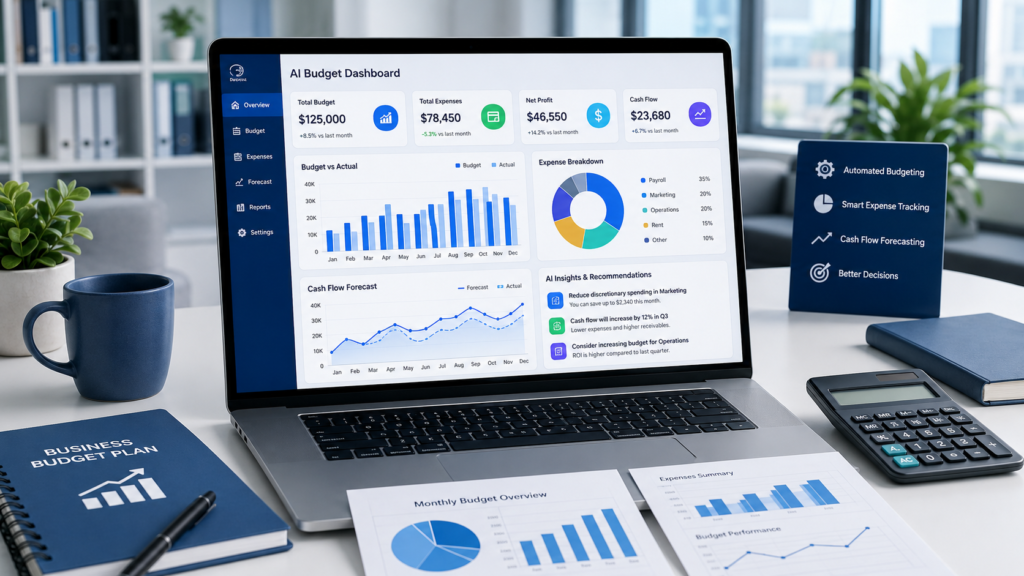
Instead of reviewing budgets once a month, AI continuously updates financial information in real time.
Managers can instantly see whether spending remains within budget.
6. Improved Financial Decision-Making
AI provides data-driven recommendations that help business owners decide when to invest, reduce costs, or expand operations.
These insights reduce uncertainty and improve strategic planning.
7. Faster Financial Reporting
AI automatically generates budget reports, expense summaries, and financial performance dashboards.
Business owners spend less time preparing reports and more time growing their businesses.
Comparison Table
The following comparison highlights how AI improves traditional business budgeting.
| Traditional Budgeting | AI Business Budgeting |
|---|---|
| Manual budgeting | Automated budgeting |
| Static spreadsheets | Real-time dashboards |
| Historical analysis | Predictive analytics |
| Manual expense tracking | Automated monitoring |
| Slow updates | Continuous optimization |
| Higher error risk | Improved accuracy |
Best Practices
To maximize AI business budgeting:
- Keep financial records updated.
- Review budgets every month.
- Connect accounting software with AI tools.
- Monitor cash flow regularly.
- Combine AI recommendations with business experience.
Common Mistakes to Avoid
Avoid these common budgeting mistakes:
- Using outdated financial data.
- Ignoring unexpected expenses.
- Failing to monitor budget performance.
- Depending entirely on manual spreadsheets.
- Not reviewing AI recommendations regularly.
FAQ
Can AI create business budgets automatically?
Yes. AI analyzes historical financial data and business performance to generate accurate and realistic budgets.
How does AI improve budgeting accuracy?
AI evaluates revenue, expenses, cash flow, and business trends to produce more reliable financial plans.
Is AI budgeting suitable for small businesses?
Absolutely. Many affordable AI budgeting tools are designed specifically for small businesses.
Can AI reduce unnecessary business expenses?
Yes. AI identifies spending patterns, detects unusual expenses, and recommends opportunities to reduce costs.
Conclusion
AI business budgeting helps small businesses manage finances with greater confidence by automating budget creation, monitoring expenses, and providing real-time financial insights. By reducing manual work and improving forecasting accuracy, AI allows business owners to make smarter financial decisions and maintain healthier cash flow.
Businesses that adopt AI-powered budgeting solutions today will be better prepared to control costs, improve profitability, and achieve sustainable growth in 2026.