
Introduction
Business decisions are only as good as the data behind them. Small businesses collect large amounts of information every day, including sales figures, customer interactions, website traffic, and marketing performance. However, manually analyzing all this data can be time-consuming and difficult.
Artificial intelligence (AI) is transforming business analytics by processing large datasets, identifying hidden patterns, and generating real-time insights. Instead of spending hours creating reports, business owners can use AI to make faster and more informed decisions.
In this guide, you’ll learn how AI improves business analytics for small businesses and why AI-driven analytics have become essential for business growth in 2026.
What Is AI Business Analytics?
AI business analytics combines artificial intelligence with data analysis to help businesses understand performance, predict future trends, and make smarter decisions.
AI can analyze:
- Sales data
- Customer behavior
- Marketing campaigns
- Financial performance
- Website traffic
- Inventory levels
- Business operations
Unlike traditional analytics, AI continuously learns from new data and improves its predictions over time.
Why Business Analytics Matters
Without proper analytics, businesses often experience:
- Poor decision-making
- Missed growth opportunities
- Inefficient marketing
- Unclear customer behavior
- Slow problem detection
AI helps businesses overcome these challenges by providing accurate, real-time insights.
1. Analyzing Large Amounts of Data
AI processes thousands of data points in seconds.
Business owners gain valuable insights without manually reviewing spreadsheets.
2. Identifying Customer Trends
Machine learning detects purchasing patterns, customer preferences, and seasonal demand.
Businesses can better understand what customers want.
3. Improving Marketing Performance
AI measures campaign effectiveness and identifies which marketing channels generate the highest return on investment.
Marketing budgets become more efficient.
4. Predicting Future Business Performance
AI forecasts future sales, revenue, and customer demand using historical data.
This supports better planning and business growth.
5. Detecting Business Problems Early
AI continuously monitors business metrics and identifies unusual activity before it becomes a serious issue.
Early detection reduces financial risk.
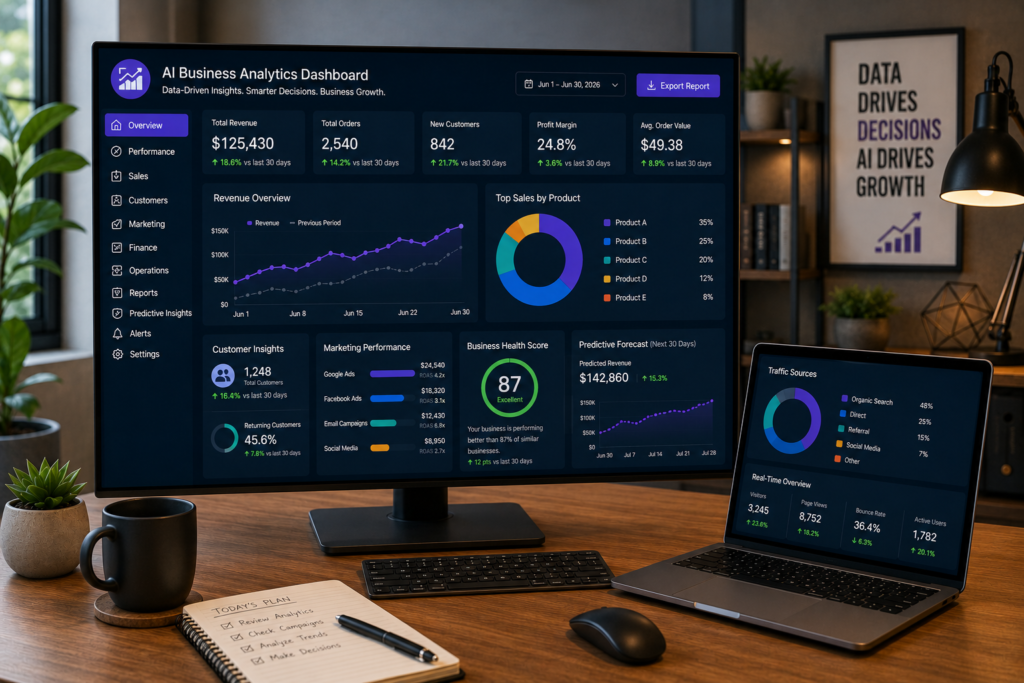
6. Creating Real-Time Dashboards
AI automatically updates dashboards with live business data.
Business owners always have access to the latest performance metrics.
7. Supporting Better Decision-Making
AI provides recommendations based on data rather than assumptions.
Business leaders can make faster, more confident decisions.
Comparison Table
| Traditional Analytics | AI Business Analytics |
|---|---|
| Manual reports | Automated insights |
| Static data | Real-time analytics |
| Historical analysis | Predictive analytics |
| Manual trend analysis | AI pattern detection |
| Slower decisions | Faster decisions |
| Limited forecasting | Intelligent forecasting |
Best Practices
To maximize AI business analytics:
- Keep business data organized.
- Connect all business systems.
- Monitor dashboards regularly.
- Review AI recommendations frequently.
- Combine AI insights with business experience.
Common Mistakes to Avoid
Avoid these common mistakes:
- Using incomplete business data
- Ignoring AI insights
- Monitoring only sales metrics
- Failing to update data sources
- Depending entirely on automation
FAQ
What is AI business analytics?
AI business analytics uses artificial intelligence to analyze business data, identify trends, and support better decision-making.
Can AI improve business decisions?
Yes. AI provides real-time insights, predictive analytics, and accurate recommendations that improve business planning.
Is AI analytics suitable for small businesses?
Absolutely. Small businesses can use AI analytics to monitor performance, optimize marketing, and improve profitability.
Does AI replace business analysts?
No. AI supports analysts by automating data processing while humans focus on strategy and decision-making.
Conclusion
AI business analytics helps small businesses transform raw data into valuable insights. From customer trends and marketing performance to sales forecasting and operational monitoring, AI enables businesses to make smarter decisions based on accurate information.
Businesses that adopt AI-powered analytics today will improve efficiency, identify new opportunities, and stay competitive throughout 2026.