
Introduction
Small businesses often use multiple financial systems to manage their daily operations. Accounting software, bank accounts, payment platforms, payroll systems, expense tools, and sales platforms can all generate important financial information.
When financial data is spread across different systems, business owners may struggle to create a complete view of their company’s financial position. Manually collecting and combining information can also take significant time and increase the risk of inconsistencies.
Artificial intelligence (AI) is changing financial consolidation by helping businesses collect, organize, compare, and analyze financial information from multiple sources.
Instead of manually combining financial data, businesses can use AI-powered systems to identify inconsistencies, automate repetitive consolidation tasks, and create more complete financial insights.
In this guide, you’ll learn how AI financial consolidation helps small businesses organize financial data, improve reporting, reduce manual work, identify discrepancies, and make better financial decisions in 2026.
What Is AI Financial Consolidation?
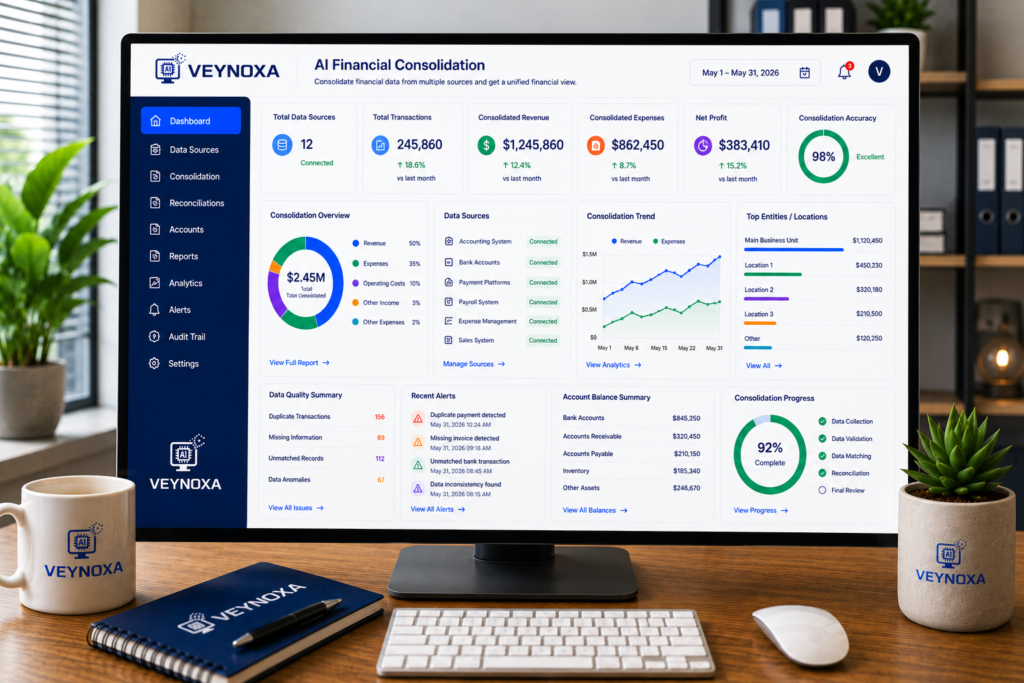
AI financial consolidation uses artificial intelligence, machine learning, and automation to combine financial information from multiple sources into a unified financial view.
Financial information may come from:
- Accounting systems
- Bank accounts
- Payment platforms
- Sales systems
- Payroll systems
- Expense management tools
- Accounts receivable
- Accounts payable
- Business subsidiaries or divisions
AI can analyze information from these different sources and help identify duplicate, missing, or inconsistent data.
This creates a more organized financial information environment and reduces the need for businesses to manually consolidate information using spreadsheets.
Why Financial Consolidation Matters
Financial consolidation becomes increasingly important as a business grows and begins using more financial systems.
Poor consolidation can lead to:
- Inconsistent financial information
- Duplicate transactions
- Reporting delays
- Manual data entry
- Difficult financial analysis
- Missing transactions
- Poor visibility into business performance
- Increased administrative work
Effective financial consolidation gives business owners a more complete understanding of their company’s financial position.
AI can make this process more efficient by automating repetitive data collection and analysis.
1. Combining Financial Data From Multiple Sources
One of the main benefits of AI financial consolidation is the ability to organize information from different financial systems.
AI can help bring together:
- Revenue data
- Expense information
- Bank transactions
- Customer payments
- Supplier payments
- Payroll information
- Financial account balances
Instead of reviewing each system separately, business owners can access a more unified view of financial information.
2. Automating Data Collection
Collecting financial information manually can consume a significant amount of time.
Employees may need to download reports, copy information into spreadsheets, check account balances, and compare records.
AI can automate many of these repetitive activities.
Automated data collection can help businesses:
- Reduce manual entry
- Save administrative time
- Improve data consistency
- Reduce repetitive tasks
- Prepare financial information faster
This allows employees to spend more time analyzing financial results rather than collecting data.
3. Detecting Duplicate Financial Data
Duplicate transactions can distort financial reports and make financial analysis less reliable.
AI can compare financial records across different systems and identify transactions that appear to represent the same activity.
Potential duplicates may involve:
- Customer payments
- Supplier invoices
- Expense transactions
- Bank transactions
- Sales records
AI can flag these records for review so that financial teams can determine whether they should be removed or corrected.
4. Identifying Missing Financial Information
Incomplete financial data can create problems during financial reporting and analysis.
AI can compare information across financial systems and identify potential gaps.
For example, it may detect that:
- A transaction exists in one system but not another.
- A payment has no corresponding invoice.
- An expense appears without supporting information.
- A financial account has incomplete data.
Early detection helps businesses investigate missing information before it affects important financial reports.
5. Improving Financial Data Accuracy
Financial consolidation depends on accurate information.
AI can compare financial records and identify inconsistencies in:
- Transaction amounts
- Account classifications
- Dates
- Payment records
- Customer information
- Supplier information
- Account balances
Businesses can review these exceptions and correct errors before consolidated reports are finalized.
Better data accuracy can improve confidence in financial information.
6. Supporting Multi-Location Businesses
Businesses with multiple locations may need to consolidate financial information from different offices, stores, or operating units.
Each location may generate its own:
- Sales
- Expenses
- Payroll
- Inventory transactions
- Supplier payments
- Customer payments
AI can help combine these records into a centralized financial view.
This allows business owners to compare financial performance across locations and identify differences more efficiently.
7. Supporting Financial Reporting
Financial consolidation plays an important role in preparing reliable financial reports.
AI can organize consolidated financial information and help identify potential inconsistencies before reporting.
Businesses can use consolidated information to better understand:
- Revenue
- Expenses
- Profit
- Cash
- Assets
- Liabilities
- Financial obligations
More organized financial information can make reporting processes more efficient.
8. Improving Financial Visibility
Financial data spread across multiple systems can make it difficult for business owners to understand their overall financial position.
AI consolidation creates a broader view of financial activity.
Business owners can gain better visibility into:
- Total revenue
- Total expenses
- Cash position
- Customer payments
- Supplier obligations
- Profitability
- Financial trends
This broader perspective can support faster and more informed management decisions.
9. Reducing Spreadsheet Dependency
Spreadsheets can be useful for financial analysis, but manually consolidating large amounts of financial information can become difficult.
AI can reduce the need to manually copy and combine information between spreadsheets.
Businesses can use AI to automate repetitive consolidation activities and reduce the risk of spreadsheet errors.
This can make financial workflows more scalable as transaction volumes increase.
10. Supporting Faster Financial Analysis
Once financial information has been consolidated, businesses can analyze it more efficiently.
AI can identify:
- Revenue trends
- Expense changes
- Unusual transactions
- Profitability patterns
- Cash flow changes
- Financial performance differences
These insights help business owners understand what is happening across their business without manually reviewing every individual financial system.
11. Improving Financial Control
Consolidated financial information can also improve financial control.
AI can help businesses monitor financial activity across multiple systems and identify transactions that require additional review.
Businesses can establish controls around:
- Expenses
- Payments
- Revenue
- Account balances
- Financial approvals
- Transaction activity
This can reduce the risk that important financial issues remain unnoticed.
12. Supporting Better Business Decisions
A consolidated financial view gives business owners better information for important decisions.
AI financial consolidation can support decisions about:
- Hiring
- Expansion
- Equipment purchases
- Marketing investments
- Inventory
- Cost reduction
- Financing
- Business growth
Instead of relying on isolated financial reports, management can evaluate decisions using information from multiple financial sources.
Comparison Table
| Traditional Financial Consolidation | AI Financial Consolidation |
|---|---|
| Manual data collection | Automated data collection |
| Spreadsheet-based consolidation | AI-powered consolidation |
| Manual transaction comparison | Automated data matching |
| Periodic data reviews | Continuous data analysis |
| Manual duplicate detection | Automated duplicate identification |
| Limited financial visibility | Unified financial visibility |
| Time-consuming reporting | Faster financial reporting |
| Reactive error detection | Proactive discrepancy detection |
Best Practices
To maximize AI financial consolidation:
- Keep financial systems properly connected.
- Maintain accurate financial records.
- Standardize account classifications.
- Review consolidated data regularly.
- Investigate AI-generated exceptions.
- Maintain supporting financial documentation.
- Establish clear financial controls.
- Protect sensitive financial information.
- Compare consolidated information with source records.
- Maintain human oversight over important financial decisions.
Common Mistakes to Avoid
Avoid these common financial consolidation mistakes:
- Relying entirely on manual spreadsheets.
- Combining data without checking its accuracy.
- Ignoring duplicate transactions.
- Failing to investigate missing financial information.
- Using inconsistent account classifications.
- Delaying financial data reconciliation.
- Connecting unreliable data sources.
- Approving consolidated reports without review.
- Ignoring discrepancies between financial systems.
- Depending entirely on AI without human oversight.
Frequently Asked Questions
What is AI financial consolidation?
AI financial consolidation uses artificial intelligence and automation to combine financial information from multiple systems into a more unified and organized financial view.
Can small businesses use AI financial consolidation?
Yes. Small businesses can use AI-powered financial tools to combine accounting, banking, payment, expense, payroll, and other financial information.
How does AI consolidate financial data?
AI can collect information from connected financial systems, organize the data, compare transactions, identify inconsistencies, and help create a unified financial view.
Can AI detect duplicate financial transactions?
Yes. AI can compare financial records and identify transactions that appear to be duplicates, allowing businesses to review and correct them.
Can AI identify missing financial information?
AI can compare information across different systems and flag potential missing transactions, payments, invoices, or other financial records.
Does AI improve financial reporting?
Yes. By organizing and validating financial information before reports are prepared, AI can help businesses improve the efficiency and reliability of financial reporting.
Can AI help businesses with multiple locations?
Yes. AI can help combine financial information from different locations or operating units, making it easier to compare performance and understand the overall financial position.
Does AI replace accountants?
No. AI can automate repetitive financial tasks and identify potential issues, but accountants and business owners remain responsible for reviewing financial information and making important decisions.
What are the benefits of AI financial consolidation?
Businesses can benefit from reduced manual work, better financial data accuracy, faster reporting, improved financial visibility, better financial controls, and more efficient financial analysis.
Conclusion
AI financial consolidation helps small businesses create a more unified view of financial information across multiple systems.
By automating data collection, identifying duplicate and missing information, comparing financial records, and organizing consolidated data, AI can reduce manual work and improve financial accuracy.
Better financial consolidation also gives business owners greater visibility into revenue, expenses, cash, payments, and overall business performance.
As AI-powered financial management continues to evolve throughout 2026, small businesses that combine intelligent automation with accurate source data and human oversight can create more efficient financial processes and make better-informed decisions for sustainable long-term growth.