
Introduction
Financial controls are essential for maintaining the financial stability and accuracy of a small business. They help business owners monitor transactions, control expenses, protect company funds, and reduce the risk of financial errors.
As businesses grow, managing financial controls manually can become increasingly difficult. Employees may process hundreds of transactions, invoices, payments, expenses, and financial records while business owners need to ensure that financial activities remain accurate and properly authorized.
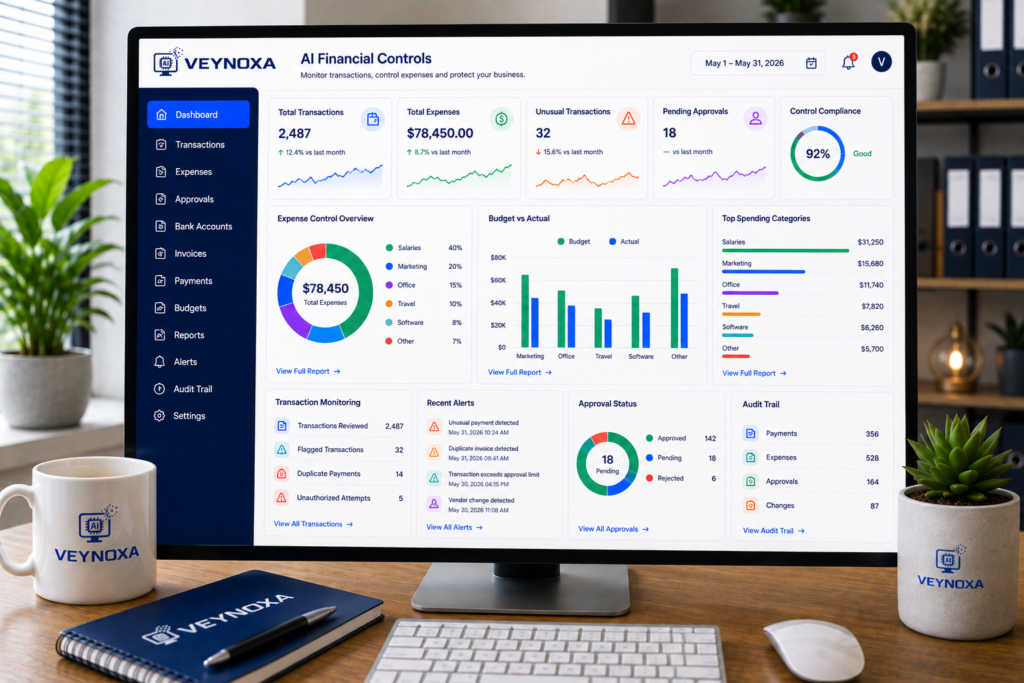
Artificial intelligence (AI) is transforming financial controls by analyzing transactions, monitoring spending, identifying unusual activity, and automating repetitive financial checks.
In this guide, you’ll learn how AI financial controls help small businesses improve financial oversight, reduce errors, monitor expenses, strengthen internal processes, and protect business finances in 2026.
What Are AI Financial Controls?
AI financial controls use artificial intelligence, machine learning, and automated data analysis to monitor and manage financial activities within a business.
AI can analyze financial information such as:
- Business transactions
- Expenses
- Invoices
- Payments
- Bank activity
- Employee spending
- Supplier payments
- Customer payments
- Financial approvals
- Accounting records
Traditional financial controls often depend on manual reviews, approval processes, spreadsheets, and periodic audits.
AI can continuously analyze financial activity and identify transactions or patterns that may require additional attention.
Why Financial Controls Matter
Strong financial controls help businesses protect their money and maintain accurate financial records.
Without effective controls, small businesses may experience:
- Unnecessary expenses
- Unauthorized payments
- Duplicate transactions
- Accounting errors
- Fraud risks
- Poor financial visibility
- Incorrect financial reporting
- Weak spending management
Financial controls create processes that help ensure business money is used appropriately and financial transactions are properly recorded.
AI can make these controls more efficient by automating many monitoring and verification tasks.
1. Monitoring Business Transactions
AI can continuously analyze financial transactions and compare them with expected business activity.
Businesses can monitor:
- Payment amounts
- Transaction dates
- Vendors
- Customers
- Expense categories
- Payment frequency
- Transaction patterns
If a transaction appears unusual, AI can flag it for review.
This allows business owners and finance teams to investigate potential problems before they affect financial performance.
2. Controlling Business Expenses
Expense management is an important component of financial control.
AI can analyze business spending and identify:
- Unusual expenses
- Increasing costs
- Duplicate expenses
- Recurring charges
- Spending outside company policies
- Unexpected supplier costs
Businesses can use these insights to review spending and reduce unnecessary expenses.
AI can also help managers understand where business funds are being allocated and whether spending remains within established budgets.
3. Automating Financial Approvals
Many businesses require approval before certain expenses or payments can be processed.
AI can help automate parts of the approval process by analyzing:
- Transaction amounts
- Expense categories
- Employee spending
- Supplier information
- Approval thresholds
- Previous transaction patterns
For example, smaller routine expenses may follow an automated workflow while larger or unusual transactions can be sent to a manager for review.
This can make financial approval processes faster while maintaining appropriate oversight.
4. Detecting Duplicate Payments
Duplicate payments can occur when the same invoice or expense is processed more than once.
AI can compare:
- Invoice numbers
- Vendor names
- Payment amounts
- Transaction dates
- Payment references
- Purchase information
When similar transactions are identified, AI can flag them for review.
This helps businesses reduce unnecessary payments and maintain more accurate financial records.
5. Identifying Unauthorized Transactions
AI can monitor financial activity and compare transactions with established business rules and historical patterns.
Potential warning signs may include:
- Payments to unfamiliar vendors
- Transactions outside normal business hours
- Unusually large payments
- Unexpected employee expenses
- Changes in normal spending behavior
AI alerts can help business owners investigate unusual activity more quickly.
However, an AI alert does not automatically mean that a transaction is unauthorized or fraudulent. Human review remains important.
6. Strengthening Budget Controls
Budgets provide businesses with spending limits and financial targets.
AI can compare actual spending with budget expectations and identify areas where costs are exceeding planned levels.
For example, AI may detect:
- Marketing spending above budget
- Higher supplier costs
- Increasing payroll expenses
- Unexpected operating costs
- Departments exceeding spending limits
Early warnings give business owners more time to adjust spending before financial problems become larger.
7. Improving Financial Data Accuracy
Financial controls depend on accurate financial information.
AI can identify potential inconsistencies such as:
- Missing transactions
- Duplicate records
- Incorrect categories
- Unusual transaction amounts
- Inconsistent payment information
Businesses can review these alerts and correct financial records when necessary.
More accurate financial information improves the reliability of financial reporting and financial analysis.
8. Supporting Accounts Payable Controls
Accounts payable involves many financial activities, including supplier invoices, payment schedules, and outgoing payments.
AI can help businesses monitor:
- Supplier invoices
- Payment amounts
- Payment deadlines
- Duplicate invoices
- Supplier information
- Outstanding obligations
Automated checks can identify potential problems before payments are completed.
This can help businesses reduce duplicate payments and improve control over outgoing funds.
9. Supporting Accounts Receivable Controls
Financial controls also apply to money coming into the business.
AI can monitor:
- Customer invoices
- Customer payments
- Outstanding balances
- Payment dates
- Credit activity
- Unusual customer transactions
This helps businesses maintain accurate accounts receivable records and identify payment activity that requires review.
Better monitoring can also support stronger cash management.
10. Creating Audit Trails
A clear audit trail helps businesses understand what happened during a financial transaction.
AI-powered systems can organize information about:
- Who initiated a transaction
- Who approved it
- When it occurred
- What amount was involved
- Which vendor or customer was involved
- What changes were made
These records make financial activities easier to review.
They can also help businesses investigate discrepancies and prepare information for financial reviews.
11. Improving Fraud Prevention
AI can support fraud prevention by analyzing large volumes of financial transactions and identifying unusual patterns.
Potential warning signs can include:
- Repeated transactions
- Unusual payment amounts
- Unexpected vendors
- Unusual employee spending
- Transactions that differ from normal patterns
AI can help businesses identify activity that deserves investigation.
However, AI should be considered a monitoring and detection tool rather than a replacement for human investigation and established financial controls.
12. Supporting Better Financial Decisions
Strong financial controls give business owners more reliable information.
AI-generated financial insights can support decisions about:
- Hiring employees
- Purchasing equipment
- Increasing inventory
- Marketing investments
- Supplier relationships
- Business expansion
- Cost reduction
- Financial planning
When financial information is accurate and properly monitored, business owners can make decisions with greater confidence.
Comparison Table
| Traditional Financial Controls | AI Financial Controls |
|---|---|
| Manual transaction reviews | Automated transaction monitoring |
| Manual expense checking | AI-powered expense analysis |
| Periodic financial reviews | Continuous financial monitoring |
| Manual approval workflows | Automated approval support |
| Manual duplicate detection | Automated duplicate detection |
| Reactive issue identification | Proactive financial alerts |
| Spreadsheet-based controls | Automated financial controls |
| Limited transaction analysis | Large-scale transaction analysis |
Best Practices
To maximize AI financial controls:
- Keep financial records accurate and updated.
- Establish clear spending policies.
- Define appropriate approval limits.
- Review AI-generated alerts regularly.
- Investigate unusual transactions.
- Monitor employee and supplier spending.
- Reconcile financial accounts regularly.
- Protect sensitive financial information.
- Maintain clear audit trails.
- Combine AI monitoring with human oversight.
- Review financial controls as the business grows.
Common Mistakes to Avoid
Avoid these common financial control mistakes:
- Giving employees unlimited spending authority.
- Ignoring unusual transactions.
- Automatically approving every AI recommendation.
- Failing to separate financial responsibilities.
- Not reviewing supplier payments.
- Ignoring duplicate transactions.
- Using outdated financial information.
- Failing to maintain audit trails.
- Depending entirely on automated controls.
- Not updating financial policies as the business changes.
Frequently Asked Questions
What are AI financial controls?
AI financial controls use artificial intelligence to monitor financial transactions, analyze spending, identify unusual activity, support approvals, and improve financial oversight.
Can small businesses use AI financial controls?
Yes. Small businesses can use AI-powered financial tools to monitor transactions, control expenses, detect unusual activity, and automate parts of their financial control processes.
How does AI help control business expenses?
AI analyzes spending patterns, identifies unusual or unnecessary expenses, compares spending with budgets, and provides alerts when financial activity requires attention.
Can AI detect unauthorized transactions?
AI can identify transactions that differ from normal business activity or established financial rules. These alerts can then be reviewed by authorized employees or business owners.
Can AI help prevent duplicate payments?
Yes. AI can compare invoices, payment amounts, vendor information, transaction dates, and other details to identify potential duplicate payments.
Does AI prevent financial fraud?
AI can help detect unusual financial activity and identify potential fraud risks, but it does not completely prevent fraud. Human oversight and strong financial procedures remain important.
How does AI improve financial approvals?
AI can analyze transactions against approval rules, spending limits, employee permissions, and historical activity to determine which transactions may require additional review.
Does AI replace accountants?
No. AI automates monitoring and analysis, but accountants and financial professionals remain important for reviewing financial information, investigating issues, and making strategic decisions.
What are the benefits of AI financial controls?
Businesses can benefit from better financial oversight, reduced errors, stronger expense management, faster transaction monitoring, improved fraud detection, and more reliable financial information.
Conclusion
AI financial controls help small businesses monitor financial activity, control expenses, detect unusual transactions, and improve financial oversight.
By continuously analyzing transactions, invoices, payments, employee spending, supplier activity, and other financial information, AI can identify potential problems earlier and reduce the amount of manual financial monitoring required.
Strong financial controls also give business owners more reliable information for financial reporting, budgeting, and decision-making.
As AI-powered financial technology continues to evolve throughout 2026, small businesses that combine intelligent financial controls with accurate data, clear policies, and human oversight can strengthen financial security, improve operational efficiency, and build a more reliable foundation for sustainable growth.