
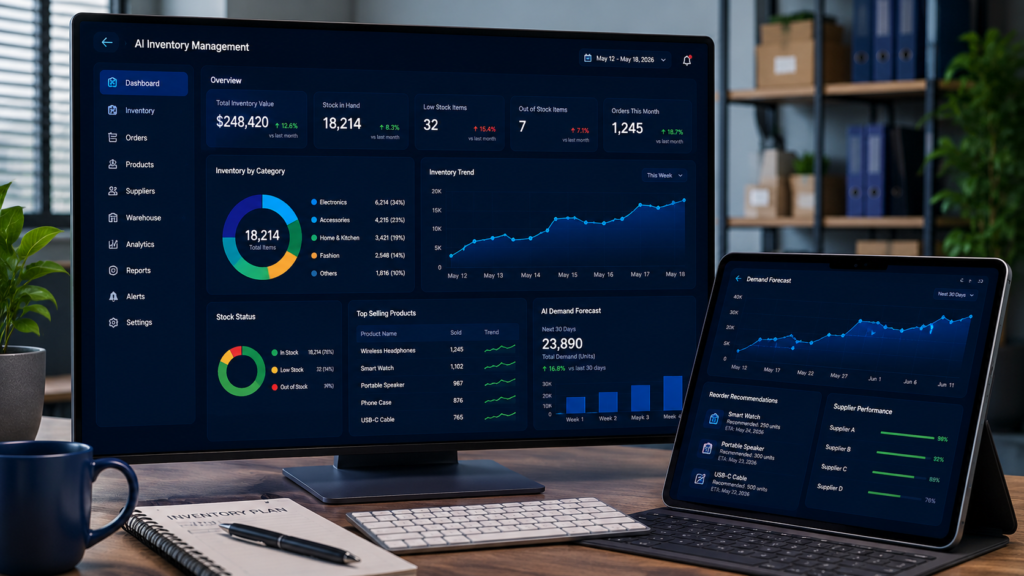
Introduction
Running out of popular products or overstocking slow-moving items can quickly reduce profits for small businesses. Inventory mistakes often lead to wasted money, unhappy customers, and inefficient operations. Fortunately, artificial intelligence (AI) is changing the way businesses manage inventory by providing accurate forecasts, real-time tracking, and automated decision-making.
In 2026, AI inventory management tools are becoming more affordable and accessible, allowing even small businesses to compete with larger companies. Whether you own an online store, retail shop, warehouse, or wholesale business, AI can simplify inventory management while improving customer satisfaction.
Why Inventory Management Matters
Inventory directly affects cash flow and profitability. Having too much inventory ties up valuable capital, while having too little results in lost sales.
Common inventory challenges include:
- Overstocking slow-selling products
- Running out of best-selling items
- Manual stock counting errors
- Poor demand forecasting
- Inefficient warehouse organization
- Delayed purchase orders
AI helps solve these problems using data instead of guesswork.
How AI Improves Inventory Management
AI continuously analyzes sales history, customer behavior, seasonal trends, supplier performance, and market conditions.
Instead of relying on manual estimates, AI predicts future inventory needs with remarkable accuracy.
It can automatically recommend:
- When to reorder products
- How much stock to purchase
- Which products sell fastest
- Which products move slowly
- Seasonal inventory adjustments
- Warehouse optimization strategies
This allows business owners to make smarter purchasing decisions while reducing waste.
AI automation plays a major role in streamlining everyday business operations. Learn more in our guide about How AI Automation Helps Small Businesses Grow.
Real-Time Inventory Tracking
Modern AI inventory platforms update stock levels instantly.
Whenever a product is sold, returned, or restocked, inventory records are automatically updated across multiple sales channels.
Real-time visibility helps businesses:
- Prevent overselling
- Reduce inventory errors
- Improve warehouse accuracy
- Synchronize online and offline sales
- Monitor stock movement continuously
Accurate inventory information also improves customer trust by reducing canceled orders.
AI Demand Forecasting
Demand forecasting is one of AI’s strongest capabilities.
Instead of using simple historical averages, AI analyzes multiple factors simultaneously, including:
- Previous sales trends
- Holidays
- Weather conditions
- Marketing campaigns
- Customer purchasing behavior
- Economic changes
This enables businesses to prepare inventory before demand increases.
For example, an online electronics store can stock additional accessories before a major shopping season instead of reacting after products sell out.
Reducing Overstock and Stockouts
Maintaining the right inventory balance is essential.
Too much inventory increases storage costs, while insufficient inventory results in missed sales opportunities.
AI identifies the ideal stock level for every product by continuously adjusting recommendations based on changing demand.
Businesses benefit from:
- Lower storage expenses
- Reduced waste
- Higher inventory turnover
- Better cash flow
- Improved customer satisfaction
Smarter Supplier Management
AI also evaluates supplier performance.
It can measure:
- Delivery speed
- Reliability
- Product quality
- Purchase costs
- Order accuracy
Businesses can compare suppliers objectively and choose the most reliable partners.
Some AI platforms even recommend alternative suppliers when disruptions occur.
Warehouse Optimization
Inventory management is not only about purchasing products.
AI also improves warehouse organization.
It can recommend:
- Better shelf placement
- Faster picking routes
- Improved storage layouts
- Efficient product grouping
- Reduced walking distance for employees
These improvements increase operational efficiency while lowering labor costs.
Automated Reordering
Many inventory systems now include intelligent automation.
When inventory falls below a predefined level, AI automatically creates purchase recommendations or generates supplier orders.
Automation reduces:
- Human error
- Forgotten purchases
- Emergency orders
- Stock shortages
Business owners spend less time monitoring inventory and more time growing their business.
AI for Multi-Channel Businesses
Many small businesses sell through multiple platforms simultaneously.
For example:
- Shopify
- WooCommerce
- Amazon
- Etsy
- Physical stores
Managing inventory manually across different channels can become complicated.
AI synchronizes inventory automatically across every platform, ensuring accurate stock levels everywhere.
This prevents overselling while providing customers with reliable product availability.
Cost Savings Through AI
Inventory optimization leads directly to financial savings.
Businesses often experience:
- Lower storage costs
- Fewer emergency shipments
- Reduced product waste
- Better purchasing decisions
- Faster inventory turnover
Even modest improvements in inventory accuracy can significantly increase annual profits.
Improving inventory is only one way artificial intelligence boosts efficiency. Discover more practical strategies in our article on How AI Can Improve Business Productivity.
Challenges to Consider
Although AI offers many benefits, businesses should implement it carefully.
Important considerations include:
- Maintaining accurate inventory data
- Integrating AI with existing software
- Training employees
- Monitoring AI recommendations
- Regularly reviewing supplier information
AI should support business decisions rather than replace human judgment entirely.
The Future of AI Inventory Management
Inventory systems continue to evolve rapidly.
Future AI platforms are expected to provide:
- Autonomous purchasing decisions
- Advanced predictive analytics
- Deeper supply chain visibility
- Robotics integration
- Real-time global inventory optimization
These innovations will help small businesses operate with greater efficiency while remaining competitive in increasingly digital markets.
FAQ
Can AI manage inventory automatically?
Yes. Many AI platforms can monitor stock levels, recommend reorder quantities, and automate purchasing workflows.
Is AI inventory software suitable for small businesses?
Absolutely. Many cloud-based inventory management platforms are designed specifically for small and medium-sized businesses.
Does AI reduce inventory costs?
Yes. AI helps reduce overstocking, stock shortages, storage costs, and unnecessary purchasing.
Can AI predict future inventory demand?
Yes. AI analyzes historical sales, customer behavior, seasonal trends, and market conditions to forecast future demand more accurately.
Do online stores benefit from AI inventory management?
Yes. AI is especially valuable for e-commerce businesses that manage inventory across multiple sales channels and need real-time stock synchronization.
Conclusion
AI inventory management is no longer limited to large corporations. In 2026, affordable AI solutions enable small businesses to forecast demand, automate stock management, reduce waste, and improve operational efficiency.
By adopting AI-powered inventory tools, businesses can lower costs, prevent stock shortages, and make better decisions based on real-time data. As technology continues to improve, AI will become an essential part of successful inventory management for businesses of every size.