
Introduction
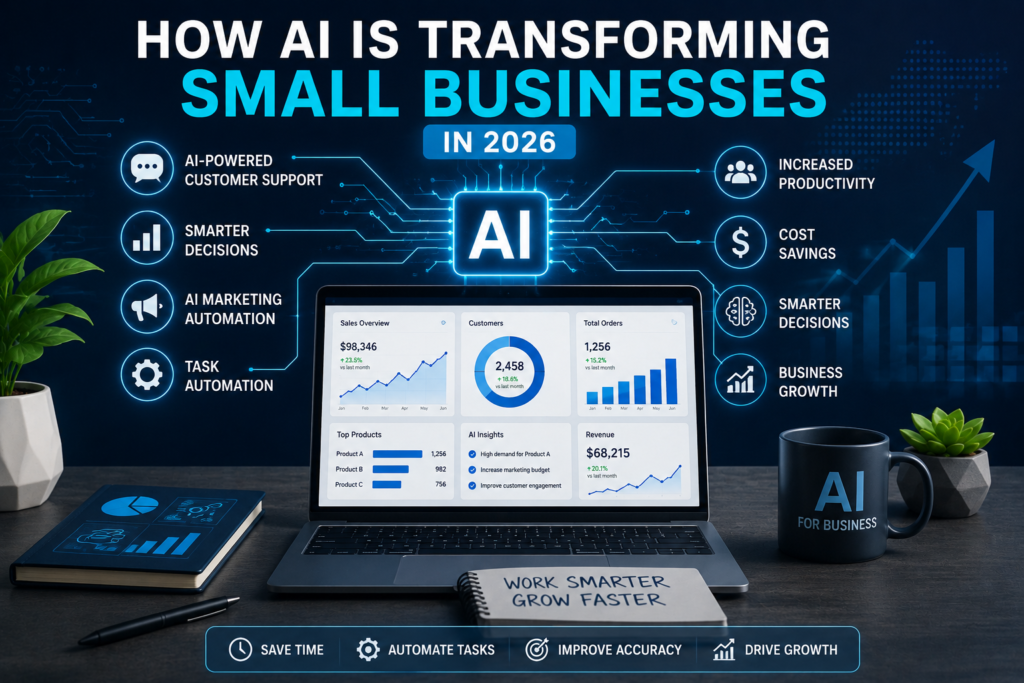
Artificial intelligence (AI) is changing the way businesses operate across every industry. In 2026, AI is no longer reserved for large corporations with massive budgets. Small businesses now have access to affordable AI-powered tools that help automate repetitive tasks, improve customer service, increase productivity, and make smarter business decisions.
Whether you run an online store, a local service company, or a growing startup, AI can help you save time while improving overall business performance. Modern AI solutions are easier to use than ever before, allowing business owners to focus on growth instead of spending countless hours on manual work.
In this guide, you’ll discover how AI is transforming small businesses in 2026 and why adopting these technologies can provide a significant competitive advantage.
Table of Contents
- What Is AI for Small Businesses?
- Why AI Is Becoming Essential
- Automating Daily Business Tasks
- Improving Customer Service
- AI-Powered Marketing
- Smarter Business Decisions
- Increasing Productivity
- Challenges of AI Adoption
- Best Practices
- Frequently Asked Questions
- Conclusion
What Is AI for Small Businesses?
Artificial intelligence refers to computer systems that can perform tasks normally requiring human intelligence. These tasks include learning from data, recognizing patterns, generating content, answering customer questions, and making recommendations.
For small businesses, AI serves as a powerful digital assistant capable of automating repetitive work while improving efficiency across multiple departments.
Unlike traditional software, AI continuously learns from data and becomes more effective over time. This allows businesses to improve operations without constantly increasing costs.
Why AI Is Becoming Essential
Business competition continues to grow every year. Customers expect faster responses, personalized experiences, and high-quality service.
Small businesses often have limited budgets and fewer employees than larger companies. AI helps close this gap by providing affordable automation and intelligent decision-making.
Some of the biggest advantages include:
- Lower operating costs
- Faster customer support
- Improved marketing performance
- Better productivity
- Smarter business decisions
- Time savings
- Higher customer satisfaction
Instead of replacing employees, AI supports them by handling repetitive tasks so they can focus on strategic work.
Automating Daily Business Tasks
One of the biggest benefits of AI is automation.
Business owners spend many hours performing repetitive administrative work every day. AI tools can automate these activities, reducing manual effort while improving accuracy.
Examples include:
- Scheduling appointments
- Managing calendars
- Responding to emails
- Organizing documents
- Data entry
- Invoice generation
- Meeting summaries
Automation reduces human error and allows employees to spend more time on revenue-generating activities.
Improving Customer Service
Customer experience has become one of the most important factors influencing business success.
AI-powered chatbots can answer common customer questions 24 hours a day without requiring human intervention.
Customers can instantly receive information about:
- Products
- Pricing
- Shipping
- Business hours
- Appointment availability
- Return policies
This improves customer satisfaction while reducing response times.
When more complex situations arise, AI can transfer conversations to human support representatives.
AI-Powered Marketing
Marketing is another area where AI delivers outstanding results.
You may also like our guide on Best AI Tools for Business Growth in 2026.
Modern AI tools help businesses create high-quality content much faster than traditional methods.
Companies can use AI to generate:
- Blog articles
- Product descriptions
- Social media captions
- Email campaigns
- Advertising copy
AI also analyzes customer behavior to identify which marketing campaigns perform best.
Smarter Business Decisions
Artificial intelligence allows small businesses to make better decisions by analyzing large amounts of data in seconds. Instead of relying on assumptions, AI provides valuable insights based on customer behavior, sales trends, and operational performance.
Business owners can use AI to identify:
- Best-selling products
- Customer buying patterns
- Seasonal demand
- High-performing marketing campaigns
- Revenue opportunities
- Areas where costs can be reduced
With accurate data, businesses can make faster and more confident decisions that support long-term growth.
Increasing Productivity
Every business wants to accomplish more without significantly increasing costs.
AI improves productivity by automating repetitive work and helping employees complete tasks more efficiently.
For example, AI can:
- Organize business documents
- Summarize meetings
- Generate reports
- Schedule appointments
- Manage workflows
- Prioritize daily tasks
Instead of spending hours on administrative work, teams can focus on innovation, customer relationships, and business development.
AI Helps Reduce Business Costs
Reducing operational expenses is one of the biggest priorities for small businesses.
AI contributes to cost savings by minimizing manual work, reducing errors, and improving efficiency across different departments.
Examples include:
- Lower customer support costs through AI chatbots
- Reduced marketing expenses using AI content tools
- Better inventory management
- Faster financial reporting
- Automated administrative tasks
Although implementing AI may require an initial investment, many businesses quickly recover these costs through increased efficiency and higher productivity.
Challenges of AI Adoption
Despite its many advantages, AI is not a perfect solution.
Businesses should understand both the benefits and limitations before adopting AI technologies.
Some common challenges include:
- Learning how to use new tools
- Protecting customer data
- Verifying AI-generated content
- Integrating AI with existing software
- Choosing the right AI platform
Human oversight remains essential. AI should support decision-making rather than replace human judgment.
Best Practices for Using AI
To achieve the best results, businesses should introduce AI gradually instead of trying to automate everything at once.
Recommended steps include:
- Identify repetitive tasks.
- Choose one reliable AI tool.
- Train employees.
- Measure productivity improvements.
- Expand AI usage over time.
This approach helps businesses maximize return on investment while minimizing disruption.
The Future of AI for Small Businesses
Artificial intelligence continues to evolve rapidly.
Future AI technologies are expected to become even more accessible for small businesses, offering advanced automation, predictive analytics, personalized customer experiences, and smarter business management tools.
Businesses that begin adopting AI today will be better prepared to compete in an increasingly digital marketplace.
Rather than replacing people, AI will continue serving as a powerful assistant that helps teams work faster, smarter, and more efficiently.
Frequently Asked Questions
What is AI for small businesses?
AI for small businesses refers to artificial intelligence tools that automate tasks, improve customer service, analyze business data, and increase productivity.
Is AI expensive for small businesses?
No. Many AI platforms offer free plans and affordable subscriptions, making AI accessible to businesses of all sizes.
Can AI replace employees?
No. AI is designed to assist employees by handling repetitive work, allowing people to focus on creativity, strategy, and customer relationships.
Which business tasks can AI automate?
AI can automate customer support, content creation, email marketing, scheduling, reporting, bookkeeping, document management, and many other repetitive business tasks.
Why should small businesses invest in AI?
AI helps businesses save time, reduce operational costs, improve customer experiences, make better decisions, and remain competitive in today’s digital economy.
Conclusion
Artificial intelligence is transforming the way small businesses operate in 2026. From automating repetitive tasks to improving customer service, marketing, financial management, and decision-making, AI provides practical solutions that help businesses grow more efficiently.
Companies that embrace AI today can improve productivity, reduce costs, and deliver better experiences for their customers. As AI technologies continue to evolve, businesses that adapt early will be in a stronger position to achieve sustainable growth and long-term success.