
Introduction
Running a small business often means handling multiple repetitive tasks every day. From managing emails and invoices to updating customer records and scheduling appointments, these activities consume valuable time that could be spent growing the business.
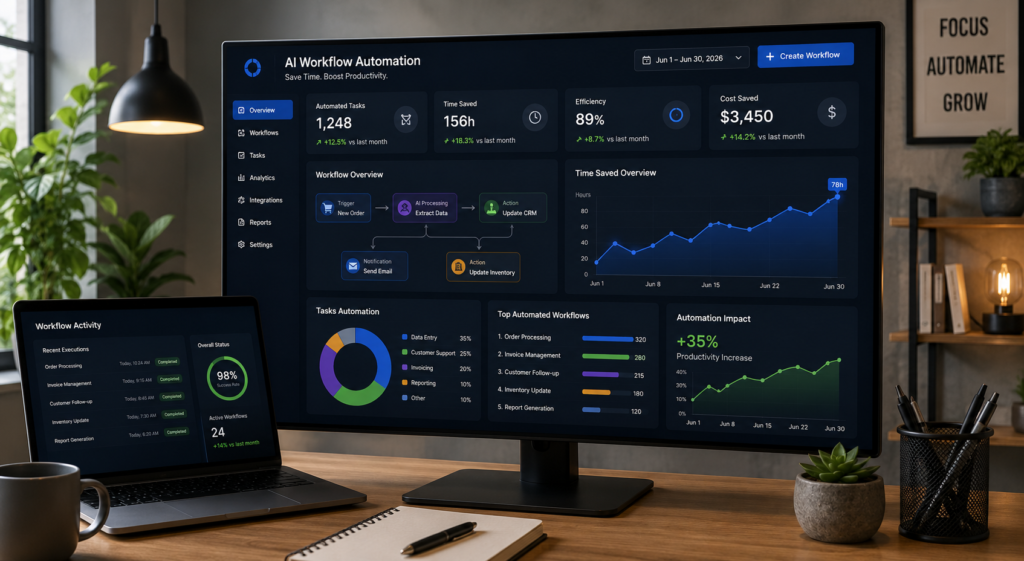
Artificial intelligence (AI) workflow automation helps businesses automate routine processes, reduce manual work, and improve overall efficiency. By allowing AI to handle repetitive tasks, business owners can focus on strategic decisions and customer satisfaction.
In this guide, you’ll learn how AI workflow automation helps small businesses save time, reduce costs, and increase productivity in 2026.
What Is AI Workflow Automation?
AI workflow automation combines artificial intelligence with business processes to automate repetitive tasks without constant human intervention.
AI can automate workflows involving:
- Customer communications
- Invoice processing
- Appointment scheduling
- Data entry
- Email management
- Inventory updates
- Report generation
Unlike traditional automation, AI continuously learns from business data and improves workflow efficiency over time.
Why Workflow Automation Matters
Without automation, businesses often experience:
- Time-consuming manual work
- Human errors
- Delayed customer responses
- Lower employee productivity
- Higher operational costs
AI workflow automation minimizes these problems while improving overall business performance.
1. Automating Repetitive Administrative Tasks
Many daily business activities involve repetitive work.
AI automatically handles:
- Data entry
- File organization
- Document processing
- Customer record updates
This reduces administrative workload and allows employees to focus on higher-value activities.
2. Faster Customer Response Times
AI-powered automation instantly responds to customer inquiries through chatbots, automated emails, and support systems.
Benefits include:
- Faster replies
- Higher customer satisfaction
- Reduced support workload
- Improved service availability
3. Streamlining Internal Workflows
AI connects different business systems and automatically moves information between them.
Examples include:
- CRM updates
- Accounting software synchronization
- Order processing
- Inventory updates
This eliminates duplicate work and improves operational efficiency.
4. Reducing Human Errors
Manual processes often lead to mistakes.
AI performs repetitive tasks consistently while minimizing:
- Data entry errors
- Missing information
- Duplicate records
- Incorrect calculations
This improves overall business accuracy.
5. Increasing Employee Productivity
When employees spend less time on repetitive work, they can focus on:
- Customer relationships
- Sales
- Business development
- Strategic planning
Higher productivity leads to faster business growth.
6. Improving Process Visibility
AI monitors workflows in real time and identifies bottlenecks before they become serious problems.
Business owners gain visibility into:
- Task completion
- Team performance
- Process efficiency
- Workflow delays
These insights support continuous improvement.
7. Supporting Business Growth
As businesses grow, manual workflows become increasingly difficult to manage.
AI automation scales alongside the business by handling larger workloads without significantly increasing staffing requirements.
This supports sustainable growth while controlling operating costs.
Comparison Table
| Traditional Workflow | AI Workflow Automation |
|---|---|
| Manual processes | Automated workflows |
| Higher error rates | Improved accuracy |
| Slow task completion | Faster execution |
| Limited scalability | Easy business scaling |
| Repetitive work | Intelligent automation |
| Reactive management | Proactive optimization |
Best Practices
To maximize AI workflow automation:
- Start with repetitive tasks.
- Keep business data organized.
- Integrate AI with existing software.
- Review automated workflows regularly.
- Monitor workflow performance metrics.
Common Mistakes to Avoid
Avoid these common mistakes:
- Automating inefficient processes
- Ignoring workflow monitoring
- Using outdated business data
- Skipping employee training
- Depending entirely on automation without human oversight
FAQ
What is AI workflow automation?
AI workflow automation uses artificial intelligence to automate repetitive business tasks and improve operational efficiency.
Can small businesses benefit from workflow automation?
Yes. AI automation helps small businesses save time, reduce costs, and improve productivity without requiring large teams.
Which tasks can AI automate?
AI can automate customer support, invoicing, scheduling, data entry, reporting, inventory updates, and many other routine business processes.
Does AI workflow automation replace employees?
No. AI automates repetitive tasks while employees focus on decision-making, creativity, and customer relationships.
Conclusion
AI workflow automation enables small businesses to eliminate repetitive work, improve productivity, reduce operational costs, and provide better customer experiences. By automating routine business processes, companies can operate more efficiently while preparing for future growth.
Businesses that adopt AI workflow automation today will gain a competitive advantage by working smarter, responding faster, and scaling more effectively in 2026.