
Introduction
Business forecasting is essential for every small business that wants to grow sustainably. Predicting future sales, expenses, customer demand, and market trends helps business owners make informed decisions and reduce uncertainty.
Traditional forecasting methods often rely on spreadsheets and historical data alone. Artificial intelligence (AI) improves this process by analyzing large amounts of business data, identifying hidden patterns, and generating more accurate predictions in real time.
In this guide, you’ll learn how AI improves business forecasting for small businesses and why it has become a valuable planning tool in 2026.
What Is AI Business Forecasting?
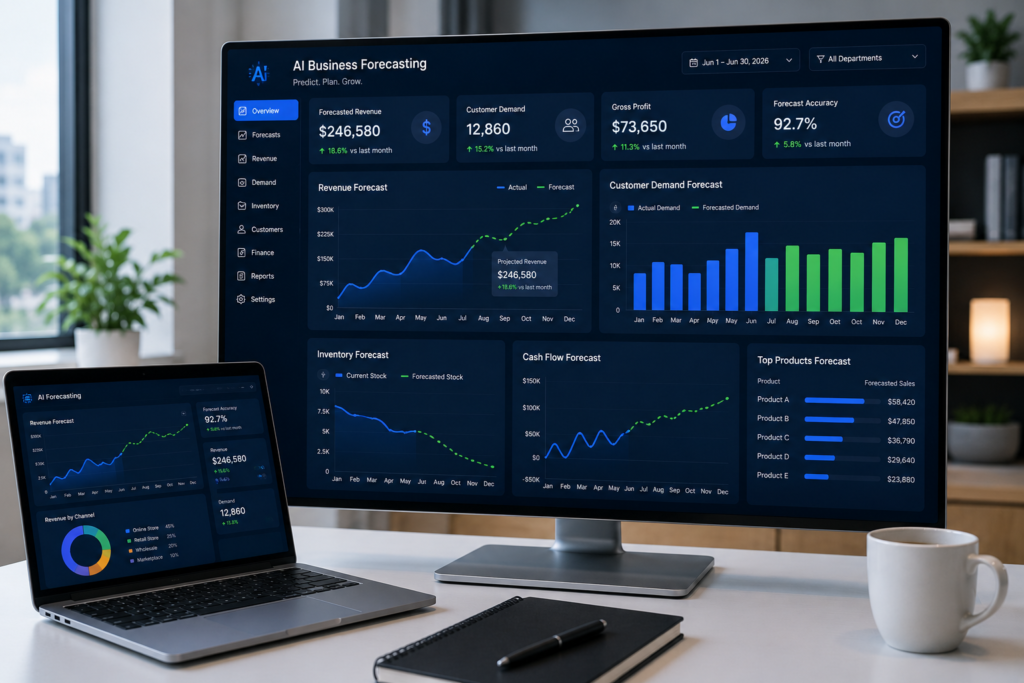
AI business forecasting uses machine learning, predictive analytics, and historical business data to estimate future business performance.
AI analyzes information such as:
- Sales history
- Customer behavior
- Market trends
- Seasonal demand
- Financial performance
- Inventory levels
Using this data, AI generates forecasts that help businesses prepare for future opportunities and challenges.
Why Business Forecasting Matters
Without accurate forecasting, businesses often face:
- Poor financial planning
- Inventory shortages
- Excess inventory
- Unexpected expenses
- Missed growth opportunities
AI helps businesses reduce these risks through data-driven forecasting.
1. More Accurate Revenue Predictions
AI analyzes historical revenue patterns together with current market conditions to predict future sales more accurately.
This allows businesses to:
- Set realistic revenue goals
- Plan future investments
- Improve budgeting
2. Better Customer Demand Forecasting
Understanding future customer demand helps businesses prepare inventory and staffing levels.
AI identifies purchasing patterns by analyzing:
- Customer buying habits
- Seasonal trends
- Product popularity
- Market demand
This improves customer satisfaction while reducing inventory waste.
3. Smarter Inventory Planning
Business forecasting directly supports inventory management.
AI predicts future product demand, helping businesses maintain optimal stock levels.
Benefits include:
- Reduced storage costs
- Fewer stock shortages
- Lower inventory waste
- Faster order fulfillment
4. Improved Financial Planning
Forecasting future business performance also improves financial planning.
AI estimates future:
- Cash flow
- Revenue
- Expenses
- Profit margins
These forecasts help business owners prepare for both growth opportunities and unexpected financial challenges.
5. Identifying Seasonal Trends
Many businesses experience seasonal fluctuations.
AI automatically detects recurring seasonal patterns and predicts when customer demand is likely to increase or decrease.
This allows businesses to prepare marketing campaigns, inventory, and staffing in advance.
6. Reducing Business Risks
AI continuously monitors business data for unusual changes.
It can identify:
- Declining sales
- Rising operating costs
- Supply chain disruptions
- Changing customer behavior
Early warnings help businesses respond before problems become serious.
7. Supporting Better Strategic Decisions
Business forecasting provides leaders with reliable information for long-term planning.
AI helps businesses decide:
- When to expand
- When to hire employees
- When to launch new products
- When to increase marketing budgets
Better forecasts lead to more confident business decisions.
Comparison Table
| Traditional Business Forecasting | AI Business Forecasting |
|---|---|
| Manual analysis | Automated forecasting |
| Historical data only | Real-time predictive analytics |
| Lower accuracy | Higher accuracy |
| Static reports | Continuous learning |
| Slow updates | Real-time insights |
| Reactive planning | Proactive decision-making |
Best Practices
To maximize AI business forecasting:
- Keep business data accurate and updated.
- Review forecasts regularly.
- Combine AI insights with business experience.
- Monitor changing market conditions.
- Integrate AI with accounting and CRM software.
Common Mistakes to Avoid
Avoid these common mistakes:
- Using outdated business data
- Ignoring AI forecasting reports
- Relying only on historical trends
- Not updating forecasting models
- Making decisions without reviewing forecasts
FAQ
Can AI improve business forecasting?
Yes. AI analyzes historical data, market trends, and customer behavior to generate more accurate business forecasts.
Is AI forecasting suitable for small businesses?
Absolutely. Many affordable AI tools are designed specifically for small businesses and require little technical knowledge.
What can AI predict?
AI can forecast revenue, customer demand, inventory needs, cash flow, seasonal trends, and overall business performance.
Does AI replace business owners?
No. AI provides valuable forecasts and recommendations, while business owners continue making strategic decisions based on experience and business goals.
Conclusion
AI business forecasting helps small businesses plan for the future with greater confidence by transforming historical data into accurate predictive insights. From forecasting revenue and customer demand to improving inventory planning and reducing business risks, AI enables smarter and faster decision-making.
Businesses that adopt AI-powered forecasting tools today will be better prepared to adapt to market changes, improve operational efficiency, and achieve sustainable long-term growth in 2026.