
Introduction
Procurement is a critical business process that directly affects profitability, inventory availability, and supplier relationships. For many small businesses, managing purchases manually can lead to delays, unnecessary expenses, and inefficient decision-making.
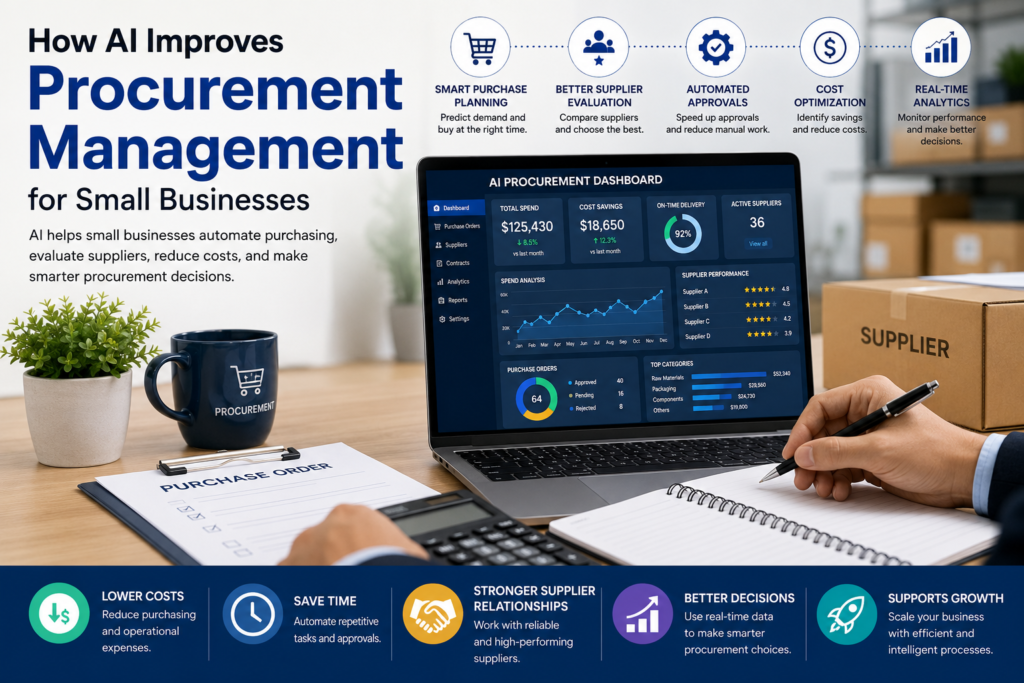
Artificial intelligence (AI) is transforming procurement management by automating purchasing decisions, evaluating supplier performance, predicting demand, and reducing operational costs. Instead of relying on spreadsheets and manual approvals, businesses can use AI to make faster and more accurate procurement decisions.
In this guide, you’ll learn how AI improves procurement management for small businesses and why AI-powered procurement solutions are becoming essential in 2026.
What Is AI Procurement Management?
AI procurement management uses artificial intelligence, machine learning, and predictive analytics to automate purchasing activities and optimize supplier relationships.
AI helps businesses manage:
- Purchase planning
- Supplier evaluation
- Demand forecasting
- Cost analysis
- Purchase approvals
- Contract monitoring
- Procurement reporting
Unlike traditional procurement systems, AI continuously analyzes purchasing data and recommends smarter buying strategies.
Why Procurement Management Matters
Without effective procurement management, businesses often experience:
- Higher purchasing costs
- Supplier delays
- Overstocking
- Stock shortages
- Poor supplier performance
- Inefficient purchasing decisions
AI helps reduce these challenges through automation and intelligent decision-making.
1. Smarter Purchase Planning
AI predicts future purchasing needs using historical sales, inventory levels, and customer demand.
Businesses can purchase products at the right time while avoiding unnecessary inventory.
2. Better Supplier Evaluation
AI compares suppliers based on:
- Pricing
- Delivery reliability
- Product quality
- Response time
- Order accuracy
This helps businesses select the most reliable suppliers.
AI also improves supplier relationships by continuously monitoring supplier performance and identifying long-term procurement opportunities.
3. Automated Purchase Approvals
AI automates routine purchasing approvals based on predefined business rules.
This speeds up procurement while reducing manual administrative work.
Workflow automation also helps businesses streamline purchase approvals and reduce repetitive administrative tasks.
4. Cost Optimization
AI analyzes purchasing patterns and identifies opportunities to reduce procurement costs.
Businesses improve profitability through smarter purchasing decisions.
Procurement decisions become even more effective when combined with business analytics that reveal spending trends and purchasing performance.
5. Contract Monitoring
AI tracks supplier contracts, renewal dates, and purchasing agreements.
Businesses avoid missed deadlines and contract violations.
6. Procurement Analytics
AI generates real-time procurement reports that help business owners monitor spending, supplier performance, and purchasing efficiency.
These insights support better strategic planning.
Procurement reports can also support financial planning by helping business owners better control purchasing budgets and operational expenses.
7. Supporting Business Growth
As businesses expand, procurement becomes more complex.
AI helps manage larger supplier networks, higher purchasing volumes, and more complex procurement workflows without increasing manual effort.
Comparison Table
| Traditional Procurement | AI Procurement |
|---|---|
| Manual purchasing | Automated purchasing |
| Basic reporting | Real-time analytics |
| Reactive decisions | Predictive decisions |
| Manual supplier evaluation | AI supplier analysis |
| Slow approvals | Automated approvals |
| Higher operating costs | Lower procurement costs |
Best Practices
To maximize AI procurement management:
- Maintain accurate purchasing records.
- Review supplier performance regularly.
- Monitor procurement reports.
- Integrate AI with inventory software.
- Update purchasing policies consistently.
Common Mistakes to Avoid
Avoid these mistakes:
- Using outdated supplier data
- Ignoring AI recommendations
- Delaying purchase approvals
- Depending only on manual purchasing
- Failing to monitor procurement performance
Frequently Asked Questions
What is AI procurement management?
AI procurement management uses artificial intelligence to automate purchasing, evaluate suppliers, monitor contracts, and improve procurement efficiency.
Can small businesses use AI procurement software?
Yes. Many affordable cloud-based procurement platforms are designed specifically for small businesses.
Does AI replace procurement managers?
No. AI automates repetitive procurement tasks while managers continue making strategic purchasing decisions.
What are the biggest benefits of AI procurement management?
Businesses benefit from lower purchasing costs, improved supplier relationships, faster approvals, better forecasting, and greater operational efficiency.
Conclusion
AI procurement management enables small businesses to automate purchasing, improve supplier performance, reduce procurement costs, and make smarter buying decisions. By combining predictive analytics with intelligent automation, businesses can create more efficient procurement processes while supporting long-term growth.
Companies that adopt AI procurement management today will improve operational efficiency, strengthen supplier relationships, and remain competitive throughout 2026.