
Introduction
Supply chain management plays a vital role in the success of every small business that sells physical products. Delays in deliveries, supplier issues, inaccurate demand forecasting, and inventory shortages can all reduce profitability and customer satisfaction.
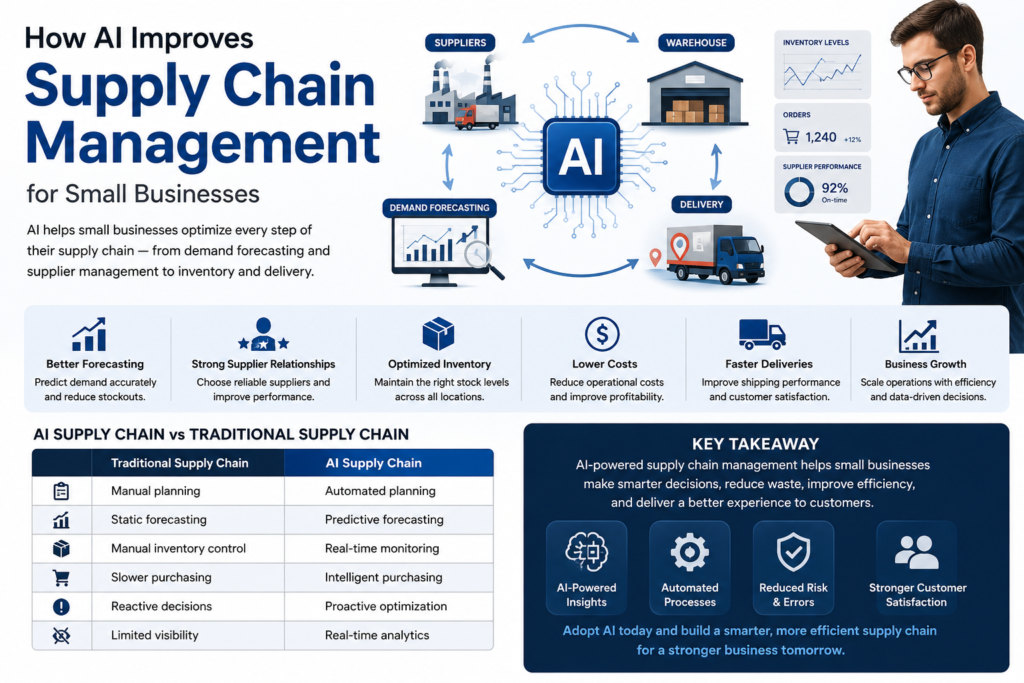
Artificial intelligence (AI) is transforming supply chain management by helping businesses predict demand, monitor supplier performance, optimize inventory, and automate purchasing decisions. Instead of relying on manual processes, AI enables companies to make faster and more accurate supply chain decisions.
In this guide, you’ll learn how AI improves supply chain management for small businesses and why AI-powered supply chain solutions are becoming essential in 2026.
What Is AI Supply Chain Management?
AI supply chain management uses artificial intelligence, machine learning, and predictive analytics to optimize the flow of products from suppliers to customers.
AI helps businesses manage:
- Supplier performance
- Inventory movement
- Demand forecasting
- Shipping schedules
- Warehouse operations
- Purchase planning
- Delivery performance
Unlike traditional supply chain management, AI continuously learns from business data to improve efficiency over time.
AI supply chain management uses artificial intelligence, machine learning, and predictive analytics to optimize the flow of products from suppliers to customers.
Why Supply Chain Management Matters
Without effective supply chain management, businesses often experience:
- Delivery delays
- Stock shortages
- Overstocking
- Higher operating costs
- Poor customer satisfaction
- Supplier inefficiencies
AI helps reduce these problems through automation and predictive insights.
1. Smarter Demand Forecasting
AI analyzes historical sales, seasonal trends, and customer behavior to predict future demand more accurately.
Businesses can purchase inventory before demand increases while avoiding unnecessary stock.
2. Better Supplier Management
AI evaluates suppliers based on:
- Delivery speed
- Product quality
- Pricing
- Reliability
This helps businesses choose the best suppliers.
3. Optimizing Inventory Movement
AI continuously monitors inventory levels across warehouses and sales channels.
Businesses avoid both shortages and excess inventory.
AI inventory management helps businesses maintain optimal stock levels while reducing waste and improving inventory accuracy.
4. Faster Purchase Planning
AI recommends optimal purchasing schedules based on inventory levels and expected demand.
This improves cash flow while reducing unnecessary purchases.
AI workflow automation also simplifies purchasing approvals, inventory updates, and supplier communication.
5. Improving Delivery Performance
AI monitors shipping performance and identifies delivery delays before they affect customers.
Businesses improve customer satisfaction by responding more quickly.
6. Reducing Supply Chain Costs
AI identifies inefficiencies that increase operating expenses.
Businesses can lower transportation, storage, and purchasing costs.
Business analytics helps companies identify supply chain inefficiencies and improve purchasing decisions using real-time operational data.
7. Supporting Business Growth
As businesses grow, supply chains become more complex.
AI helps manage larger product catalogs, more suppliers, and higher order volumes without significantly increasing manual work.
Comparison Table
| Traditional Supply Chain | AI Supply Chain |
|---|---|
| Manual planning | Automated planning |
| Static forecasting | Predictive forecasting |
| Manual inventory control | Real-time monitoring |
| Slower purchasing | Intelligent purchasing |
| Reactive decisions | Proactive optimization |
| Limited visibility | Real-time analytics |
Best Practices
To maximize AI supply chain management:
- Maintain accurate inventory data.
- Monitor supplier performance regularly.
- Review AI recommendations frequently.
- Effective project management helps businesses implement AI supply chain solutions more efficiently while reducing operational disruptions.
- Integrate AI with inventory software.
- Analyze supply chain reports consistently.
Common Mistakes to Avoid
Avoid these mistakes:
- Ignoring supplier performance
- Using outdated inventory data
- Delaying purchasing decisions
- Depending entirely on manual processes
- Failing to monitor AI recommendations
FAQ
What is AI supply chain management?
AI supply chain management uses artificial intelligence to improve purchasing, inventory management, supplier performance, and delivery planning.
Can small businesses benefit from AI supply chain management?
Yes. AI helps small businesses reduce costs, improve inventory accuracy, and make faster purchasing decisions.
Does AI replace supply chain managers?
No. AI automates repetitive tasks while managers continue making strategic business decisions.
What are the biggest benefits of AI supply chain management?
Businesses benefit from better forecasting, improved supplier management, lower costs, faster purchasing, and greater operational efficiency.
Conclusion
AI supply chain management enables small businesses to optimize purchasing, improve supplier relationships, reduce operational costs, and deliver products more efficiently. By combining predictive analytics with intelligent automation, AI helps businesses build more reliable and scalable supply chains.
Companies that adopt AI-powered supply chain management today will strengthen their operations, improve customer satisfaction, and remain competitive throughout 2026.