
Introduction
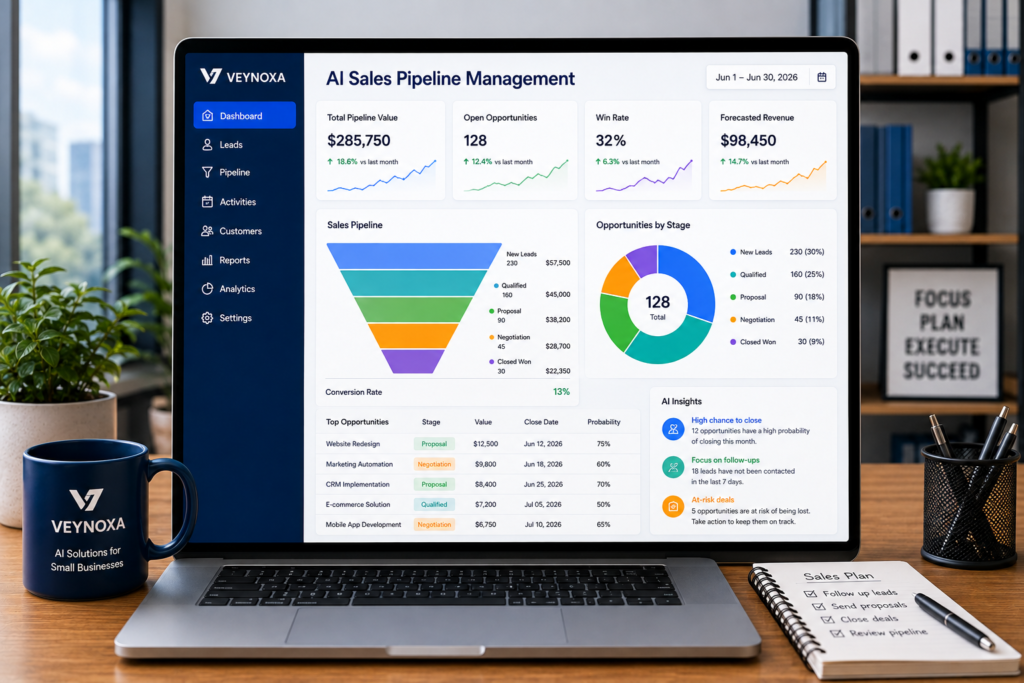
Managing a sales pipeline efficiently is essential for every small business. Without a clear view of potential customers, sales opportunities, and follow-up activities, businesses can lose qualified leads and miss valuable revenue opportunities. Many small businesses still rely on spreadsheets or manual tracking, making it difficult to monitor sales progress accurately.
Artificial intelligence (AI) is transforming sales pipeline management by organizing leads, predicting sales outcomes, prioritizing opportunities, and automating repetitive tasks. Instead of spending hours updating customer records and tracking sales activities manually, businesses can use AI to gain real-time insights and improve their entire sales process.
In this guide, you’ll learn how AI sales pipeline management helps small businesses increase sales efficiency, improve lead management, and drive sustainable business growth in 2026.
What Is AI Sales Pipeline Management?
AI sales pipeline management uses artificial intelligence, machine learning, and predictive analytics to monitor, organize, and optimize every stage of the sales process.
AI analyzes multiple sources of business data, including:
- Customer interactions
- Sales history
- Lead behavior
- Email communications
- CRM data
- Website activity
- Purchase intent
Unlike traditional pipeline management, AI continuously updates sales opportunities as new customer data becomes available.
Why Sales Pipeline Management Matters
A poorly managed sales pipeline often results in:
- Lost sales opportunities
- Slow follow-up
- Poor lead organization
- Lower conversion rates
- Inaccurate sales forecasting
- Reduced revenue growth
AI helps businesses manage every sales opportunity more effectively while improving decision-making throughout the sales cycle.
1. Prioritizing High-Quality Leads
Not every lead has the same chance of becoming a customer.
AI evaluates customer behavior, engagement history, and buying signals to rank leads based on their likelihood of converting.
Sales teams can focus their efforts on the opportunities most likely to generate revenue.
2. Automating Lead Qualification
Manually reviewing every lead takes time and often produces inconsistent results.
AI automatically scores and qualifies leads using predefined criteria and historical sales data.
Businesses spend less time evaluating prospects and more time closing deals.
3. Tracking Every Sales Opportunity
AI continuously monitors each opportunity throughout the sales pipeline.
Business owners can instantly see:
- New opportunities
- Active negotiations
- Deals at risk
- Closed sales
- Lost opportunities
This creates complete visibility across the entire sales process.
4. Predicting Sales Outcomes
AI analyzes previous sales performance together with current pipeline activity to estimate which opportunities are most likely to close successfully.
Instead of relying on assumptions, businesses receive accurate probability scores that help prioritize resources and improve sales planning.
5. Automating Follow-Up Activities
Following up with prospects consistently is one of the most important parts of the sales process. However, busy business owners often forget to send emails, schedule calls, or check in with potential customers.
AI automates follow-up reminders, email sequences, and task scheduling based on customer engagement and sales activity. This ensures that no valuable opportunity is overlooked and every lead receives timely communication.
6. Improving Sales Forecast Accuracy
Accurate forecasting helps businesses prepare for future growth.
AI continuously analyzes pipeline activity, lead quality, conversion rates, and historical performance to predict future sales more accurately than traditional forecasting methods.
Business owners can make better financial, staffing, and inventory decisions based on reliable sales projections.
7. Increasing Revenue Growth
An organized sales pipeline creates more opportunities to close deals successfully.
By automating repetitive tasks and identifying high-value opportunities, AI helps businesses improve:
- Lead conversion rates
- Sales productivity
- Customer engagement
- Revenue forecasting
- Sales efficiency
- Long-term business growth
Comparison Table
| Traditional Sales Pipeline | AI Sales Pipeline Management |
|---|---|
| Manual lead tracking | Automated lead management |
| Equal focus on all leads | AI lead prioritization |
| Manual follow-ups | Automated reminders and workflows |
| Limited forecasting | Predictive sales forecasting |
| Static CRM updates | Real-time pipeline updates |
| Slower decision-making | AI-powered business insights |
Best Practices
To maximize AI sales pipeline management:
- Keep your CRM data accurate and up to date.
- Review AI lead scores regularly.
- Respond quickly to high-priority leads.
- Monitor pipeline performance weekly.
- Combine AI insights with personal customer relationships.
Common Mistakes to Avoid
Avoid these common mistakes:
- Ignoring AI lead recommendations.
- Failing to update customer information.
- Waiting too long to follow up with prospects.
- Depending only on manual sales tracking.
- Not reviewing sales pipeline reports regularly.
Frequently Asked Questions
What is AI sales pipeline management?
AI sales pipeline management uses artificial intelligence to organize leads, track sales opportunities, automate follow-ups, and improve sales forecasting throughout the sales process.
Can small businesses use AI sales pipeline software?
Yes. Many affordable AI-powered CRM platforms are designed specifically for small businesses and help improve sales efficiency without requiring a large sales team.
Does AI replace sales representatives?
No. AI supports sales professionals by automating repetitive tasks and providing valuable insights, while human sales representatives continue building relationships and closing deals.
How does AI improve lead management?
AI analyzes customer behavior, engagement history, and buying signals to identify high-quality leads and recommend which prospects should receive immediate attention.
What are the benefits of AI sales pipeline management?
Businesses benefit from improved lead organization, faster follow-ups, better forecasting, higher conversion rates, increased productivity, and sustainable revenue growth.
Conclusion
AI sales pipeline management helps small businesses organize every stage of the sales process with greater accuracy and efficiency. By automating lead qualification, prioritizing high-value opportunities, tracking pipeline performance, and improving sales forecasting, AI enables businesses to close more deals while reducing manual work.
As artificial intelligence continues to reshape sales operations in 2026, businesses that adopt AI-powered pipeline management will strengthen customer relationships, improve decision-making, increase revenue, and build a more scalable sales process for long-term success.