
Introduction
Pricing is one of the most important decisions every small business makes. Setting prices too high can reduce sales, while pricing products too low may hurt profitability. Many business owners still rely on manual pricing strategies that fail to keep up with changing market conditions.
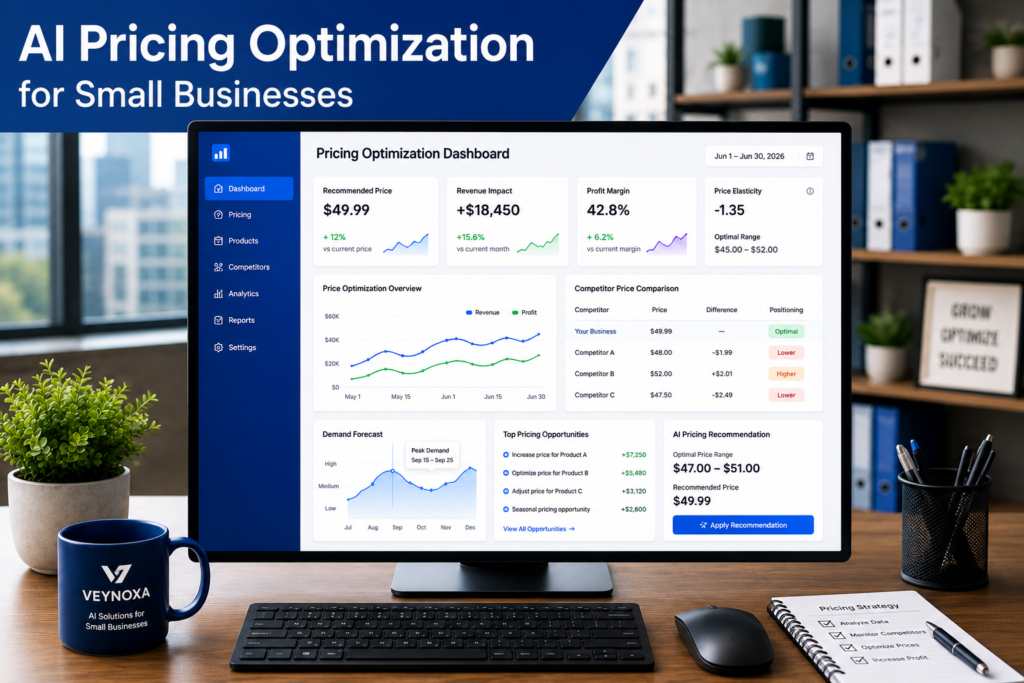
Artificial intelligence (AI) is transforming pricing optimization by analyzing customer behavior, competitor pricing, market demand, and sales data in real time. Instead of relying on guesswork, AI helps businesses make smarter pricing decisions that increase revenue while maintaining customer satisfaction.
In this guide, you’ll learn how AI pricing optimization helps small businesses improve profitability, stay competitive, and make data-driven pricing decisions in 2026.
What Is AI Pricing Optimization?
AI pricing optimization uses artificial intelligence, machine learning, and predictive analytics to recommend the most effective prices for products or services.
AI analyzes data such as:
- Customer purchasing behavior
- Historical sales
- Competitor pricing
- Market demand
- Seasonal trends
- Inventory levels
- Customer segments
Instead of using fixed pricing models, AI continuously adjusts recommendations based on real-time business data.
Why Pricing Optimization Matters
Poor pricing decisions often lead to:
- Lost revenue
- Lower profit margins
- Reduced competitiveness
- Slow inventory turnover
- Customer dissatisfaction
- Missed sales opportunities
AI helps businesses identify pricing strategies that maximize both revenue and customer value.
1. Analyzing Market Demand
AI continuously monitors demand patterns and identifies how customer interest changes over time.
Businesses can increase prices during high demand and remain competitive during slower periods.
2. Monitoring Competitor Pricing
AI tracks competitor pricing across multiple channels.
Instead of manually checking competitors, businesses receive automatic pricing insights that help maintain competitive positioning.
3. Predicting Customer Price Sensitivity
Not every customer responds to pricing in the same way.
AI analyzes purchasing behavior to estimate how different customer groups react to price changes, helping businesses avoid unnecessary discounts.
4. Optimizing Profit Margins
AI evaluates product costs, operating expenses, and expected demand to recommend prices that improve profitability without sacrificing sales volume.
Business owners gain greater confidence in every pricing decision.
5. Supporting Dynamic Pricing
Markets change every day.
AI can automatically recommend pricing adjustments based on:
- Demand fluctuations
- Seasonal trends
- Inventory availability
- Competitor activity
- Customer behavior
This allows businesses to respond quickly to market conditions.
6. Reducing Pricing Errors
Manual pricing often leads to inconsistent decisions.
AI reduces human error by applying consistent pricing rules based on accurate data analysis.
Businesses spend less time reviewing prices manually.
7. Increasing Revenue Growth
Better pricing leads to stronger financial performance.
AI helps businesses improve:
- Revenue
- Profit margins
- Conversion rates
- Customer satisfaction
- Sales performance
- Long-term growth
Comparison Table
| Traditional Pricing | AI Pricing Optimization |
|---|---|
| Manual pricing decisions | AI-driven recommendations |
| Fixed prices | Dynamic pricing strategies |
| Limited market analysis | Real-time market monitoring |
| Manual competitor research | Automated competitor tracking |
| Slower adjustments | Continuous optimization |
| Higher pricing errors | Data-driven pricing accuracy |
Best Practices
To maximize AI pricing optimization:
- Monitor competitor pricing regularly.
- Review AI recommendations before major pricing changes.
- Analyze customer purchasing behavior.
- Consider seasonal demand patterns.
- Continuously evaluate pricing performance.
Common Mistakes to Avoid
Avoid these common pricing mistakes:
- Setting prices based on assumptions.
- Ignoring competitor pricing.
- Changing prices too frequently without analysis.
- Focusing only on sales volume.
- Overlooking customer value perception.
Frequently Asked Questions
What is AI pricing optimization?
AI pricing optimization uses artificial intelligence to recommend the most profitable prices based on market data, customer behavior, and business performance.
Can small businesses benefit from AI pricing?
Yes. Many affordable AI tools help small businesses improve pricing decisions, increase profits, and remain competitive.
Does AI automatically change prices?
Some AI platforms can automate pricing updates, while others provide recommendations that business owners approve manually.
Is AI pricing optimization expensive?
Many cloud-based AI pricing solutions offer affordable plans designed specifically for small businesses.
What are the benefits of AI pricing optimization?
Businesses benefit from higher revenue, improved profit margins, better competitiveness, smarter pricing decisions, and stronger long-term growth.
Conclusion
AI pricing optimization enables small businesses to make smarter pricing decisions using real-time data instead of guesswork. By analyzing customer behavior, market demand, competitor pricing, and profitability, AI helps businesses maximize revenue while maintaining customer satisfaction.
As competition continues to increase throughout 2026, businesses that adopt AI-powered pricing strategies will be better positioned to improve profitability, strengthen customer relationships, and achieve sustainable long-term growth.