
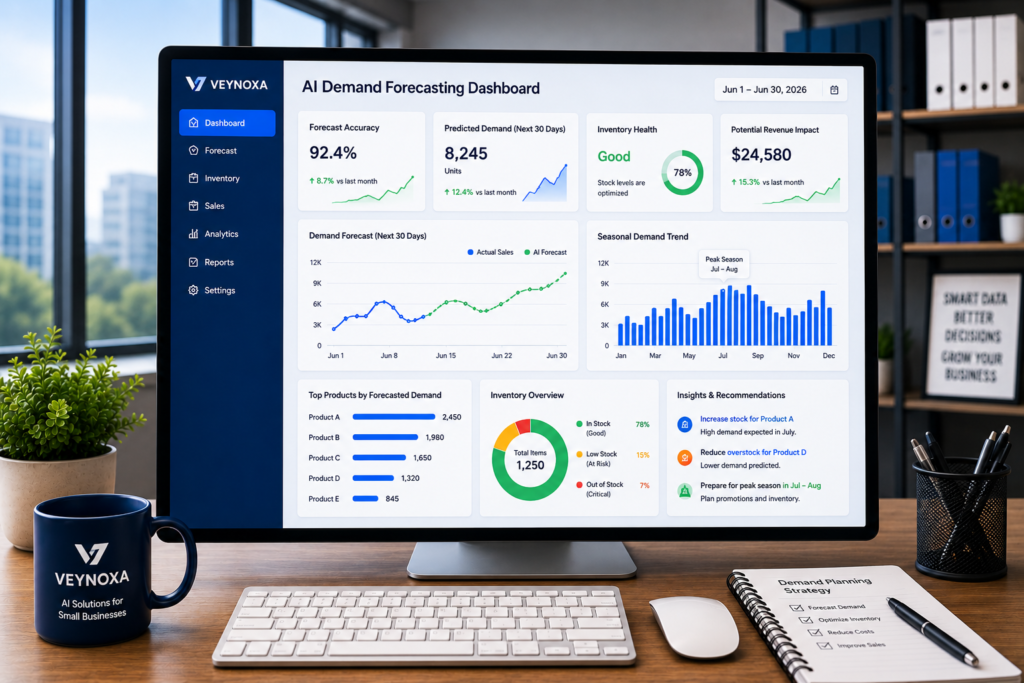
Introduction
Accurately predicting customer demand has always been one of the biggest challenges for small businesses. Unexpected spikes in demand can lead to stock shortages, while overestimating demand often results in excess inventory and unnecessary costs.
Artificial intelligence (AI) is changing demand forecasting by analyzing historical sales, customer behavior, seasonal trends, and market conditions in real time. Instead of relying on manual estimates or outdated spreadsheets, businesses can use AI to make smarter decisions based on accurate data.
In this guide, you’ll learn how AI demand forecasting helps small businesses improve inventory planning, reduce waste, and make more informed business decisions in 2026.
What Is AI Demand Forecasting?
AI demand forecasting uses artificial intelligence, machine learning, and predictive analytics to estimate future customer demand.
AI analyzes multiple data sources, including:
- Historical sales
- Customer purchasing behavior
- Seasonal trends
- Market demand
- Promotions
- Economic conditions
- Inventory levels
Unlike traditional forecasting methods, AI continuously updates predictions as new business data becomes available.
Why Demand Forecasting Matters
Poor demand forecasting often leads to:
- Overstocking
- Stock shortages
- Lost sales
- Higher storage costs
- Poor customer satisfaction
- Lower profitability
AI helps businesses balance inventory while improving operational efficiency.
1. Predicting Customer Demand
AI identifies purchasing patterns and predicts future demand with greater accuracy.
Business owners can prepare inventory before demand increases.
2. Reducing Inventory Costs
Holding too much inventory ties up valuable capital.
AI recommends inventory levels that reduce storage costs while maintaining product availability.
3. Improving Inventory Planning
AI combines historical trends with current market conditions to recommend smarter inventory planning.
Businesses avoid both overstocking and stockouts.
4. Supporting Seasonal Planning
Customer demand changes throughout the year.
AI detects seasonal patterns and helps businesses prepare for holidays, promotions, and peak shopping periods.
Business owners gain better visibility into future demand.
5. Improving Supply Chain Decisions
Demand forecasting helps businesses communicate more accurately with suppliers.
AI enables better purchasing schedules and reduces unnecessary delays.
6. Increasing Customer Satisfaction
Products are available when customers need them.
Accurate forecasting reduces out-of-stock situations and improves the overall shopping experience.
7. Driving Business Growth
Better forecasting supports:
- Higher revenue
- Lower operating costs
- Better inventory turnover
- Improved cash flow
- Faster decision-making
- Sustainable business growth
Comparison Table
| Traditional Demand Forecasting | AI Demand Forecasting |
|---|---|
| Manual forecasting | AI-powered predictions |
| Historical reports | Real-time analysis |
| Fixed forecasts | Continuous updates |
| Higher forecasting errors | Greater accuracy |
| Limited data | Multiple data sources |
| Slow decision-making | Faster business insights |
Best Practices
To maximize AI demand forecasting:
- Monitor sales trends regularly.
- Update inventory data frequently.
- Review AI forecasts before purchasing inventory.
- Analyze seasonal demand changes.
- Combine AI insights with business experience.
Common Mistakes to Avoid
Avoid these common mistakes:
- Relying only on historical sales.
- Ignoring seasonal demand.
- Not updating inventory data.
- Ordering inventory without reviewing forecasts.
- Depending solely on manual predictions.
Frequently Asked Questions
What is AI demand forecasting?
AI demand forecasting uses artificial intelligence to predict future customer demand using historical data, purchasing patterns, and market trends.
Can small businesses use AI demand forecasting?
Yes. Many affordable AI forecasting tools are designed specifically for small businesses and online stores.
How accurate is AI demand forecasting?
AI is generally more accurate than traditional forecasting because it continuously analyzes new business data and market changes.
Does AI reduce inventory costs?
Yes. AI helps businesses maintain optimal inventory levels, reducing storage costs and minimizing unnecessary stock.
What are the benefits of AI demand forecasting?
Businesses benefit from improved inventory planning, lower costs, higher customer satisfaction, better cash flow, and smarter business decisions.
Conclusion
AI demand forecasting helps small businesses predict customer demand more accurately by analyzing sales data, seasonal trends, customer behavior, and market conditions. Instead of relying on manual forecasting, businesses gain real-time insights that improve inventory planning and reduce operational costs.
As AI continues to evolve throughout 2026, businesses that adopt AI demand forecasting will be better equipped to respond to changing customer demand, improve profitability, and achieve sustainable long-term growth.