
Introduction
Managing business expenses is one of the most important responsibilities for small businesses. Even when revenue is increasing, unnecessary spending, poor expense tracking, and inefficient purchasing decisions can reduce profitability and create financial pressure.
Traditional expense management often depends on spreadsheets, receipts, manual data entry, and periodic financial reviews. These processes can take valuable time and make it difficult for business owners to understand exactly where money is being spent.
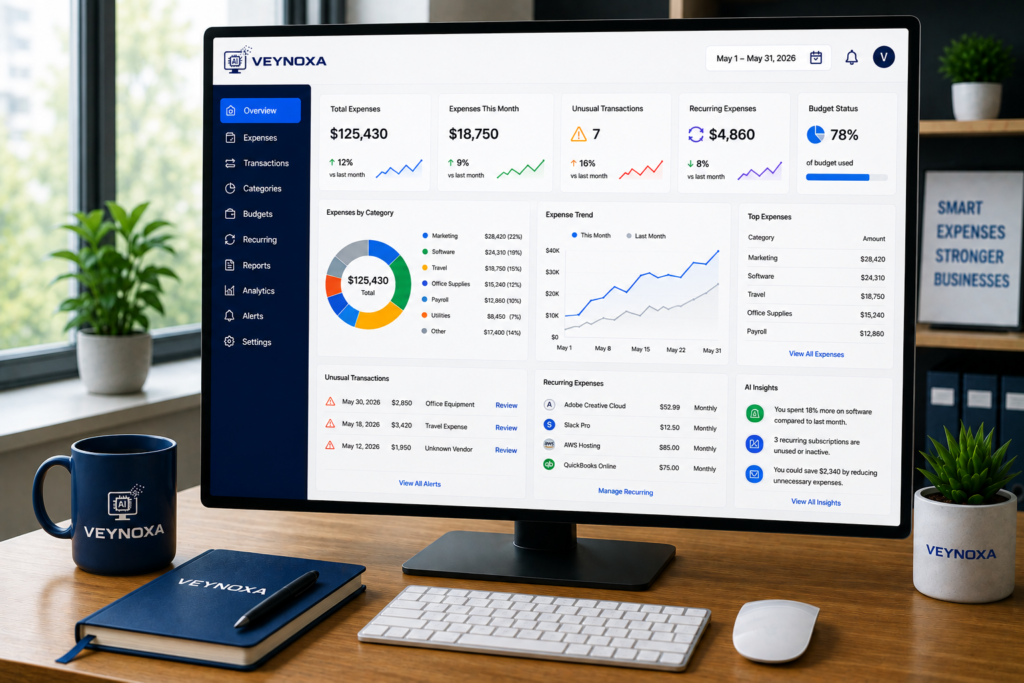
Artificial intelligence (AI) is transforming expense management by automatically categorizing transactions, identifying unusual spending, monitoring recurring expenses, and providing real-time financial insights. Instead of manually reviewing every expense, businesses can use AI to understand spending patterns and make better financial decisions.
In this guide, you’ll learn how AI expense management helps small businesses control spending, reduce unnecessary costs, improve financial visibility, and strengthen profitability in 2026.
What Is AI Expense Management?
AI expense management uses artificial intelligence, machine learning, and automated financial analysis to monitor, categorize, and optimize business expenses.
AI can analyze multiple sources of financial data, including:
- Business transactions
- Receipts
- Supplier payments
- Credit card expenses
- Recurring subscriptions
- Travel expenses
- Operating costs
- Purchase records
Unlike traditional expense tracking, AI can continuously analyze financial activity and provide updated insights as new transactions occur.
Why Expense Management Matters
Poor expense management can create several challenges for small businesses, including:
- Unnecessary spending
- Reduced profitability
- Poor financial visibility
- Budget overruns
- Duplicate expenses
- Increasing operating costs
- Cash flow pressure
AI helps businesses understand their spending more clearly and identify opportunities to control unnecessary expenses.
1. Automatically Categorizing Expenses
AI can automatically organize business transactions into categories such as:
- Office supplies
- Marketing
- Travel
- Software
- Payroll
- Utilities
- Equipment
- Professional services
Automated categorization reduces manual data entry and makes financial records easier to analyze.
2. Identifying Unnecessary Spending
Not every business expense contributes equally to growth.
AI analyzes spending patterns to identify expenses that may be unnecessary, excessive, or no longer valuable.
Businesses can review these recommendations and decide where costs can be reduced without affecting essential operations.
3. Monitoring Recurring Expenses
Recurring subscriptions and services can become a significant source of unnecessary spending over time.
AI can monitor recurring expenses and identify subscriptions, memberships, and services that may no longer be actively used.
This helps businesses avoid paying for services they no longer need.
4. Detecting Unusual Transactions
AI can establish patterns based on normal business spending and identify transactions that appear unusual.
For example, AI may detect:
- Unexpectedly large purchases
- Unusual supplier payments
- Spending outside normal categories
- Sudden increases in expenses
- Transactions that differ from historical patterns
Businesses can investigate these transactions before they create larger financial problems.
5. Improving Budget Control
AI can compare actual spending with planned budgets and identify areas where expenses are increasing faster than expected.
Business owners can receive early insights when spending approaches or exceeds budget limits.
This makes it easier to take corrective action before financial problems become more serious.
6. Improving Financial Visibility
AI provides businesses with a clearer view of where money is being spent.
Instead of waiting for monthly financial reports, business owners can monitor spending patterns and expense trends more continuously.
Better financial visibility supports faster and more informed business decisions.
7. Supporting Better Profitability
Expense management directly affects profitability.
AI helps businesses identify unnecessary costs, monitor spending patterns, improve budget control, and optimize resource allocation.
Reducing avoidable expenses can help businesses retain more of their revenue as profit and create stronger financial stability.
Comparison Table
| Traditional Expense Management | AI Expense Management |
|---|---|
| Manual transaction categorization | Automated expense categorization |
| Spreadsheet-based tracking | Automated financial monitoring |
| Periodic expense reviews | Continuous spending analysis |
| Manual anomaly detection | AI-powered unusual transaction detection |
| Static budgets | Dynamic budget monitoring |
| Limited spending visibility | Real-time financial insights |
| Reactive cost control | Proactive expense optimization |
Best Practices
To maximize AI expense management:
- Keep financial records accurate and updated.
- Review AI-generated spending insights regularly.
- Monitor recurring subscriptions.
- Set clear business spending limits.
- Compare expenses with planned budgets.
- Investigate unusual transactions quickly.
- Combine AI recommendations with human financial judgment.
Common Mistakes to Avoid
Avoid these common expense management mistakes:
- Tracking expenses only at the end of the month.
- Ignoring small recurring expenses.
- Failing to categorize transactions accurately.
- Spending without clear budget limits.
- Ignoring unusual transactions.
- Making cost-cutting decisions without reviewing business impact.
- Relying on outdated financial information.
Frequently Asked Questions
What is AI expense management?
AI expense management uses artificial intelligence to automatically track, categorize, analyze, and optimize business expenses.
Can small businesses use AI expense management tools?
Yes. AI-powered expense management tools can help small businesses automate transaction categorization, monitor spending, identify unusual expenses, and improve financial visibility.
How does AI reduce business expenses?
AI identifies unnecessary spending, recurring costs, unusual transactions, and areas where expenses are increasing. Businesses can then review these insights and take appropriate action.
Can AI track recurring subscriptions?
Yes. AI can identify recurring transactions and help businesses monitor subscriptions and services that may no longer be necessary.
How does AI improve budget management?
AI compares actual spending with planned budgets and can highlight areas where expenses are approaching or exceeding budget limits.
Can AI detect unusual expenses?
Yes. AI can compare new transactions with historical spending patterns and identify activity that appears unusual or significantly different from normal business behavior.
Does AI replace financial professionals?
No. AI automates repetitive analysis and provides financial insights, while business owners and financial professionals remain responsible for reviewing information and making strategic decisions.
What are the benefits of AI expense management?
Businesses can benefit from better spending visibility, reduced unnecessary costs, improved budget control, faster financial analysis, stronger profitability, and better financial decision-making.
Conclusion
AI expense management helps small businesses gain better control over their spending by automatically categorizing transactions, monitoring recurring costs, identifying unusual expenses, and providing continuous financial insights.
Instead of relying entirely on spreadsheets and periodic reviews, businesses can use AI to understand spending patterns faster and identify opportunities to reduce unnecessary costs.
As AI-powered financial management continues to evolve throughout 2026, businesses that adopt intelligent expense management can improve financial visibility, strengthen profitability, control operating costs, and build a more financially sustainable business.