
Introduction
Managing accounts payable is an essential part of maintaining healthy business finances. Small businesses need to track supplier invoices, payment deadlines, outstanding bills, and operating expenses while making sure payments are completed accurately and on time.
Traditional accounts payable management often depends on spreadsheets, manual data entry, email communication, and repeated invoice checks. As the number of suppliers and transactions increases, these processes can become time-consuming and increase the risk of missed payments and accounting errors.
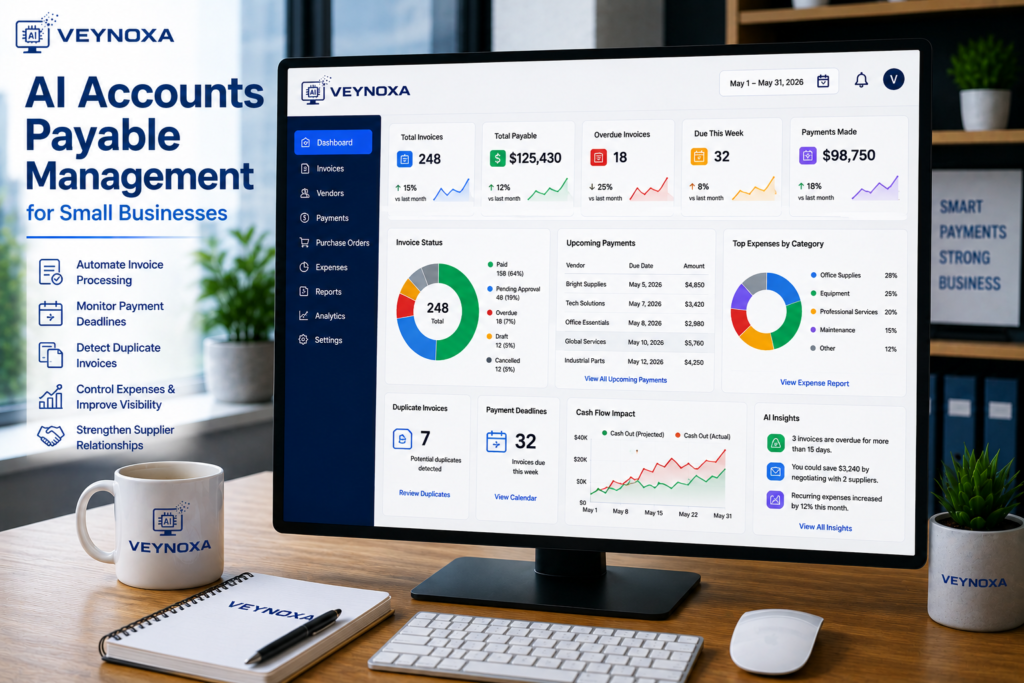
Artificial intelligence (AI) is transforming accounts payable management by automating invoice processing, identifying payment deadlines, detecting unusual transactions, and helping businesses prioritize payments. Instead of handling every invoice manually, businesses can use AI to improve financial efficiency and maintain better control over expenses.
In this guide, you’ll learn how AI accounts payable management helps small businesses automate invoice processing, reduce payment errors, control expenses, and improve financial stability in 2026.
What Is AI Accounts Payable Management?
AI accounts payable management uses artificial intelligence, machine learning, and automation to manage supplier invoices, business bills, payment schedules, and outgoing expenses.
AI can analyze multiple financial data sources, including:
- Supplier invoices
- Payment due dates
- Purchase orders
- Vendor information
- Operating expenses
- Payment history
- Transaction records
- Business budgets
Unlike traditional accounts payable processes, AI can continuously analyze financial information and automate repetitive payment-related tasks.
Why Accounts Payable Management Matters
Poor accounts payable management can create several problems for small businesses, including:
- Missed payment deadlines
- Late payment penalties
- Duplicate payments
- Accounting errors
- Unnecessary administrative work
- Poor expense visibility
- Cash flow pressure
AI helps businesses maintain better control over outgoing payments while reducing the amount of manual financial administration.
1. Automating Invoice Processing
AI can automatically extract important information from supplier invoices, including:
- Invoice numbers
- Supplier names
- Payment amounts
- Due dates
- Tax information
- Payment terms
Automated invoice processing reduces manual data entry and helps businesses process invoices more efficiently.
2. Detecting Duplicate Invoices
Duplicate invoices can lead to unnecessary payments and financial losses.
AI compares invoice information, supplier details, payment amounts, and transaction records to identify potential duplicates.
Businesses can review suspicious invoices before payments are processed.
3. Monitoring Payment Deadlines
Missing payment deadlines can result in late fees and damaged supplier relationships.
AI monitors invoice due dates and can notify businesses about upcoming payments.
This allows business owners to organize payments before deadlines are reached.
4. Prioritizing Business Payments
Not every invoice requires the same level of urgency.
AI can prioritize payments based on:
- Due dates
- Invoice amounts
- Supplier terms
- Late payment penalties
- Available cash
- Business priorities
This helps businesses manage outgoing payments more efficiently.
5. Improving Expense Visibility
AI analyzes accounts payable data to identify where business money is being spent.
Businesses can discover spending patterns across:
- Suppliers
- Products
- Services
- Departments
- Recurring expenses
Better expense visibility helps business owners identify unnecessary costs and improve financial control.
6. Supporting Better Cash Flow Management
Accounts payable directly affects business cash flow because supplier payments represent outgoing cash.
AI analyzes upcoming invoices, payment deadlines, available cash, and historical expenses to help businesses understand future payment requirements.
These insights allow businesses to plan expenses more effectively while maintaining sufficient cash for essential operations.
7. Improving Supplier Relationships
Consistent and accurate payments can help businesses maintain stronger relationships with suppliers.
AI helps prevent missed deadlines, payment errors, and duplicate transactions.
Businesses can therefore create a more reliable payment process while reducing unnecessary communication and administrative work.
Comparison Table
| Traditional Accounts Payable | AI Accounts Payable Management |
|---|---|
| Manual invoice entry | Automated invoice processing |
| Manual deadline tracking | Automated payment monitoring |
| Spreadsheet-based records | AI-powered financial data |
| Manual duplicate checks | Automated duplicate detection |
| Reactive payment management | Proactive payment prioritization |
| Limited expense visibility | Detailed spending insights |
| Time-consuming administration | Reduced manual workload |
Best Practices
To maximize AI accounts payable management:
- Keep supplier information accurate.
- Review invoices before approving payments.
- Monitor payment deadlines regularly.
- Check AI-generated duplicate alerts.
- Review supplier spending patterns.
- Maintain accurate financial records.
- Combine AI automation with human approval for important payments.
Common Mistakes to Avoid
Avoid these common accounts payable mistakes:
- Paying invoices without verification.
- Ignoring duplicate invoice alerts.
- Missing supplier payment deadlines.
- Depending entirely on spreadsheets.
- Failing to monitor recurring expenses.
- Approving payments without reviewing supplier information.
- Ignoring the effect of outgoing payments on cash flow.
Frequently Asked Questions
What is AI accounts payable management?
AI accounts payable management uses artificial intelligence to automate invoice processing, monitor payment deadlines, detect duplicate invoices, and improve the management of business expenses.
Can small businesses use AI accounts payable tools?
Yes. AI-powered accounts payable tools can help small businesses automate repetitive financial tasks, improve invoice accuracy, and manage supplier payments more efficiently.
How does AI reduce invoice errors?
AI automatically analyzes invoice information and compares it with existing financial records. This can help identify missing information, duplicate invoices, unusual amounts, and other potential errors.
Can AI automate supplier invoice processing?
Yes. AI can extract information from invoices, organize financial data, identify payment deadlines, and help businesses prepare invoices for approval.
How does AI improve cash flow management?
AI analyzes upcoming payments, invoice due dates, expenses, and available cash to provide better visibility into future outgoing payments.
Does AI replace accounting employees?
No. AI automates repetitive tasks and provides financial insights, while accounting professionals and business owners continue reviewing important transactions and making financial decisions.
What are the benefits of AI accounts payable management?
Businesses can benefit from faster invoice processing, fewer payment errors, better expense visibility, improved cash flow management, reduced administrative work, and stronger supplier relationships.
Conclusion
AI accounts payable management helps small businesses improve the way they process invoices, manage supplier payments, and control outgoing expenses. By automating invoice processing, detecting duplicate payments, monitoring deadlines, and analyzing spending patterns, AI reduces repetitive work while improving financial visibility.
As AI-powered financial management continues to evolve throughout 2026, businesses that adopt intelligent accounts payable solutions will be better positioned to reduce payment errors, control expenses, improve cash flow management, and build stronger financial operations for long-term growth.