
Introduction
Managing accounts receivable is essential for maintaining healthy cash flow and financial stability. When customers pay invoices late, small businesses can experience cash shortages, increased administrative work, and difficulty covering operating expenses.
Traditional accounts receivable management often requires employees to track invoices, monitor payment dates, send reminders, and manually review customer payment histories. As the number of customers grows, these tasks can become increasingly difficult to manage efficiently.
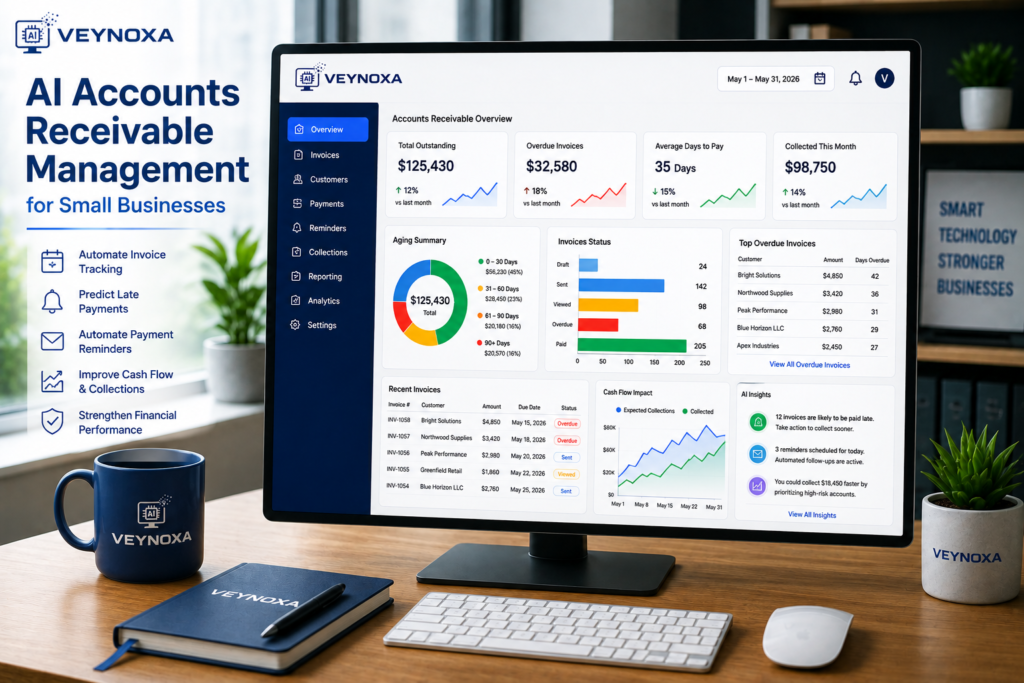
Artificial intelligence (AI) is transforming accounts receivable management by monitoring invoices, predicting payment behavior, identifying overdue accounts, and automating collection workflows. Instead of relying entirely on manual processes, businesses can use AI to improve payment collection and maintain more predictable cash flow.
In this guide, you’ll learn how AI accounts receivable management helps small businesses reduce late payments, improve cash flow, automate invoice management, and strengthen financial performance in 2026.
What Is AI Accounts Receivable Management?
AI accounts receivable management uses artificial intelligence, machine learning, and predictive analytics to monitor customer invoices and improve the process of collecting payments.
AI can analyze multiple financial data sources, including:
- Customer invoices
- Payment history
- Outstanding balances
- Payment due dates
- Customer purchasing behavior
- Transaction records
- Cash flow data
- Collection activity
Unlike traditional accounts receivable processes, AI continuously analyzes payment information and provides updated insights as new transactions occur.
Why Accounts Receivable Management Matters
Poor accounts receivable management can create several problems for small businesses, including:
- Late customer payments
- Unpredictable cash flow
- Increased administrative workload
- Higher collection costs
- Cash shortages
- Financial uncertainty
- Slower business growth
AI helps businesses monitor outstanding payments and take action before delayed invoices create larger financial problems.
1. Automating Invoice Tracking
AI can automatically monitor invoices from the moment they are issued until payment is received.
Businesses can quickly identify:
- New invoices
- Upcoming due dates
- Overdue invoices
- Outstanding balances
- Payment delays
Automated tracking reduces manual administrative work and gives business owners a clearer view of their accounts receivable.
2. Predicting Late Payments
Not all customers have the same payment behavior.
AI analyzes historical payment patterns and customer activity to predict which invoices may be paid late.
Businesses can use these predictions to prioritize collection efforts and reduce potential cash flow disruptions.
3. Automating Payment Reminders
Following up with customers about unpaid invoices can consume significant time.
AI can automate payment reminders based on invoice due dates and customer payment behavior.
Businesses can send timely reminders before and after payment deadlines without manually contacting every customer.
4. Improving Collection Prioritization
AI can rank outstanding invoices based on factors such as:
- Payment history
- Invoice value
- Days overdue
- Customer risk
- Previous collection activity
This allows businesses to focus their attention on the accounts that require the most immediate action.
5. Reducing Days Sales Outstanding
Days Sales Outstanding (DSO) measures how long it takes a business to collect payment after making a sale.
AI can help reduce DSO by identifying delayed payments, predicting collection problems, and recommending when businesses should follow up with customers.
Faster collections can improve cash availability and financial stability.
6. Improving Customer Payment Experience
Effective accounts receivable management is not only about collecting money.
AI can help businesses create more consistent payment experiences by sending relevant reminders, identifying preferred payment patterns, and reducing unnecessary communication.
A smoother payment process can help businesses maintain stronger customer relationships.
7. Supporting Better Cash Flow Forecasting
Accounts receivable data plays an important role in predicting future cash flow.
AI combines outstanding invoices, customer payment behavior, historical collections, and expected payment dates to estimate future cash inflows.
These insights help businesses plan expenses, payroll, investments, and other financial commitments with greater confidence.
Comparison Table
| Traditional Accounts Receivable | AI Accounts Receivable Management |
|---|---|
| Manual invoice tracking | Automated invoice monitoring |
| Manual payment reminders | Automated reminders |
| Historical payment reviews | Predictive payment analysis |
| Reactive collections | Proactive collection management |
| Limited payment visibility | Real-time financial insights |
| Time-consuming administration | Reduced manual workload |
| Slower collection decisions | Faster collection prioritization |
Best Practices
To maximize AI accounts receivable management:
- Keep customer and invoice data accurate.
- Monitor outstanding invoices regularly.
- Review predicted late payments.
- Automate payment reminders.
- Prioritize high-risk overdue accounts.
- Track Days Sales Outstanding.
- Combine AI recommendations with human judgment.
Common Mistakes to Avoid
Avoid these common accounts receivable mistakes:
- Waiting too long to follow up on overdue invoices.
- Tracking invoices entirely through spreadsheets.
- Ignoring customer payment patterns.
- Sending identical reminders to every customer.
- Failing to monitor outstanding balances.
- Relying on inaccurate financial data.
- Focusing only on revenue while ignoring collections.
Frequently Asked Questions
What is AI accounts receivable management?
AI accounts receivable management uses artificial intelligence to monitor invoices, analyze payment behavior, predict late payments, and improve the collection process.
Can small businesses use AI accounts receivable tools?
Yes. AI-powered financial tools can help small businesses automate invoice tracking, payment reminders, collection prioritization, and payment forecasting.
How does AI reduce late payments?
AI analyzes customer payment behavior and invoice information to predict potential delays. Businesses can then send reminders and take action before invoices become significantly overdue.
Can AI automate payment reminders?
Yes. AI systems can automatically schedule and send payment reminders based on invoice due dates, customer behavior, and payment status.
How does AI improve cash flow?
AI helps businesses predict when outstanding invoices are likely to be paid. More accurate collection forecasts allow businesses to plan expenses and manage cash more effectively.
Does AI replace accounts receivable employees?
No. AI automates repetitive tasks and provides financial insights, while employees continue handling customer communication, complex collection situations, and strategic decisions.
What are the benefits of AI accounts receivable management?
Businesses can benefit from faster collections, fewer late payments, reduced administrative work, improved cash flow visibility, better customer payment experiences, and stronger financial stability.
Conclusion
AI accounts receivable management helps small businesses improve the way they track invoices, collect payments, and manage customer balances. By analyzing payment behavior, automating reminders, predicting late payments, and prioritizing collection activities, AI can reduce administrative work while improving financial visibility.
As AI-powered financial management continues to evolve throughout 2026, businesses that adopt intelligent accounts receivable solutions will be better positioned to reduce payment delays, improve cash flow, strengthen customer relationships, and build a more financially stable business.