
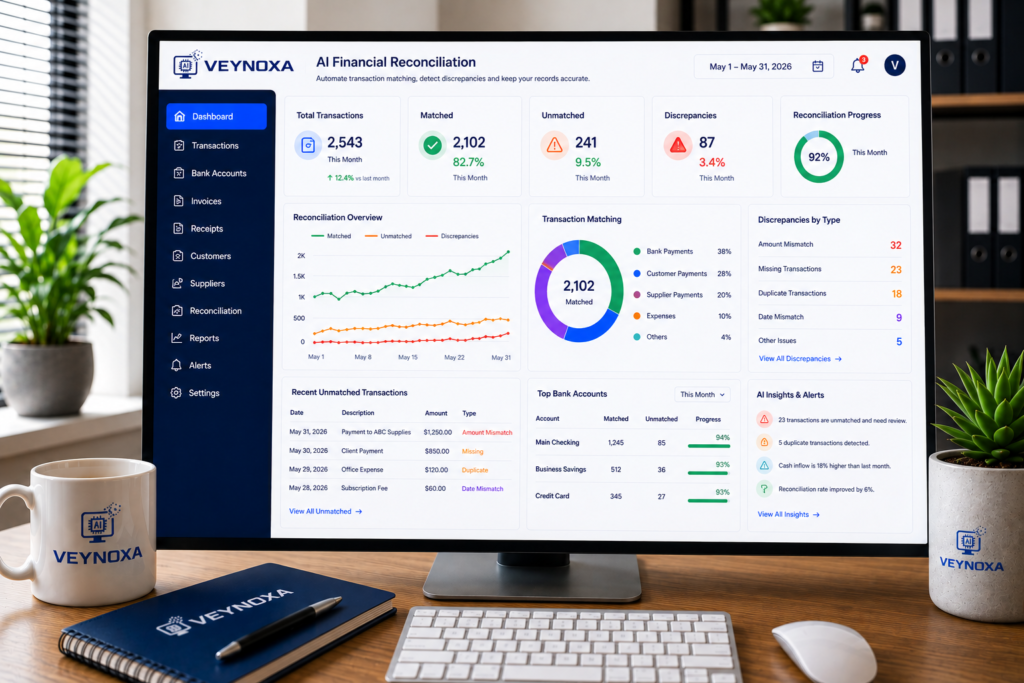
Introduction
Financial reconciliation is an important part of maintaining accurate business records. Small businesses regularly process bank transactions, invoices, customer payments, supplier payments, expenses, and other financial activities. If these transactions are not matched correctly with accounting records, errors can remain unnoticed and affect financial reporting.
Traditional financial reconciliation often requires employees to compare bank statements, accounting records, invoices, receipts, and transaction data manually. This process can be time-consuming, especially when a business handles a large number of transactions.
Artificial intelligence (AI) is transforming financial reconciliation by automatically comparing financial records, identifying discrepancies, matching transactions, and highlighting unusual activity.
In this guide, you’ll learn how AI financial reconciliation helps small businesses reduce manual work, identify discrepancies faster, improve financial accuracy, and maintain more reliable financial records in 2026.
What Is AI Financial Reconciliation?
AI financial reconciliation uses artificial intelligence, machine learning, and automated data analysis to compare financial transactions from different sources and identify differences between them.
AI can compare information from:
- Bank accounts
- Accounting systems
- Credit card transactions
- Invoices
- Receipts
- Customer payments
- Supplier payments
- Expense records
- Payroll transactions
- Financial statements
The goal is to ensure that recorded transactions match the corresponding financial activity.
Instead of manually comparing every transaction, AI can analyze large volumes of financial data and identify transactions that require attention.
Why Financial Reconciliation Matters
Accurate financial reconciliation helps businesses maintain reliable financial records.
Without regular reconciliation, businesses may experience:
- Incorrect account balances
- Duplicate transactions
- Missing transactions
- Unrecorded payments
- Incorrect expense records
- Financial reporting errors
- Difficulty identifying unusual transactions
- Poor financial visibility
Regular reconciliation allows businesses to identify discrepancies before they create larger financial problems.
AI can make this process faster and more efficient by continuously analyzing financial transactions.
1. Automating Transaction Matching
One of the most useful applications of AI reconciliation is automated transaction matching.
AI can compare transactions from bank accounts with corresponding entries in accounting systems.
For example, AI may match:
- A bank payment with an invoice
- A customer payment with an outstanding receivable
- A supplier payment with an accounts payable record
- A business expense with a receipt
Automated matching reduces the amount of manual work required to reconcile financial records.
2. Identifying Financial Discrepancies
AI can identify differences between financial records and actual transactions.
For example, the system may detect:
- Different transaction amounts
- Missing payments
- Duplicate entries
- Incorrect transaction dates
- Unmatched invoices
- Unexpected account activity
These discrepancies can then be reviewed by a business owner, accountant, or finance professional.
Early detection helps prevent small errors from becoming larger accounting problems.
3. Detecting Duplicate Transactions
Duplicate transactions can occur because of manual data entry errors, system integrations, or repeated payments.
AI can compare transaction details such as:
- Amount
- Date
- Vendor
- Customer
- Transaction description
- Payment reference
When similar transactions appear more than once, AI can flag them for review.
This can help businesses avoid overstated expenses and incorrect financial balances.
4. Improving Data Accuracy
Financial reconciliation is closely connected to data accuracy.
AI can identify inconsistencies between different financial records and highlight information that may require correction.
For example, a transaction may appear in a bank account but not in the accounting system.
AI can identify this mismatch and notify the business that additional review may be necessary.
More accurate financial records improve the reliability of financial reporting and decision-making.
5. Reconciling Accounts More Frequently
Traditional reconciliation is often performed on a monthly basis.
AI can allow businesses to reconcile financial transactions more frequently.
Depending on the financial systems being used, businesses may be able to monitor transactions continuously or perform reconciliation more often throughout the month.
More frequent reconciliation provides better visibility into the current financial position of the business.
6. Supporting Accounts Receivable Reconciliation
Customer payments need to be matched with invoices and outstanding balances.
AI can analyze:
- Customer invoices
- Payment amounts
- Payment dates
- Outstanding balances
- Customer payment references
This helps businesses identify which invoices have been paid, which remain outstanding, and which payments may not have been correctly matched.
Better reconciliation can support faster cash collection and more accurate accounts receivable records.
7. Supporting Accounts Payable Reconciliation
Supplier transactions also need to be accurately recorded.
AI can compare supplier invoices with:
- Payments
- Purchase records
- Payment dates
- Supplier account balances
- Transaction amounts
This can help businesses identify unpaid invoices, duplicate payments, and discrepancies between supplier records and internal accounting records.
Accurate accounts payable reconciliation can also help businesses manage supplier relationships more effectively.
8. Detecting Unusual Financial Activity
AI can learn normal transaction patterns and identify activity that differs significantly from those patterns.
For example, AI may flag:
- Unexpected large payments
- Unusual vendor transactions
- Transactions outside normal patterns
- Repeated payments
- Unusual expense activity
These alerts do not automatically mean that a transaction is fraudulent.
Instead, they provide an opportunity for human review and investigation.
9. Reducing Manual Administrative Work
Manual reconciliation can require employees to spend hours reviewing financial records.
AI can automate repetitive tasks such as:
- Comparing transactions
- Matching payments
- Identifying discrepancies
- Categorizing transaction information
- Creating reconciliation reports
- Flagging transactions for review
Reducing repetitive work allows employees to spend more time on financial analysis and strategic activities.
10. Improving Financial Reporting
Reliable financial reporting depends on accurate underlying financial records.
When transactions are properly reconciled, businesses can have greater confidence in their:
- Revenue reports
- Expense reports
- Profit and loss statements
- Cash flow reports
- Balance sheets
- Financial forecasts
AI reconciliation helps improve the quality of financial information used to prepare these reports.
11. Supporting Better Financial Decisions
Accurate financial records give business owners better information for making decisions.
AI-powered reconciliation can help businesses understand their financial position before making decisions about:
- Hiring
- Inventory purchases
- Equipment
- Marketing
- Expansion
- Supplier payments
- Business investments
Instead of making decisions based on incomplete or inaccurate records, business owners can use more reliable financial information.
Comparison Table
| Traditional Financial Reconciliation | AI Financial Reconciliation |
|---|---|
| Manual transaction matching | Automated transaction matching |
| Periodic reconciliation | More frequent reconciliation |
| Manual discrepancy detection | Automated discrepancy detection |
| Spreadsheet-based review | AI-powered transaction analysis |
| Manual duplicate checking | Automated duplicate detection |
| Limited transaction monitoring | Continuous financial monitoring |
| Time-consuming processes | Faster reconciliation workflows |
| Reactive error identification | Proactive discrepancy alerts |
Best Practices
To maximize AI financial reconciliation:
- Keep financial records accurate and updated.
- Connect reliable financial data sources.
- Reconcile accounts regularly.
- Review unmatched transactions promptly.
- Investigate unusual financial activity.
- Verify automated transaction matches.
- Maintain appropriate access controls.
- Protect sensitive financial information.
- Compare reconciled records with financial statements.
- Combine AI automation with human financial oversight.
Common Mistakes to Avoid
Avoid these common financial reconciliation mistakes:
- Reconciling accounts only when problems occur.
- Ignoring unmatched transactions.
- Automatically accepting every AI match.
- Failing to investigate unusual transactions.
- Using incomplete financial information.
- Ignoring duplicate transactions.
- Delaying reconciliation for long periods.
- Failing to review financial records regularly.
- Depending entirely on automated systems without human oversight.
Frequently Asked Questions
What is AI financial reconciliation?
AI financial reconciliation uses artificial intelligence to compare financial transactions from different sources, match records, and identify discrepancies that may require review.
Can small businesses use AI for financial reconciliation?
Yes. Small businesses can use AI-powered financial tools to automate transaction matching, identify discrepancies, detect duplicates, and reduce manual reconciliation work.
How does AI match financial transactions?
AI analyzes transaction information such as amounts, dates, descriptions, vendors, customers, references, and other available data to identify transactions that are likely to correspond with each other.
Can AI detect duplicate transactions?
Yes. AI can compare transaction details and identify transactions that appear to have been recorded more than once.
Can AI identify missing transactions?
AI can compare financial records from different sources and highlight transactions that appear in one system but are missing from another.
Does AI financial reconciliation prevent fraud?
AI can help identify unusual transactions and patterns that may require investigation, but it does not automatically determine whether a transaction is fraudulent. Human review remains important.
How often should a business reconcile its accounts?
The appropriate frequency depends on transaction volume, business complexity, and financial processes. Businesses with frequent transactions may benefit from more frequent reconciliation.
Does AI replace accountants?
No. AI can automate repetitive reconciliation tasks and provide useful alerts, but accountants and financial professionals remain important for reviewing discrepancies, applying professional judgment, and making financial decisions.
What are the benefits of AI financial reconciliation?
Businesses can benefit from faster transaction matching, improved financial accuracy, earlier discrepancy detection, reduced administrative work, better financial reporting, and stronger financial visibility.
Conclusion
AI financial reconciliation gives small businesses a more efficient way to compare financial records, match transactions, identify discrepancies, and maintain accurate accounting information.
By automating repetitive reconciliation tasks, AI can reduce administrative work while helping businesses identify missing transactions, duplicate entries, unusual activity, and other discrepancies more quickly.
Accurate reconciliation also supports better financial reporting and gives business owners more reliable information for making important financial decisions.
As AI-powered financial technology continues to evolve throughout 2026, small businesses that combine automated reconciliation with reliable financial data and human oversight can improve financial accuracy, reduce administrative workloads, and build stronger financial management processes.