
Introduction
Financial reporting is one of the most important parts of running a successful small business. Accurate financial reports help business owners understand revenue, expenses, profitability, cash flow, and overall financial performance.
However, preparing financial reports manually can take significant time. Business owners often need to collect information from accounting systems, invoices, bank transactions, payroll records, and other financial documents before they can understand what is happening inside the business.
Artificial intelligence (AI) is changing financial reporting by automatically analyzing financial information, identifying important trends, detecting unusual transactions, and generating useful financial insights.
In this guide, you’ll learn how AI financial reporting helps small businesses automate reporting, improve financial visibility, identify trends, reduce manual work, and make better business decisions in 2026.
What Is AI Financial Reporting?
AI financial reporting uses artificial intelligence, machine learning, and data analytics to collect, analyze, organize, and interpret financial information.
AI can analyze financial data such as:
- Business revenue
- Operating expenses
- Sales transactions
- Bank transactions
- Accounts receivable
- Accounts payable
- Payroll expenses
- Invoices
- Profit margins
- Cash flow
- Budget information
Instead of relying entirely on manually prepared spreadsheets and periodic reports, businesses can use AI to continuously analyze financial information and generate updated insights.
AI can also identify patterns that may be difficult to recognize through traditional financial reporting methods.
Why Financial Reporting Matters
Accurate financial reporting helps small businesses understand their financial position and make informed decisions.
Without reliable financial reports, businesses may experience:
- Poor financial visibility
- Uncontrolled expenses
- Incorrect budgeting
- Cash flow problems
- Poor investment decisions
- Missed financial trends
- Difficulty measuring profitability
- Slower decision-making
Financial reporting gives business owners a clearer picture of how the business is performing.
AI makes this process faster by reducing manual analysis and providing financial insights more efficiently.
1. Automating Financial Report Preparation
Preparing financial reports manually can require significant administrative work.
AI can collect financial information from connected systems and automatically organize it into useful reports.
For example, AI can help prepare reports covering:
- Revenue
- Expenses
- Profitability
- Cash flow
- Accounts receivable
- Accounts payable
- Business performance
Automation reduces the amount of time employees spend collecting and organizing financial information.
It also allows business owners to access financial reports more frequently instead of waiting for periodic reporting cycles.
2. Improving Financial Data Accuracy
Financial reporting depends on accurate information.
Manual data entry can create mistakes such as:
- Duplicate transactions
- Incorrect categories
- Missing information
- Calculation errors
- Incorrect reporting periods
AI can analyze financial transactions and identify potential inconsistencies.
For example, an AI system may identify unusual transaction amounts, duplicate entries, or financial information that does not match expected patterns.
This can help businesses improve the quality of their financial reports before important decisions are made.
3. Monitoring Financial Performance
AI can continuously monitor financial performance and compare current results with previous periods.
Business owners can track indicators such as:
- Revenue growth
- Expense growth
- Profit margins
- Operating costs
- Cash flow
- Customer payments
- Business profitability
Instead of reviewing financial performance only at the end of a month or quarter, businesses can receive more frequent insights.
This makes it easier to identify financial changes and respond quickly.
4. Identifying Financial Trends
AI can analyze historical and current financial information to identify trends.
For example, AI may detect:
- Increasing operating expenses
- Declining profit margins
- Growing sales
- Seasonal revenue patterns
- Changes in customer purchasing behavior
- Increasing supplier costs
Identifying these trends early gives business owners more time to adjust their strategies.
A business experiencing rising expenses, for example, can investigate the cause before those costs significantly affect profitability.
5. Detecting Unusual Transactions
Unusual financial transactions can sometimes indicate errors, fraud, or unexpected expenses.
AI can analyze large numbers of transactions and compare them with normal financial patterns.
It may identify:
- Unusual expenses
- Duplicate transactions
- Unexpected payments
- Abnormal transaction amounts
- Unusual spending patterns
These alerts can help businesses investigate potential problems more quickly.
AI does not automatically determine that a transaction is fraudulent, but it can help identify transactions that deserve human review.
6. Improving Financial Forecasting
AI financial reporting can also support future financial planning.
By analyzing historical financial information and current business trends, AI can help estimate future:
- Revenue
- Expenses
- Profitability
- Cash flow
- Financial requirements
These forecasts can help business owners prepare budgets and make better decisions about future investments.
AI-powered forecasting becomes particularly useful when businesses need to plan for seasonal changes or periods of increased expenses.
7. Supporting Better Business Decisions
Financial reports provide important information for business decision-making.
AI can turn financial data into practical insights that help business owners decide whether to:
- Increase spending
- Reduce unnecessary expenses
- Hire employees
- Purchase equipment
- Increase inventory
- Invest in marketing
- Expand operations
- Adjust pricing
Instead of relying only on assumptions, business owners can use current financial information to support their decisions.
8. Reducing Administrative Work
Financial reporting can consume a significant amount of time for small business teams.
Employees may spend hours:
- Collecting financial information
- Updating spreadsheets
- Categorizing transactions
- Preparing reports
- Checking calculations
- Comparing financial periods
AI can automate many repetitive reporting tasks.
This allows employees to spend more time on activities that require human judgment, financial expertise, and strategic planning.
9. Improving Financial Visibility
One of the biggest advantages of AI financial reporting is improved visibility.
Business owners can bring information from multiple financial areas together and analyze it through a single reporting process.
This can provide a clearer understanding of:
- Where money is coming from
- Where money is being spent
- Which areas generate the most profit
- Which costs are increasing
- How financial performance is changing
Better financial visibility helps business owners understand the overall financial health of their company.
10. Supporting Compliance and Financial Reviews
Accurate financial information is important when businesses need to prepare financial documents, review transactions, or work with accountants.
AI can help organize financial information and identify missing or inconsistent records.
Businesses can use AI-generated reports to make financial information easier to review.
However, AI should support—not replace—professional accounting and financial judgment when businesses face important tax, accounting, or compliance requirements.
11. Improving Management Reporting
Financial reporting is not only useful for accountants.
Business owners and managers also need financial information to understand operational performance.
AI can create management reports that summarize important financial indicators in a more accessible format.
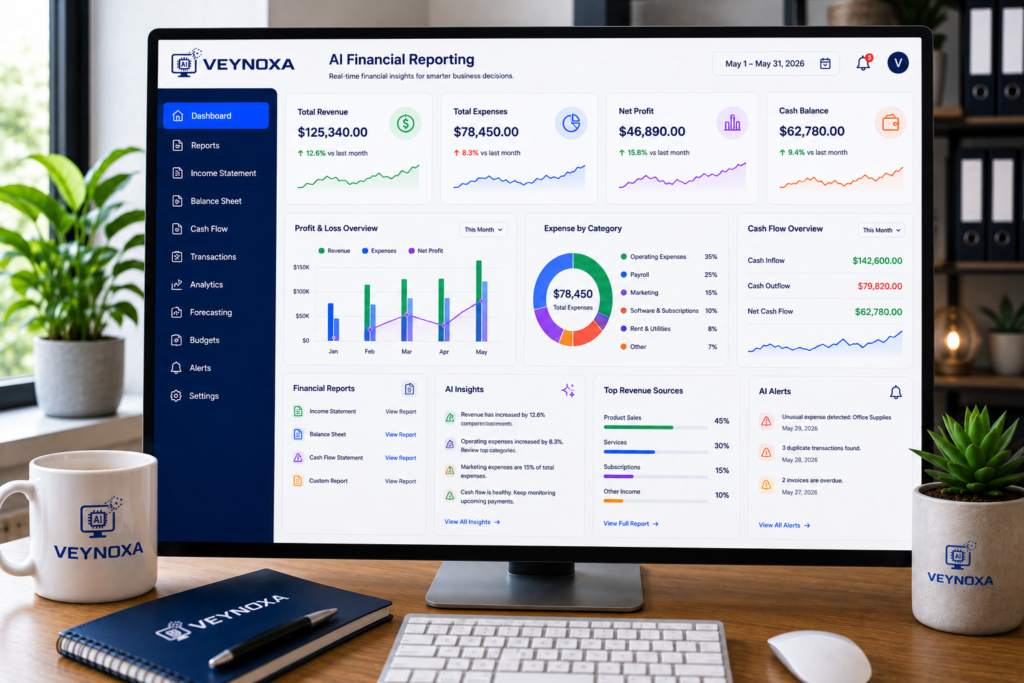
For example, a management dashboard may show:
- Revenue performance
- Expense trends
- Profitability
- Cash flow
- Outstanding payments
- Financial forecasts
These simplified reports can help managers understand important financial changes without manually reviewing large amounts of raw data.
Comparison Table
| Traditional Financial Reporting | AI Financial Reporting |
|---|---|
| Manual data collection | Automated data analysis |
| Spreadsheet-heavy processes | Automated reporting workflows |
| Periodic financial reports | Continuous financial insights |
| Manual calculations | Automated calculations |
| Manual trend analysis | AI-powered trend detection |
| Limited transaction monitoring | Automated anomaly detection |
| Historical reporting | Historical and predictive insights |
| Slower financial decisions | Faster data-driven decisions |
Best Practices
To maximize the value of AI financial reporting:
- Keep financial information accurate and updated.
- Connect reliable financial data sources.
- Review AI-generated reports regularly.
- Verify unusual transactions before taking action.
- Compare current results with historical performance.
- Monitor important financial indicators.
- Review financial forecasts regularly.
- Combine AI insights with professional financial expertise.
- Protect sensitive financial information.
- Maintain appropriate human oversight.
Common Mistakes to Avoid
Avoid these common AI financial reporting mistakes:
- Using inaccurate financial information.
- Relying entirely on automated reports.
- Ignoring unusual transactions.
- Failing to review financial trends.
- Treating AI forecasts as guaranteed outcomes.
- Connecting unreliable financial data sources.
- Ignoring data security.
- Making major financial decisions without human review.
- Focusing only on revenue while ignoring expenses and profitability.
Frequently Asked Questions
What is AI financial reporting?
AI financial reporting uses artificial intelligence to collect, analyze, organize, and interpret financial information to help businesses understand financial performance.
Can small businesses use AI financial reporting?
Yes. Small businesses can use AI-powered financial tools to automate reporting, monitor financial performance, identify trends, and reduce manual administrative work.
How does AI improve financial reporting?
AI can automate data analysis, identify unusual transactions, detect financial trends, generate reports, and provide financial insights more quickly than many traditional manual processes.
Can AI detect financial errors?
AI can identify potential inconsistencies, duplicate transactions, unusual amounts, and other patterns that may indicate errors. Human review is still important before correcting financial records.
Can AI help with financial forecasting?
Yes. AI can analyze historical financial information and current business trends to estimate future revenue, expenses, profitability, and cash flow.
Does AI replace accountants?
No. AI supports accountants and business owners by automating analysis and reporting tasks. Humans remain responsible for reviewing financial information, applying professional judgment, and making important financial decisions.
Is AI financial reporting accurate?
AI financial reporting can improve consistency and reduce certain types of manual errors, but its accuracy depends on the quality of the financial information being analyzed and the system being used.
What are the benefits of AI financial reporting?
Businesses can benefit from faster reporting, improved financial visibility, reduced administrative work, better trend detection, improved forecasting, and more informed business decisions.
Conclusion
AI financial reporting gives small businesses a faster and more efficient way to understand their financial performance. By analyzing revenue, expenses, transactions, profitability, cash flow, and other financial information, AI can automate reporting and provide useful insights.
Businesses can use AI to identify financial trends, detect unusual transactions, improve forecasting, reduce administrative work, and support better business decisions.
As AI-powered financial technology continues to evolve throughout 2026, small businesses that combine automated financial reporting with accurate data and human financial expertise can improve financial visibility, respond to changes faster, and build a stronger foundation for sustainable growth.