
Introduction
Tax management is an important financial responsibility for every small business. Businesses need to keep accurate financial records, organize expenses, monitor income, track tax-related transactions, and prepare the information required for tax reporting.
Traditional tax management can involve significant manual work. Business owners may need to collect receipts, categorize expenses, review financial records, calculate tax-related amounts, and prepare documents for accountants or tax professionals.
As transaction volumes increase, managing these tasks manually can become time-consuming and may increase the risk of missing important information.
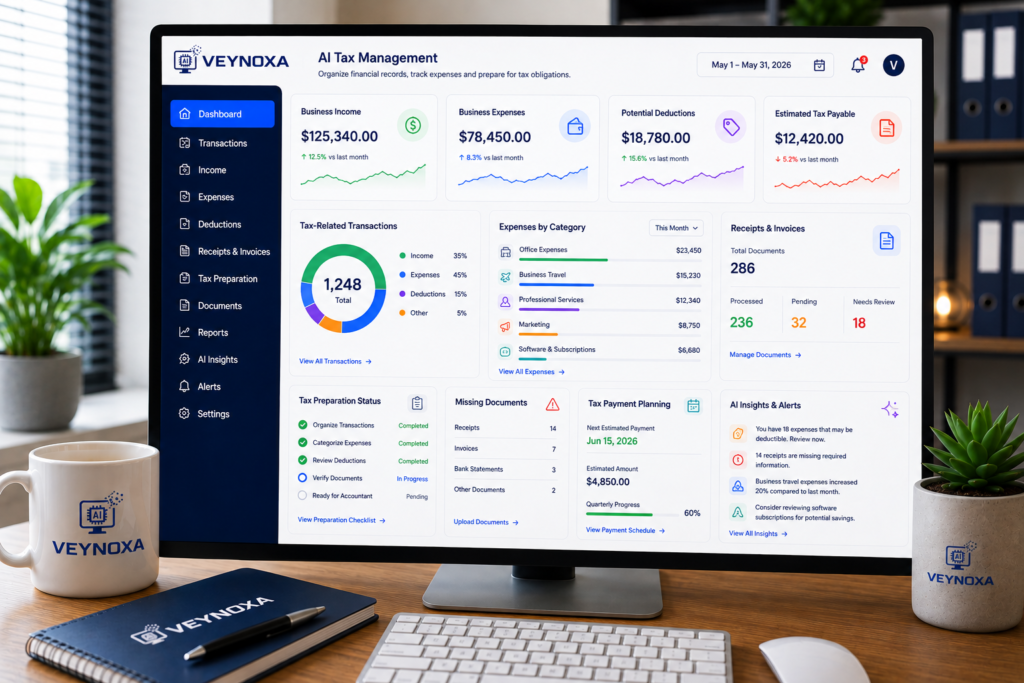
Artificial intelligence (AI) is transforming tax management by analyzing financial records, categorizing transactions, identifying potentially deductible expenses, organizing tax information, and helping businesses prepare more efficiently for tax reporting.
Instead of waiting until tax deadlines approach, businesses can use AI throughout the year to maintain better-organized financial information and improve tax preparation processes.
In this guide, you’ll learn how AI tax management helps small businesses organize financial data, reduce administrative work, identify potential tax deductions, improve accuracy, and prepare more efficiently for tax obligations in 2026.
What Is AI Tax Management?
AI tax management uses artificial intelligence, machine learning, and automated financial analysis to help businesses organize and analyze information relevant to their tax obligations.
AI can analyze financial information such as:
- Business income
- Operating expenses
- Invoices
- Receipts
- Payroll information
- Supplier payments
- Business transactions
- Tax-related expenses
- Financial reports
- Historical financial records
AI can organize this information and identify patterns that may require further review.
AI does not replace tax professionals or make final tax decisions. Instead, it can automate repetitive tasks and provide organized financial information that helps business owners and professionals work more efficiently.
Why Tax Management Matters for Small Businesses
Effective tax management helps businesses maintain accurate financial records and prepare for tax obligations throughout the year.
Poor tax management can result in:
- Missing financial documents
- Incorrect expense categorization
- Missed potential deductions
- Last-minute preparation
- Administrative delays
- Inaccurate financial information
- Increased accounting workload
- Difficulty planning for tax payments
Maintaining organized financial information makes it easier for businesses to understand their tax position and prepare the necessary documentation.
AI can support this process by continuously analyzing financial data instead of relying entirely on manual reviews.
1. Organizing Tax-Related Transactions
One of the most useful applications of AI tax management is organizing financial transactions.
AI can analyze transaction descriptions, amounts, dates, and other information to help categorize transactions into appropriate financial groups.
For example, transactions may relate to:
- Office expenses
- Business travel
- Software
- Marketing
- Professional services
- Equipment
- Utilities
- Inventory
- Employee expenses
Organized transactions make it easier to identify information that may be relevant during tax preparation.
2. Identifying Potentially Deductible Expenses
Businesses may have many expenses that could potentially qualify for tax deductions depending on applicable tax rules.
AI can analyze expense records and identify transactions that may deserve additional review.
For example, AI may flag:
- Business software expenses
- Professional services
- Advertising costs
- Business travel
- Office expenses
- Equipment purchases
- Business-related subscriptions
AI should not determine whether an expense is legally deductible on its own. Instead, flagged expenses should be reviewed according to the applicable tax rules and, when necessary, by a qualified tax professional.
3. Automating Receipt and Document Processing
Small businesses often accumulate large numbers of receipts, invoices, and other financial documents.
AI can extract information from these documents, including:
- Vendor names
- Transaction dates
- Amounts
- Tax amounts
- Invoice numbers
- Expense categories
This information can then be organized for easier financial review.
Automated document processing reduces manual data entry and helps businesses maintain better records throughout the year.
4. Improving Expense Categorization
Accurate expense categorization is important for financial reporting and tax preparation.
AI can analyze historical transactions and identify patterns in how expenses are normally categorized.
If a transaction appears inconsistent with previous records, AI can flag it for review.
This can help businesses reduce categorization errors and maintain more consistent financial records.
5. Monitoring Tax-Related Financial Data
AI can continuously monitor financial transactions and identify information that may be relevant to tax preparation.
Businesses can use AI to track:
- Business income
- Expenses
- Payments
- Receipts
- Invoices
- Payroll-related information
- Tax-related transactions
Continuous monitoring means businesses do not have to wait until the end of the financial year to organize important information.
6. Supporting Tax Preparation
Tax preparation often requires financial information to be collected from multiple sources.
AI can help organize relevant financial records and make them easier to review.
Businesses can use AI to prepare structured information for:
- Accountants
- Tax professionals
- Internal financial teams
- Tax preparation workflows
This can reduce the time required to collect and organize financial information before tax deadlines.
7. Identifying Missing Financial Information
Missing receipts, invoices, or transaction records can make financial preparation more difficult.
AI can compare financial transactions with available documentation and identify potential gaps.
For example, a system may flag a transaction that appears in a bank account but does not have a corresponding receipt or invoice.
Early identification gives businesses more time to locate missing documents or investigate the transaction.
8. Reducing Manual Administrative Work
Tax-related administration can consume significant time for small business owners.
AI can automate repetitive activities such as:
- Sorting transactions
- Extracting receipt information
- Categorizing expenses
- Organizing documents
- Identifying missing information
- Preparing financial summaries
Reducing repetitive work allows business owners and accountants to focus on reviewing information and making important financial decisions.
9. Supporting Tax Payment Planning
Businesses may need to prepare for upcoming tax payments.
AI can analyze historical financial information, current income, expenses, and other relevant data to provide better visibility into potential future tax-related obligations.
This can help businesses plan their cash reserves and avoid unexpected financial pressure.
Tax estimates should always be reviewed according to applicable tax rules and professional advice.
10. Improving Financial Accuracy
Accurate financial information is essential for effective tax management.
AI can compare financial records and identify potential inconsistencies such as:
- Duplicate transactions
- Missing transactions
- Unusual expenses
- Incorrect amounts
- Inconsistent categories
- Missing documents
Businesses can then review flagged items before financial information is used for tax preparation.
11. Supporting Better Financial Planning
Tax obligations can affect business cash flow and financial planning.
Organized tax information helps business owners understand potential financial commitments and prepare accordingly.
AI-generated insights can support decisions involving:
- Cash reserves
- Business expenses
- Investments
- Equipment purchases
- Hiring
- Business expansion
The goal is not to let AI make tax decisions independently, but to provide better financial information for human decision-making.
12. Improving Year-Round Tax Management
One of the biggest advantages of AI tax management is the ability to work throughout the year.
Instead of organizing everything immediately before a tax deadline, businesses can continuously:
- Record transactions
- Organize documents
- Categorize expenses
- Review financial information
- Identify missing records
- Monitor potential tax-related expenses
This creates a more consistent tax management process and can reduce last-minute administrative pressure.
Comparison Table
| Traditional Tax Management | AI Tax Management |
|---|---|
| Manual transaction organization | Automated transaction analysis |
| Manual receipt processing | Automated document extraction |
| Periodic expense reviews | Continuous expense monitoring |
| Manual expense categorization | AI-assisted categorization |
| Manual document organization | Automated document organization |
| Last-minute preparation | Year-round tax management |
| Manual error identification | Automated anomaly detection |
| Time-consuming administration | Faster financial workflows |
Best Practices
To maximize AI tax management:
- Keep financial records accurate and updated.
- Store receipts and invoices securely.
- Review AI-generated expense categories.
- Check potentially deductible expenses carefully.
- Investigate missing financial documents.
- Monitor tax-related transactions throughout the year.
- Keep personal and business expenses properly separated.
- Review financial information before submitting tax documents.
- Maintain appropriate financial records.
- Work with a qualified tax professional when necessary.
Common Mistakes to Avoid
Avoid these common AI tax management mistakes:
- Assuming every AI-identified expense is tax deductible.
- Automatically accepting AI expense classifications.
- Failing to keep receipts and supporting documents.
- Waiting until the tax deadline to organize records.
- Ignoring unusual financial transactions.
- Mixing personal and business expenses.
- Depending entirely on AI for tax decisions.
- Failing to review financial information.
- Ignoring applicable tax rules.
- Treating AI-generated estimates as final tax calculations.
Frequently Asked Questions
What is AI tax management?
AI tax management uses artificial intelligence to organize, analyze, and monitor financial information that can support business tax preparation and tax-related financial management.
Can small businesses use AI for tax management?
Yes. Small businesses can use AI-powered financial tools to organize transactions, process receipts, categorize expenses, identify missing information, and prepare financial records for review.
Can AI identify tax deductions?
AI can identify expenses that may deserve additional review as potentially deductible. However, whether an expense qualifies as a deduction depends on applicable tax rules and should be confirmed by a qualified professional when necessary.
Can AI process receipts?
Yes. AI can extract information such as vendor names, dates, amounts, invoice numbers, and expense categories from many types of financial documents.
Can AI reduce tax preparation time?
AI can reduce the time required for repetitive tasks such as transaction categorization, document processing, and financial record organization.
Does AI replace tax professionals?
No. AI supports tax professionals and business owners by automating administrative tasks and organizing financial information. Human professionals remain important for interpreting tax rules and making tax decisions.
Can AI help businesses prepare for tax payments?
AI can provide better visibility into financial information and potential future obligations, helping businesses plan their cash reserves. Tax calculations and payment requirements should be verified according to applicable rules.
What are the benefits of AI tax management?
Businesses can benefit from better financial organization, reduced administrative work, improved record accuracy, faster document processing, better visibility into tax-related expenses, and more efficient tax preparation.
Conclusion
AI tax management gives small businesses a more efficient way to organize and analyze financial information throughout the year. By automating transaction categorization, receipt processing, document organization, expense monitoring, and financial data analysis, AI can reduce administrative work and improve financial visibility.
Businesses can also use AI to identify potentially relevant expenses, detect missing information, and prepare more organized financial records for accountants and tax professionals.
AI should not replace professional tax advice or final tax decisions. Instead, it should be used as a supporting technology that helps businesses maintain accurate records and prepare financial information more efficiently.
As AI-powered financial technology continues to evolve throughout 2026, small businesses that adopt intelligent tax management can save time, improve financial organization, reduce administrative pressure, and build stronger year-round financial processes.