
Introduction
Business compliance is essential for every small business. Companies must follow financial regulations, data protection laws, tax requirements, employment policies, and industry standards to avoid penalties and maintain customer trust.
Artificial intelligence (AI) is making compliance management easier by automating documentation, monitoring regulatory changes, identifying potential compliance risks, and improving reporting accuracy. Instead of relying entirely on manual reviews, businesses can use AI to monitor compliance continuously.
In this guide, you’ll learn how AI improves business compliance for small businesses and why AI-powered compliance solutions are becoming increasingly valuable in 2026.
What Is AI Business Compliance?
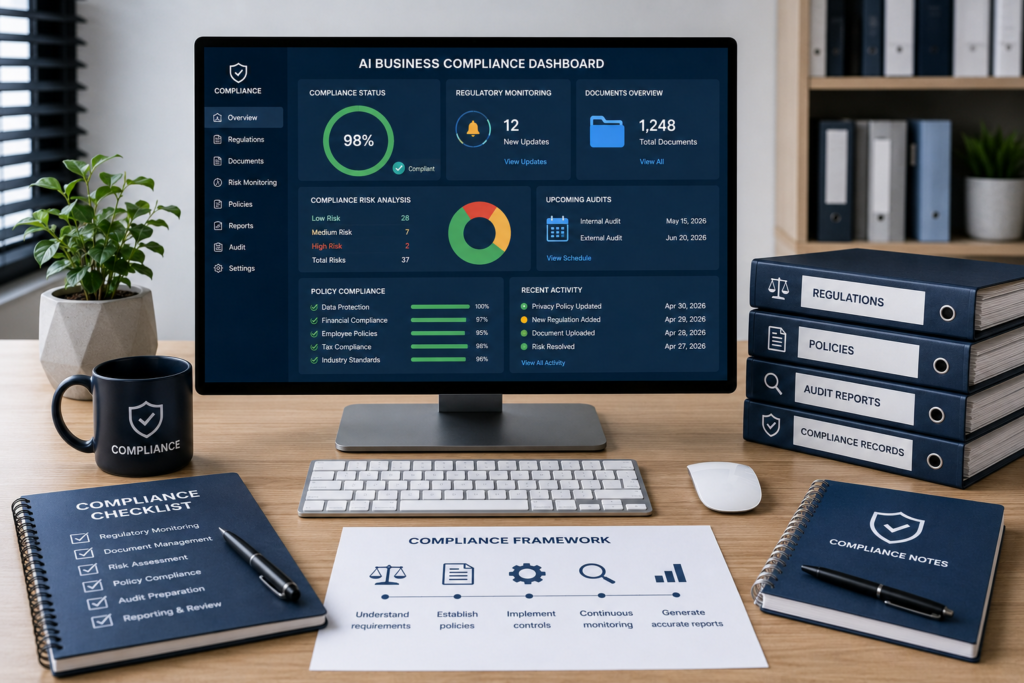
AI business compliance uses artificial intelligence, machine learning, and automation to help businesses follow legal, financial, and operational regulations.
AI assists with:
- Regulatory monitoring
- Document management
- Policy compliance
- Risk detection
- Audit preparation
- Data protection
- Compliance reporting
Unlike traditional compliance systems, AI continuously analyzes business activities and identifies possible compliance issues before they become serious problems.
Why Compliance Matters
Without proper compliance management, businesses may experience:
- Financial penalties
- Legal disputes
- Data breaches
- Customer trust issues
- Operational disruptions
- Failed audits
AI helps reduce these risks by improving monitoring and automating repetitive compliance tasks.
1. Monitoring Regulatory Changes
AI tracks changes in regulations and industry requirements.
Businesses receive timely notifications whenever new compliance rules affect their operations.
2. Automating Documentation
AI automatically organizes contracts, invoices, employee records, tax documents, and compliance reports.
This reduces paperwork while improving document accuracy.
AI-powered workflow automation also helps businesses reduce repetitive administrative tasks while keeping business documentation organized.
3. Improving Data Protection
AI monitors sensitive business information and detects unusual activities that could indicate security or privacy risks.
This helps businesses strengthen customer data protection.
4. Preparing for Audits
AI keeps compliance records organized and generates reports that simplify internal and external audits.
Businesses spend less time gathering documentation.
5. Identifying Compliance Risks
AI analyzes business activities to identify:
- Missing documentation
- Policy violations
- Financial inconsistencies
- Operational risks
Early detection helps businesses resolve problems before they escalate.
Ai business risk management helps organizations detect operational and financial risks before they affect compliance.
6. Improving Reporting Accuracy
AI automatically generates compliance reports using real-time business data.
This reduces human errors and improves reporting consistency.
Business analytics provide valuable insights that improve reporting accuracy and support better compliance decisions.
7. Supporting Business Growth
As businesses expand, compliance requirements become more complex.
AI allows companies to manage growing regulatory obligations without significantly increasing administrative work.
AI also improves business reporting by automatically generating detailed reports for compliance and performance monitoring.
Comparison Table
| Traditional Compliance | AI Compliance |
|---|---|
| Manual monitoring | Continuous monitoring |
| Manual reporting | Automated reporting |
| Reactive compliance | Proactive compliance |
| Higher error rates | Greater accuracy |
| Paper-based records | Digital documentation |
| Time-consuming audits | Faster audit preparation |
Best Practices
To maximize AI business compliance:
- Keep business records updated.
- Review compliance reports regularly.
- Monitor regulatory changes continuously.
- Integrate AI with existing business systems.
- Train employees on compliance procedures.
Common Mistakes to Avoid
Avoid these mistakes:
- Ignoring regulatory updates
- Using incomplete documentation
- Delaying compliance reviews
- Depending entirely on manual monitoring
- Failing to review AI-generated reports
Frequently Asked Questions
What is AI business compliance?
AI business compliance uses artificial intelligence to automate compliance monitoring, documentation, reporting, and risk detection.
Can small businesses use AI compliance software?
Yes. Many cloud-based compliance solutions are affordable and designed specifically for small businesses.
Does AI replace compliance officers?
No. AI automates repetitive compliance tasks while business owners and compliance professionals continue making strategic decisions.
What are the biggest benefits of AI business compliance?
Businesses benefit from improved reporting, reduced legal risks, better documentation, stronger data protection, and greater operational efficiency.
Conclusion
AI business compliance helps small businesses simplify regulatory requirements, improve documentation, reduce compliance risks, and prepare for audits more efficiently. By combining intelligent automation with real-time monitoring, AI enables businesses to remain compliant while focusing on growth.
Businesses that adopt AI-powered compliance solutions today will reduce administrative workload, improve operational reliability, and strengthen long-term business success throughout 2026.