
Introduction
Every small business faces risks that can affect profitability, operations, and long-term growth. Financial uncertainty, supply chain disruptions, cybersecurity threats, and unexpected market changes make risk management more important than ever.
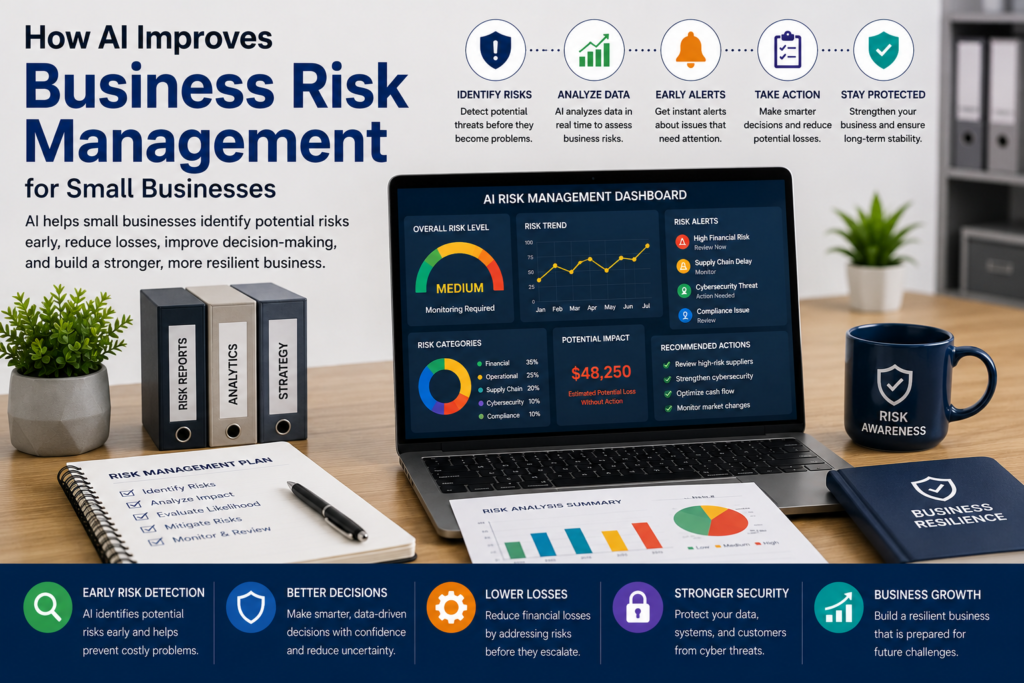
Artificial intelligence (AI) helps businesses identify potential risks before they become serious problems. By analyzing large amounts of business data in real time, AI enables companies to make faster decisions, reduce uncertainty, and improve overall business resilience.
In this guide, you’ll learn how AI improves business risk management for small businesses and why AI-powered risk analysis is becoming essential in 2026.
What Is AI Business Risk Management?
AI business risk management uses artificial intelligence, machine learning, and predictive analytics to identify, assess, and monitor potential business risks.
AI helps businesses analyze:
- Financial risks
- Operational risks
- Supply chain risks
- Customer behavior
- Market trends
- Cybersecurity threats
- Compliance risks
Unlike traditional risk management, AI continuously learns from business data and updates risk assessments automatically.
Why Risk Management Matters
Without effective risk management, businesses often experience:
- Unexpected financial losses
- Poor business decisions
- Supply chain disruptions
- Cybersecurity incidents
- Regulatory issues
- Reduced customer trust
AI helps minimize these risks through continuous monitoring and intelligent analysis.
1. Identifying Financial Risks
AI analyzes financial data to detect unusual spending patterns, declining revenue, or cash flow issues before they become major problems.
This allows businesses to respond quickly and protect profitability.
Businesses can also improve budgeting decisions by combining AI risk analysis with intelligent financial planning.
2. Improving Supply Chain Risk Monitoring
AI monitors supplier performance, inventory availability, and delivery schedules.
Businesses can identify disruptions early and reduce operational delays.
Monitoring supplier performance together with AI-powered supply chain management further reduces operational risk.
3. Detecting Market Changes
AI tracks customer behavior, competitor activity, and industry trends.
Business owners receive early warnings when market conditions begin to change.
4. Strengthening Cybersecurity
AI identifies unusual network activity, suspicious login attempts, and potential cyber threats.
Businesses improve data security while reducing the likelihood of cyberattacks.
5. Supporting Better Decision-Making
AI combines historical data with predictive analytics to evaluate possible business outcomes before important decisions are made.
This reduces uncertainty and improves strategic planning.
Business analytics provide additional insights that help companies evaluate risks using real-time performance data.
6. Monitoring Operational Risks
AI continuously evaluates business operations to identify inefficiencies, workflow delays, and performance issues.
Early detection prevents larger operational problems.
AI workflow automation also helps reduce operational bottlenecks that increase business risk.
7. Supporting Long-Term Business Growth
Businesses that manage risks effectively are better prepared for growth.
AI allows companies to expand confidently while maintaining operational stability.
Comparison Table
| Traditional Risk Management | AI Risk Management |
|---|---|
| Manual monitoring | Continuous monitoring |
| Reactive decisions | Predictive analysis |
| Limited visibility | Real-time insights |
| Manual reporting | Automated reporting |
| Slower responses | Faster risk detection |
| Periodic reviews | Continuous learning |
Best Practices
To maximize AI risk management:
- Maintain accurate business data.
- Monitor AI reports regularly.
- Review financial performance consistently.
- Integrate AI with existing business systems.
- Update risk management strategies periodically.
Common Mistakes to Avoid
Avoid these mistakes:
- Ignoring AI recommendations
- Using incomplete business data
- Delaying risk assessments
- Focusing only on financial risks
- Failing to monitor business performance
Frequently Asked Questions
What is AI business risk management?
AI business risk management uses artificial intelligence to identify, evaluate, and reduce business risks through continuous monitoring and predictive analytics.
Can small businesses use AI risk management?
Yes. Many affordable AI platforms provide risk analysis tools designed specifically for small businesses.
Does AI eliminate business risks?
No. AI helps businesses identify and reduce risks, but business owners still make the final strategic decisions.
What are the biggest benefits of AI risk management?
Businesses benefit from better forecasting, faster decision-making, improved financial stability, stronger cybersecurity, and greater operational resilience.
Conclusion
AI business risk management enables small businesses to identify potential threats before they become costly problems. By combining predictive analytics, continuous monitoring, and intelligent automation, AI helps businesses make smarter decisions while improving long-term stability.
Companies that adopt AI-powered risk management today will strengthen their operations, reduce uncertainty, and remain competitive throughout 2026.