
Introduction
Monitoring business performance is essential for every small business that wants to grow sustainably. Without accurate performance data, business owners often struggle to identify problems, measure progress, and make informed decisions.
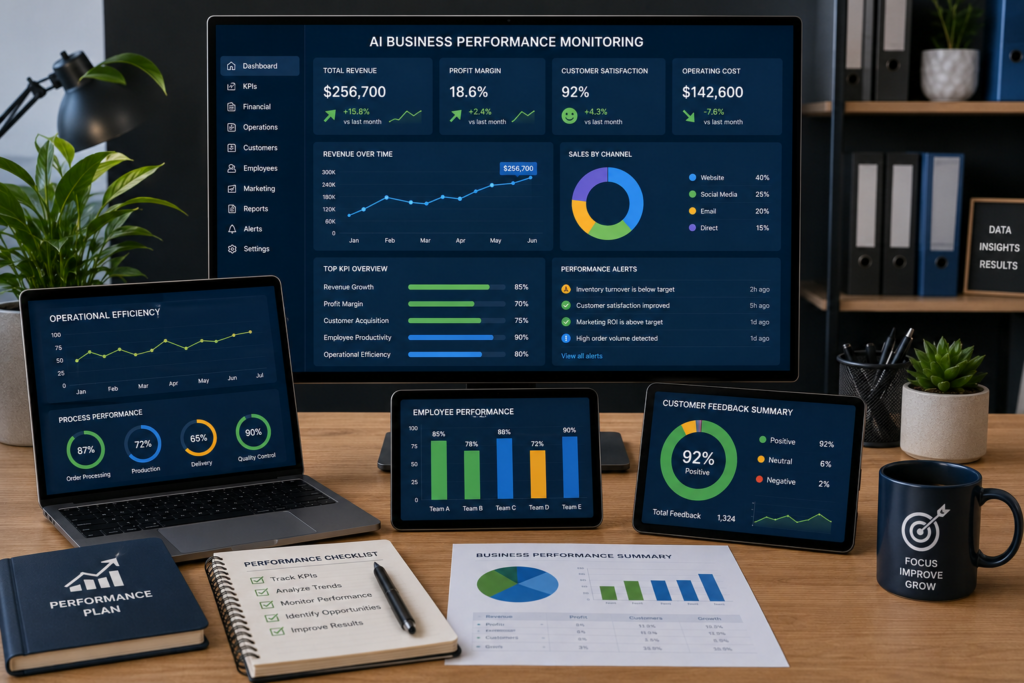
Artificial intelligence (AI) is transforming business performance monitoring by analyzing large amounts of operational data in real time. Instead of relying on manual reports or outdated spreadsheets, AI provides instant insights that help businesses improve efficiency, reduce costs, and achieve better results.
In this guide, you’ll learn how AI improves business performance monitoring for small businesses and why AI-powered performance tracking is becoming increasingly important in 2026.
What Is AI Business Performance Monitoring?
AI business performance monitoring uses artificial intelligence, machine learning, and predictive analytics to continuously measure how a business performs across different areas.
AI helps businesses monitor:
- Sales performance
- Financial performance
- Employee productivity
- Customer satisfaction
- Marketing performance
- Inventory performance
- Operational efficiency
Unlike traditional reporting methods, AI automatically detects trends, anomalies, and opportunities for improvement.
Why Performance Monitoring Matters
Without proper monitoring, businesses often experience:
- Slow decision-making
- Hidden operational problems
- Lower productivity
- Poor financial visibility
- Missed growth opportunities
- Inefficient resource allocation
AI helps businesses identify these issues before they affect long-term performance.
1. Tracking Key Performance Indicators (KPIs)
AI continuously monitors business KPIs in real time.
Business owners can instantly measure:
- Revenue growth
- Profit margins
- Customer acquisition
- Employee performance
- Sales targets
Real-time KPI tracking supports faster business decisions.
Business analytics help organizations interpret KPI data more effectively and identify long-term performance trends.
2. Improving Financial Visibility
AI analyzes financial data to identify spending trends, revenue changes, and profit opportunities.
Businesses gain a clearer understanding of their financial health.
Financial planning becomes more accurate when AI continuously monitors business performance and spending patterns.
3. Monitoring Operational Efficiency
AI detects workflow delays, production bottlenecks, and inefficient business processes.
This allows companies to improve daily operations and increase productivity.
AI workflow automation further improves operational efficiency by reducing repetitive manual tasks across business processes.
4. Measuring Employee Performance
AI helps managers evaluate employee productivity using performance metrics instead of manual observations.
Businesses can identify training opportunities and improve workforce efficiency.
5. Improving Customer Satisfaction
AI monitors customer interactions, feedback, reviews, and support requests.
Business owners receive valuable insights into customer experience.
6. Supporting Better Decision-Making
AI combines historical performance with predictive analytics to recommend improvements before problems become critical.
Business leaders make more informed strategic decisions.
Continuous performance monitoring also supports business risk management by identifying operational problems before they become critical.
7. Supporting Long-Term Business Growth
As businesses grow, tracking performance manually becomes increasingly difficult.
AI automates business monitoring while providing accurate insights that support sustainable growth.
Comparison Table
| Traditional Performance Monitoring | AI Performance Monitoring |
|---|---|
| Manual reports | Real-time monitoring |
| Periodic reviews | Continuous analysis |
| Delayed insights | Instant recommendations |
| Limited visibility | Complete business overview |
| Manual KPI tracking | Automated KPI monitoring |
| Reactive decisions | Predictive decision support |
Best Practices
To maximize AI performance monitoring:
- Define clear KPIs.
- Maintain accurate business data.
- Review AI reports regularly.
- Monitor trends over time.
- Integrate AI with existing business software.
Common Mistakes to Avoid
Avoid these mistakes:
- Tracking too many KPIs
- Ignoring AI recommendations
- Using outdated business data
- Failing to review reports regularly
- Measuring only financial performance
Frequently Asked Questions
What is AI business performance monitoring?
AI business performance monitoring uses artificial intelligence to measure business performance, track KPIs, and generate real-time insights.
Can small businesses benefit from AI performance monitoring?
Yes. AI helps small businesses monitor operations, improve productivity, and make better business decisions using real-time data.
Does AI replace business managers?
No. AI provides insights and recommendations, while managers continue making strategic business decisions.
What are the biggest benefits of AI performance monitoring?
Businesses benefit from faster decision-making, improved productivity, better financial visibility, stronger operational efficiency, and sustainable growth.
Conclusion
AI business performance monitoring enables small businesses to track KPIs, improve operational efficiency, monitor financial performance, and make smarter business decisions. By combining predictive analytics with real-time monitoring, AI provides business owners with the information they need to grow confidently.
Companies that adopt AI-powered performance monitoring today will strengthen their operations, improve decision-making, and remain competitive throughout 2026.