
Introduction
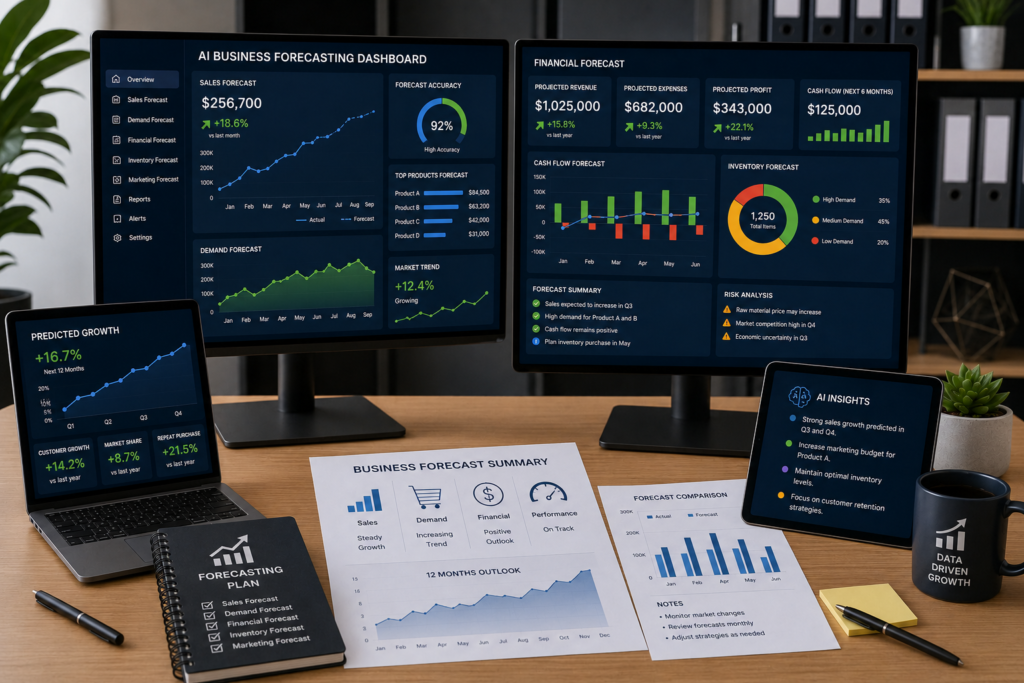
Business forecasting is essential for making informed decisions about future growth. Small businesses must predict sales, customer demand, expenses, and market changes to remain competitive. However, traditional forecasting methods often rely on historical data alone and may not accurately reflect rapidly changing market conditions.
Artificial intelligence (AI) improves business forecasting by analyzing real-time data, recognizing patterns, and generating more accurate predictions. Instead of relying on guesswork, businesses can use AI to anticipate future trends and make proactive decisions.
In this guide, you’ll learn how AI improves business forecasting for small businesses and why AI-powered forecasting is becoming an essential business tool in 2026.
What Is AI Business Forecasting?
AI business forecasting uses artificial intelligence, machine learning, and predictive analytics to estimate future business performance.
AI helps forecast:
- Sales
- Customer demand
- Cash flow
- Inventory needs
- Marketing performance
- Business growth
- Financial performance
Unlike traditional forecasting methods, AI continuously updates predictions using new business data.
Why Business Forecasting Matters
Without accurate forecasting, businesses often experience:
- Poor financial planning
- Inventory shortages
- Overstocking
- Unexpected expenses
- Missed sales opportunities
- Slower business growth
AI reduces uncertainty by providing more reliable forecasts.
1. Predicting Sales Trends
AI analyzes historical sales, seasonal patterns, promotions, and customer behavior.
Businesses can better estimate future sales and prepare for changing demand.
Performance monitoring helps businesses compare forecasted sales with actual results and improve future predictions.
2. Forecasting Customer Demand
AI predicts which products or services customers are most likely to purchase.
This helps businesses maintain the right inventory levels.
Accurate demand forecasting also improves inventory management by reducing stock shortages and unnecessary purchases.
3. Improving Cash Flow Forecasting
AI estimates future income and expenses based on business activity.
Owners gain greater visibility into future financial performance.
AI also supports financial planning by helping businesses prepare budgets based on forecasted revenue and expenses.
4. Supporting Inventory Planning
AI recommends purchasing schedules based on forecasted demand.
Businesses reduce waste while avoiding inventory shortages.
5. Improving Marketing Forecasts
AI predicts campaign performance before marketing budgets are spent.
Businesses can invest in the strategies most likely to generate results.
6. Supporting Strategic Planning
Business leaders use AI forecasts to evaluate expansion opportunities, staffing requirements, and investment decisions.
Long-term planning becomes more reliable.
7. Reducing Business Risks
Forecasting helps businesses prepare for changing market conditions before problems arise.
AI provides early warnings that support proactive decision-making.
Learn how AI strengthens business risk management by identifying operational risks before they affect business performance.
Comparison Table
| Traditional Forecasting | AI Business Forecasting |
|---|---|
| Historical estimates | Real-time predictions |
| Manual calculations | Automated forecasting |
| Periodic updates | Continuous learning |
| Lower accuracy | Higher accuracy |
| Limited visibility | Comprehensive insights |
| Reactive planning | Proactive planning |
Best Practices
To maximize AI forecasting:
- Maintain accurate business data.
- Review forecasts regularly.
- Compare predictions with actual results.
- Update forecasting models continuously.
- Integrate forecasting with financial planning.
Common Mistakes to Avoid
Avoid these mistakes:
- Ignoring forecast updates
- Using outdated business data
- Depending only on historical trends
- Failing to monitor forecast accuracy
- Making decisions without reviewing AI insights
Frequently Asked Questions
What is AI business forecasting?
AI business forecasting uses artificial intelligence to predict future business performance using real-time data and predictive analytics.
Can small businesses benefit from AI forecasting?
Yes. AI forecasting helps small businesses improve planning, reduce uncertainty, and make more informed business decisions.
Does AI guarantee accurate forecasts?
No. AI improves forecasting accuracy, but unexpected events can still affect business performance.
What are the biggest benefits of AI forecasting?
Businesses benefit from better planning, improved cash flow management, stronger inventory control, and more confident decision-making.
Conclusion
AI business forecasting enables small businesses to predict future performance with greater accuracy by combining predictive analytics, machine learning, and real-time business data. Better forecasts help companies improve planning, reduce uncertainty, and respond more effectively to changing market conditions.
Businesses that adopt AI-powered forecasting today will strengthen decision-making, optimize operations, and build a more resilient foundation for long-term growth throughout 2026.