
Introduction
Making the right business decisions is essential for long-term success. Small business owners make important decisions every day about pricing, marketing, inventory, hiring, budgeting, and customer service. However, relying only on intuition or outdated information can lead to costly mistakes.
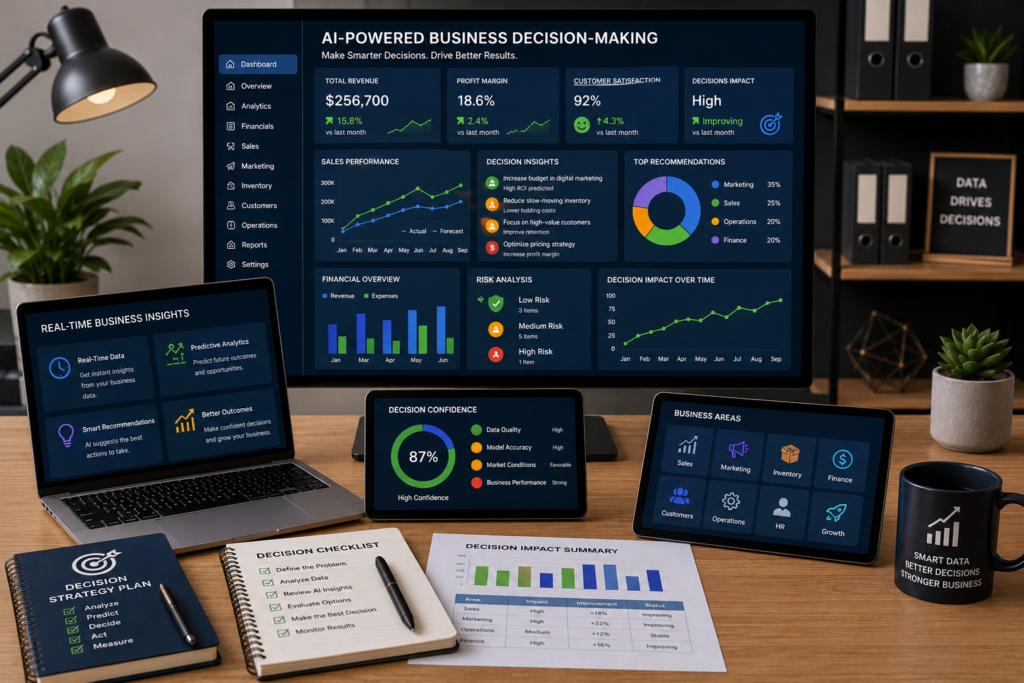
Artificial intelligence (AI) helps businesses make smarter decisions by analyzing real-time data, identifying patterns, and providing actionable recommendations. Instead of spending hours reviewing spreadsheets, business owners can use AI-powered insights to respond quickly to changing market conditions.
In this guide, you’ll learn how AI improves business decision-making for small businesses and why AI-driven decision support is becoming a competitive advantage in 2026.
What Is AI Business Decision-Making?
AI business decision-making uses artificial intelligence, machine learning, and business intelligence tools to analyze data and recommend the best possible actions.
AI supports decisions involving:
- Sales
- Marketing
- Inventory
- Financial planning
- Customer service
- Operations
- Business growth
Unlike traditional decision-making, AI continuously learns from new data and improves recommendations over time.
Why Better Decision-Making Matters
Poor decisions often lead to:
- Financial losses
- Inefficient operations
- Missed business opportunities
- Customer dissatisfaction
- Slow business growth
- Higher operational costs
AI helps reduce uncertainty by providing accurate, data-driven insights.
1. Analyzing Business Data Faster
AI processes large amounts of business data within seconds.
Instead of manually reviewing reports, business owners receive clear insights that support faster decisions.
AI business analytics provides deeper insights into business data, helping owners identify trends and improve decision-making.
2. Improving Financial Decisions
AI evaluates revenue, expenses, and cash flow to identify financial trends.
This helps businesses allocate budgets more effectively.
Better financial planning becomes possible when AI combines real-time financial data with predictive insights.
3. Supporting Inventory Decisions
AI predicts inventory needs using customer demand, seasonal trends, and sales history.
Businesses reduce waste while avoiding stock shortages.
4. Optimizing Marketing Decisions
AI analyzes campaign performance and customer behavior to recommend better marketing strategies.
Businesses invest their budgets more efficiently.
AI inventory management allows businesses to maintain optimal stock levels while reducing unnecessary purchasing costs.
5. Improving Customer Experience
AI analyzes customer feedback, purchasing behavior, and support requests.
Businesses better understand customer needs and improve satisfaction.
6. Reducing Business Risks
AI identifies potential operational and financial risks before they affect business performance.
This supports proactive decision-making.
7. Supporting Long-Term Growth
As businesses expand, decision-making becomes more complex.
AI simplifies strategic planning by providing reliable forecasts and continuous business insights.
AI business forecasting helps organizations make long-term strategic decisions based on accurate predictions and market trends.
Comparison Table
| Traditional Decision-Making | AI Decision-Making |
|---|---|
| Manual analysis | Automated analysis |
| Historical reports | Real-time insights |
| Slower decisions | Faster recommendations |
| Limited visibility | Comprehensive analytics |
| Reactive management | Predictive planning |
| Higher uncertainty | Data-driven decisions |
Best Practices
To maximize AI decision-making:
- Maintain accurate business data.
- Define clear business goals.
- Review AI recommendations regularly.
- Combine AI insights with human expertise.
- Continuously monitor business performance.
Common Mistakes to Avoid
Avoid these mistakes:
- Ignoring AI recommendations
- Using incomplete business data
- Making decisions without reviewing reports
- Depending only on intuition
- Failing to measure decision outcomes
Frequently Asked Questions
What is AI business decision-making?
AI business decision-making uses artificial intelligence to analyze business data and recommend better strategic decisions.
Can small businesses use AI decision-making tools?
Yes. Many AI platforms are affordable and designed specifically for small businesses.
Does AI replace business owners?
No. AI provides recommendations, while business owners continue making the final decisions.
What are the biggest benefits of AI decision-making?
Businesses benefit from faster analysis, improved planning, lower risks, better resource allocation, and stronger long-term growth.
Conclusion
AI business decision-making helps small businesses transform data into practical insights that improve financial planning, marketing, operations, inventory management, and customer service. By combining predictive analytics with real-time business intelligence, AI enables business owners to make smarter and faster decisions.
Businesses that adopt AI-powered decision-making today will improve efficiency, reduce uncertainty, and build a stronger competitive advantage throughout 2026.