
Introduction
Business intelligence (BI) helps organizations transform raw business data into meaningful insights that support better decision-making. Small businesses generate valuable data every day through sales, marketing, customer interactions, inventory management, and financial operations. However, without proper analysis, much of this information remains underused.
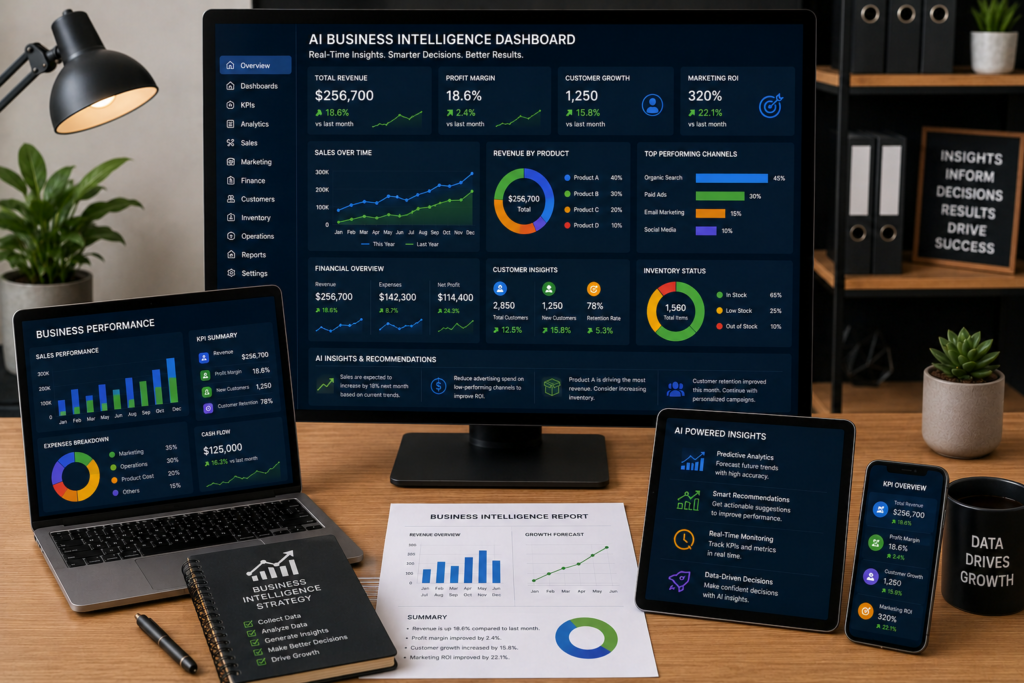
Artificial intelligence (AI) enhances business intelligence by automatically collecting, organizing, analyzing, and visualizing business data. Instead of manually reviewing reports, business owners receive real-time dashboards, predictive insights, and actionable recommendations that improve operational performance.
In this guide, you’ll learn how AI improves business intelligence for small businesses and why AI-powered BI solutions are becoming essential for business success in 2026.
What Is AI Business Intelligence?
AI business intelligence combines artificial intelligence, machine learning, and business analytics to help organizations understand business performance and support strategic decision-making.
AI business intelligence can analyze:
- Sales performance
- Financial reports
- Customer behavior
- Marketing campaigns
- Inventory performance
- Employee productivity
- Operational efficiency
Unlike traditional BI systems, AI continuously learns from new business data and improves reporting accuracy over time.
Why Business Intelligence Matters
Without effective business intelligence, businesses often experience:
- Slow decision-making
- Poor data visibility
- Missed growth opportunities
- Inefficient operations
- Higher operational costs
- Limited performance insights
AI helps solve these challenges through intelligent data analysis.
1. Centralizing Business Data
AI collects information from multiple business systems and organizes it into a single dashboard.
Owners gain a complete overview of business performance.
Businesses can generate deeper insights by combining centralized data with advanced business analytics.
2. Monitoring KPIs in Real Time
AI continuously tracks important business metrics.
Continuous KPI tracking also improves business performance monitoring by helping owners identify problems earlier.
Examples include:
- Revenue
- Profit margins
- Customer acquisition
- Sales growth
- Marketing ROI
3. Identifying Business Trends
AI analyzes historical and real-time data to detect changing customer behavior and market trends.
Businesses can react before competitors.
4. Improving Financial Analysis
AI automatically generates financial reports and identifies spending patterns, revenue opportunities, and cost-saving recommendations.
These financial insights support better budgeting and long-term financial planning.
5. Supporting Strategic Planning
Business leaders use AI-generated insights to make more informed long-term decisions.
Planning becomes more accurate and data-driven.
Businesses also rely on AI business forecasting to improve long-term strategic planning and prepare for future market changes.
6. Increasing Operational Efficiency
AI identifies workflow bottlenecks, inefficient processes, and productivity issues.
Businesses improve operations faster.
7. Driving Business Growth
Better business intelligence leads to smarter investments, improved customer experiences, and sustainable business growth.
Comparison Table
| Traditional Business Intelligence | AI Business Intelligence |
|---|---|
| Manual reporting | Automated reporting |
| Static dashboards | Real-time dashboards |
| Historical analysis | Predictive analytics |
| Periodic updates | Continuous monitoring |
| Slower insights | Instant recommendations |
| Limited automation | Intelligent automation |
Best Practices
To maximize AI business intelligence:
- Keep business data accurate.
- Define meaningful KPIs.
- Review dashboards regularly.
- Integrate multiple business systems.
- Monitor AI recommendations continuously.
Common Mistakes to Avoid
Avoid these mistakes:
- Using incomplete business data
- Ignoring dashboard insights
- Tracking too many KPIs
- Failing to update business information
- Depending only on manual reports
Frequently Asked Questions
What is AI business intelligence?
AI business intelligence uses artificial intelligence to analyze business data, generate reports, and support better business decisions.
Can small businesses use AI business intelligence?
Yes. Many affordable AI-powered BI platforms are designed specifically for small businesses.
Does AI replace business analysts?
No. AI automates data analysis while business owners and analysts continue making strategic decisions.
What are the biggest benefits of AI business intelligence?
Businesses benefit from better visibility, faster reporting, improved forecasting, stronger decision-making, and sustainable growth.
Conclusion
AI business intelligence enables small businesses to transform raw data into meaningful insights that improve financial planning, operational efficiency, marketing performance, and strategic decision-making. By combining machine learning, predictive analytics, and real-time dashboards, AI helps organizations make smarter decisions with greater confidence.
Businesses that invest in AI-powered business intelligence today will strengthen their competitive advantage and build a more data-driven future throughout 2026.