
Introduction
Working capital is one of the most important indicators of a small business’s financial health. A business may have strong sales and growing revenue but still experience financial pressure if too much money is tied up in inventory, unpaid invoices, or short-term obligations.
Traditional working capital management often requires business owners to manually review accounts receivable, accounts payable, inventory levels, cash balances, and short-term expenses. As a business grows, monitoring all these financial areas can become increasingly difficult.
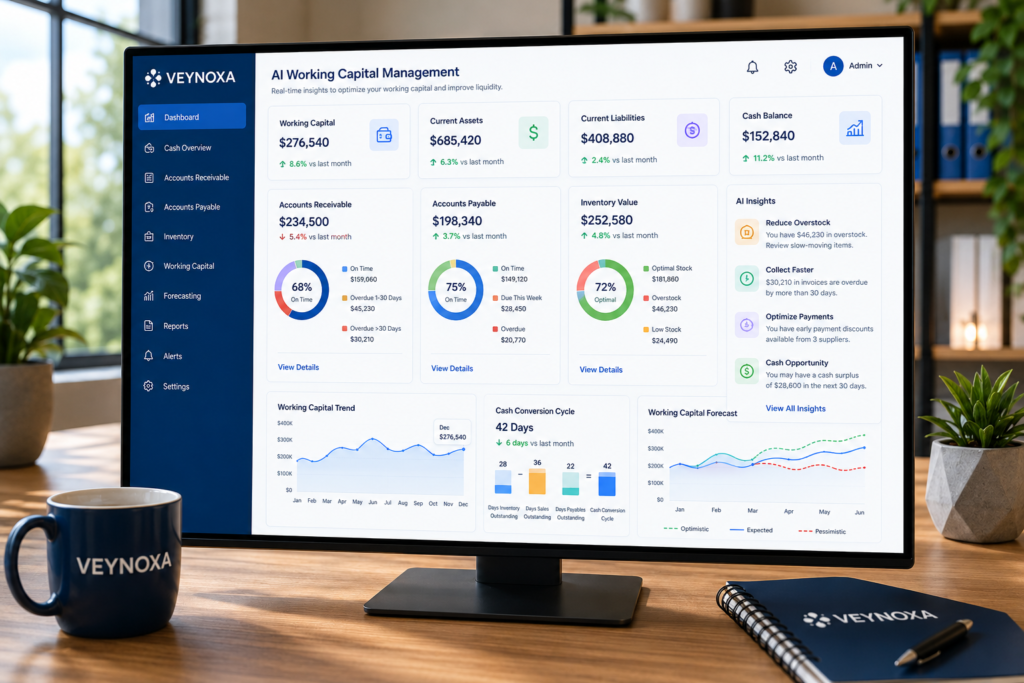
Artificial intelligence (AI) is transforming working capital management by analyzing financial data, identifying cash tied up in operations, monitoring payment patterns, and forecasting short-term financial needs. Instead of relying only on periodic financial reports, businesses can use AI to continuously evaluate working capital and identify opportunities for improvement.
In this guide, you’ll learn how AI working capital management helps small businesses improve liquidity, optimize inventory, accelerate cash collection, manage short-term obligations, and strengthen financial stability in 2026.
What Is AI Working Capital Management?
AI working capital management uses artificial intelligence, machine learning, and predictive analytics to monitor and optimize the resources a business uses for its day-to-day operations.
Working capital is generally influenced by:
- Cash
- Accounts receivable
- Accounts payable
- Inventory
- Short-term business expenses
- Supplier obligations
- Customer payment behavior
AI analyzes these financial areas together to help businesses understand how efficiently their available resources are being managed.
Unlike traditional working capital analysis, AI can continuously update financial insights as new sales, payments, invoices, and inventory transactions occur.
Why Working Capital Management Matters
Poor working capital management can create several challenges for small businesses, including:
- Cash shortages
- Excess inventory
- Slow customer payments
- Difficulty paying suppliers
- Increased short-term borrowing
- Higher operating costs
- Reduced financial flexibility
- Slower business growth
Strong working capital management helps businesses maintain enough liquidity to operate efficiently while using available resources more effectively.
1. Monitoring Accounts Receivable
Money owed by customers can significantly affect working capital.
AI analyzes outstanding invoices, customer payment history, payment deadlines, and collection patterns to help businesses understand how quickly receivables are being converted into cash.
Businesses can identify overdue accounts and prioritize collection activities more effectively.
2. Improving Accounts Payable Management
Supplier payments are another major component of working capital.
AI can analyze upcoming invoices, payment deadlines, supplier terms, and available cash to help businesses organize their short-term obligations.
This allows businesses to manage payments more strategically while maintaining healthy relationships with suppliers.
3. Optimizing Inventory Levels
Excess inventory can tie up significant amounts of business capital.
AI analyzes historical sales, customer demand, inventory levels, and purchasing patterns to identify products that may be overstocked or approaching low-stock levels.
Businesses can use these insights to improve purchasing decisions and reduce unnecessary capital tied up in inventory.
4. Forecasting Short-Term Cash Requirements
AI can combine cash flow data, expected customer payments, upcoming supplier invoices, operating expenses, and historical financial trends to forecast future working capital requirements.
These forecasts help business owners anticipate periods when additional liquidity may be required.
They can also identify periods when excess cash may be available for investment or business growth.
5. Identifying Cash Conversion Opportunities
The faster a business converts inventory and receivables into cash, the more efficiently it can use its working capital.
AI analyzes the different stages of the cash conversion cycle to identify potential delays.
For example, AI may identify that customers are paying invoices slowly or that inventory remains unsold for longer than expected.
Businesses can then focus on improving the areas that have the greatest impact on liquidity.
6. Improving Supplier Payment Strategies
AI can analyze supplier payment terms and historical payment patterns to help businesses determine when payments should be made.
Businesses can use this information to take advantage of favorable payment terms while avoiding unnecessary late fees.
Better payment planning also helps businesses balance supplier relationships with available cash.
7. Supporting Better Financial Decisions
Working capital insights can help business owners make better decisions about:
- Inventory purchases
- Supplier payments
- Customer credit
- Hiring
- Equipment purchases
- Business expansion
- Short-term financing
- Marketing investments
Instead of looking at individual financial metrics separately, AI provides a broader view of the business’s short-term financial position.
Comparison Table
| Traditional Working Capital Management | AI Working Capital Management |
|---|---|
| Manual financial reviews | Automated financial analysis |
| Periodic working capital reports | Continuous monitoring |
| Manual payment tracking | Automated payment analysis |
| Historical inventory analysis | Predictive inventory insights |
| Manual cash forecasting | AI-powered forecasts |
| Limited liquidity visibility | Real-time financial insights |
| Reactive financial management | Proactive working capital optimization |
Best Practices
To maximize AI working capital management:
- Keep financial records accurate and updated.
- Monitor accounts receivable regularly.
- Review accounts payable deadlines.
- Maintain appropriate inventory levels.
- Track customer payment behavior.
- Review working capital forecasts regularly.
- Compare AI forecasts with actual financial results.
- Combine AI insights with professional financial judgment.
Common Mistakes to Avoid
Avoid these common working capital management mistakes:
- Focusing only on revenue growth.
- Holding excessive inventory.
- Ignoring overdue customer invoices.
- Paying suppliers without reviewing cash availability.
- Failing to monitor short-term financial obligations.
- Ignoring changes in customer payment behavior.
- Making large purchases without considering working capital.
- Depending entirely on historical financial information.
Frequently Asked Questions
What is AI working capital management?
AI working capital management uses artificial intelligence to analyze cash, accounts receivable, accounts payable, inventory, and other short-term financial factors to improve business liquidity and operational efficiency.
Can small businesses use AI working capital management?
Yes. Small businesses can use AI-powered financial tools to monitor receivables, payables, inventory, cash flow, and short-term financial requirements.
How does AI improve working capital?
AI identifies delays, inefficient spending, slow customer payments, excess inventory, and other factors that can tie up business capital.
Can AI help reduce excess inventory?
Yes. AI can analyze sales history, demand patterns, and inventory levels to identify products that may be overstocked or moving slowly.
How does AI improve accounts receivable?
AI can analyze outstanding invoices, payment behavior, and overdue accounts to help businesses prioritize collections and improve cash conversion.
Can AI help businesses manage supplier payments?
Yes. AI can analyze payment deadlines, supplier terms, available cash, and upcoming obligations to support better payment planning.
How does AI forecast working capital requirements?
AI combines historical financial data with current transactions, expected customer payments, upcoming expenses, inventory information, and supplier obligations to estimate future working capital needs.
Does AI replace accountants?
No. AI supports accountants and business owners by automating analysis and providing financial insights, while humans remain responsible for reviewing information and making strategic decisions.
What are the benefits of AI working capital management?
Businesses can benefit from improved liquidity, better inventory management, faster cash collection, more effective supplier payment planning, stronger financial visibility, and improved financial stability.
Conclusion
AI working capital management helps small businesses improve the way they manage cash, receivables, payables, inventory, and short-term financial obligations. By continuously analyzing financial data, AI can identify resources that are tied up in operations and highlight opportunities to improve liquidity.
Better working capital management allows businesses to collect customer payments faster, optimize inventory, organize supplier payments, and prepare for future financial requirements.
As AI-powered financial management continues to evolve throughout 2026, small businesses that adopt intelligent working capital management can improve liquidity, strengthen financial flexibility, reduce financial pressure, and build a stronger foundation for sustainable long-term growth.