
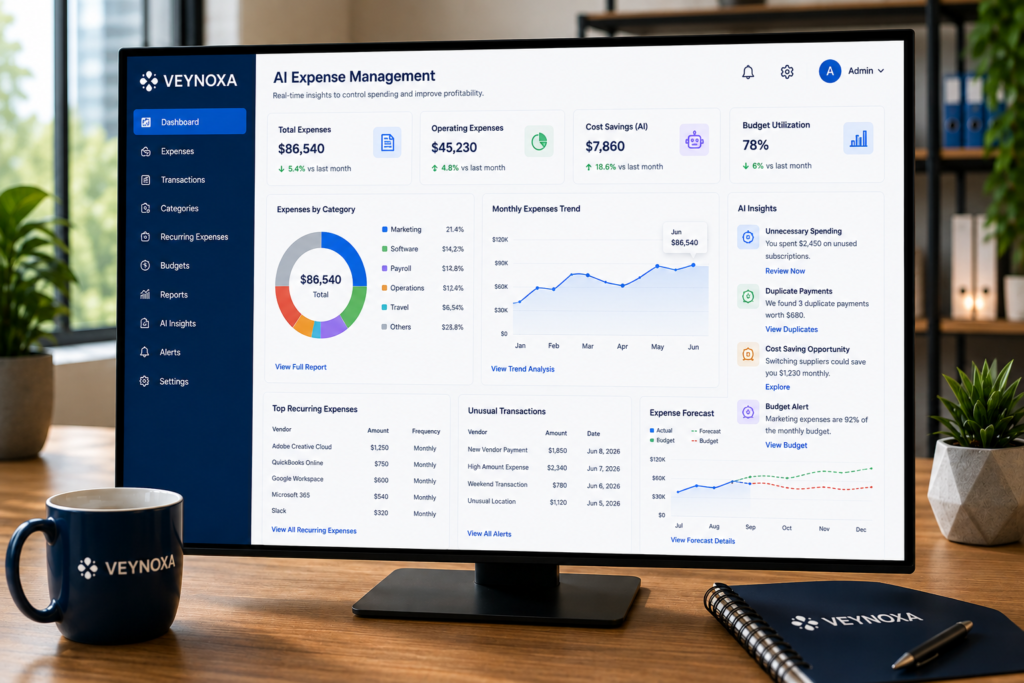
Introduction
Expense management is one of the most important parts of running a financially healthy small business. Even when revenue is growing, uncontrolled expenses, unnecessary subscriptions, inefficient spending, and unexpected costs can reduce profitability and create financial pressure.
Traditional expense management often depends on spreadsheets, receipts, invoices, bank statements, and manual bookkeeping. These methods can become time-consuming as the number of transactions increases, making it difficult for business owners to understand where money is being spent and which costs could be reduced.
Artificial intelligence (AI) is transforming expense management by automatically analyzing transactions, categorizing spending, detecting unusual expenses, monitoring recurring costs, and identifying opportunities to control business spending.
Instead of reviewing expenses only at the end of the month, businesses can use AI to continuously monitor spending and receive faster financial insights.
In this guide, you’ll learn how AI improves expense management for small businesses, reduces unnecessary spending, improves financial visibility, and supports more profitable business growth in 2026.
What Is AI Expense Management?
AI expense management uses artificial intelligence, machine learning, and data analysis to monitor, categorize, and optimize business expenses.
AI can analyze financial information such as:
- Business transactions
- Receipts
- Supplier invoices
- Employee expenses
- Software subscriptions
- Travel expenses
- Office expenses
- Marketing costs
- Operating expenses
- Recurring payments
- Purchase records
AI systems can automatically organize expenses into categories and identify patterns that may be difficult to recognize through manual analysis.
Unlike traditional expense tracking, AI can continuously update spending insights as new transactions occur.
Why Expense Management Matters
Poor expense management can create significant challenges for small businesses, including:
- Reduced profitability
- Unnecessary spending
- Higher operating costs
- Poor budgeting decisions
- Unexpected cash flow pressure
- Duplicate payments
- Unused subscriptions
- Difficulty controlling business spending
- Slower financial growth
Effective expense management helps businesses understand where money is going and ensure that spending supports important business objectives.
AI gives business owners greater visibility into expenses and helps them identify opportunities to improve financial efficiency.
1. Automatically Categorizing Business Expenses
One of the most useful applications of AI expense management is automatic expense categorization.
Businesses may process hundreds or thousands of transactions across different accounts and payment methods.
AI can analyze transaction descriptions, suppliers, payment amounts, and historical spending patterns to automatically classify expenses.
For example, AI may categorize transactions as:
- Marketing
- Software
- Payroll
- Office supplies
- Travel
- Utilities
- Inventory
- Professional services
Automatic categorization reduces manual bookkeeping and makes financial reports easier to understand.
2. Detecting Unnecessary Spending
Not every business expense contributes equally to growth.
AI can analyze spending patterns and identify expenses that may no longer provide meaningful value.
For example, a business may be paying for:
- Unused software
- Duplicate services
- Excessive subscriptions
- Unnecessary office expenses
- Low-performing marketing services
- Services that are rarely used
AI can highlight these patterns so business owners can review them and determine whether the expenses should continue.
Reducing unnecessary spending can improve profitability without requiring additional sales.
3. Monitoring Recurring Expenses
Recurring expenses can quietly increase operating costs over time.
Software subscriptions, service contracts, memberships, insurance payments, and other recurring charges may continue automatically even when they are no longer needed.
AI can monitor recurring transactions and identify:
- Subscription increases
- Duplicate subscriptions
- Unused services
- Unexpected recurring charges
- Changes in payment amounts
- Upcoming renewals
Business owners can use these insights to review recurring expenses before they become a larger financial burden.
4. Identifying Unusual Transactions
Unexpected expenses can affect budgets and reduce financial visibility.
AI can learn normal business spending patterns and identify transactions that appear unusual.
For example, AI may detect:
- An unusually large purchase
- A new supplier charge
- An unexpected increase in expenses
- A duplicate transaction
- A payment outside normal spending patterns
These alerts allow business owners to investigate unusual activity sooner.
5. Improving Budget Management
Effective budgeting requires accurate information about historical and current spending.
AI analyzes previous expenses and current spending patterns to help businesses understand whether they are staying within budget.
Business owners can monitor:
- Actual spending
- Budgeted spending
- Spending trends
- Department expenses
- Monthly expense changes
- Remaining budget
AI can also highlight areas where spending is approaching or exceeding planned limits.
This helps businesses take corrective action before expenses become difficult to control.
6. Supporting Better Purchasing Decisions
Purchasing decisions can have a significant impact on business profitability.
AI can analyze supplier prices, purchasing frequency, transaction history, and spending patterns to help businesses identify opportunities for more efficient purchasing.
For example, AI may identify that a business is purchasing the same product from multiple suppliers at significantly different prices.
Business owners can then compare purchasing options and determine whether consolidating suppliers or negotiating better terms could reduce costs.
7. Improving Expense Forecasting
AI can use historical spending data and current business trends to forecast future expenses.
These forecasts can help businesses anticipate:
- Monthly operating costs
- Seasonal expenses
- Upcoming subscriptions
- Supplier payments
- Payroll requirements
- Marketing expenses
- Planned purchases
Better expense forecasting allows businesses to prepare budgets more accurately and avoid unexpected financial pressure.
8. Detecting Duplicate Payments
Duplicate payments can happen when invoices are processed manually or when multiple employees submit similar expenses.
AI can compare transaction amounts, supplier information, invoice numbers, dates, and payment records to identify potential duplicates.
This helps businesses investigate duplicate transactions before they unnecessarily reduce available cash.
Automated detection can also reduce the amount of time employees spend reviewing financial records.
9. Improving Employee Expense Management
Employee expenses can become difficult to monitor as a business grows.
AI can analyze expense reports, receipts, transaction amounts, and spending categories to help businesses identify unusual or potentially non-compliant expenses.
Businesses can establish spending policies and use AI to highlight transactions that require additional review.
This creates greater consistency in expense management while reducing manual administrative work.
10. Supporting Better Financial Decisions
Expense insights can help business owners make more informed decisions about:
- Hiring employees
- Marketing investments
- Software purchases
- Equipment
- Supplier relationships
- Business expansion
- Operational improvements
- Future investments
Instead of making decisions based only on revenue, business owners can consider how each decision affects overall spending and profitability.
AI provides a clearer view of the financial consequences of different choices.
11. Improving Profitability
Expense management directly affects profitability.
When businesses identify unnecessary costs, improve purchasing decisions, control recurring expenses, and reduce financial waste, more revenue can remain available as profit.
AI helps businesses continuously search for expense optimization opportunities instead of waiting for problems to appear in financial reports.
Small improvements across multiple expense categories can create meaningful financial benefits over time.
Comparison Table
| Traditional Expense Management | AI Expense Management |
|---|---|
| Manual expense tracking | Automated expense tracking |
| Manual categorization | AI-powered categorization |
| Periodic expense reviews | Continuous spending monitoring |
| Manual anomaly detection | Automated unusual transaction alerts |
| Static budgets | Dynamic spending insights |
| Manual forecasting | AI-powered expense forecasting |
| Limited spending visibility | Real-time expense insights |
| Reactive cost control | Proactive expense optimization |
Best Practices
To maximize AI expense management:
- Keep financial records accurate and updated.
- Connect relevant financial data sources.
- Review AI-generated expense insights regularly.
- Establish clear business spending policies.
- Monitor recurring expenses.
- Review unusual transactions quickly.
- Compare actual spending with budgets.
- Analyze supplier and purchasing costs.
- Review expense forecasts regularly.
- Combine AI insights with professional financial judgment.
Common Mistakes to Avoid
Avoid these common expense management mistakes:
- Tracking expenses only at the end of the month.
- Ignoring small recurring expenses.
- Paying for unused subscriptions.
- Failing to review unusual transactions.
- Mixing personal and business expenses.
- Ignoring duplicate payments.
- Setting budgets without analyzing historical spending.
- Making purchases without comparing costs.
- Focusing only on revenue instead of profitability.
- Depending entirely on automated recommendations without human review.
Frequently Asked Questions
What is AI expense management?
AI expense management uses artificial intelligence to monitor, categorize, analyze, and optimize business expenses automatically.
Can small businesses use AI for expense management?
Yes. Small businesses can use AI-powered financial tools to track spending, categorize transactions, monitor recurring expenses, identify unusual payments, and improve budgeting.
How does AI reduce business expenses?
AI identifies unnecessary spending, unusual transactions, duplicate payments, unused subscriptions, and other cost-saving opportunities.
Can AI categorize expenses automatically?
Yes. AI can analyze transaction information and historical spending patterns to automatically categorize many business expenses.
Can AI detect unusual expenses?
Yes. AI can learn normal spending patterns and identify transactions that differ significantly from expected business activity.
How does AI help with budgeting?
AI compares historical and current spending with planned budgets and can highlight areas where expenses are approaching or exceeding budget limits.
Can AI monitor subscriptions?
Yes. AI can identify recurring payments, track changes in subscription costs, and highlight services that may require review.
Can AI detect duplicate payments?
AI can compare transaction details such as supplier information, payment amounts, dates, and invoice records to identify potential duplicate payments.
Does AI replace accountants?
No. AI supports accountants and business owners by automating expense analysis and providing financial insights, while humans remain responsible for reviewing information and making important financial decisions.
What are the benefits of AI expense management?
Businesses can benefit from better spending visibility, lower unnecessary costs, improved budgeting, faster financial analysis, better purchasing decisions, and stronger profitability.
Conclusion
AI expense management gives small businesses a more efficient way to monitor, analyze, and control their spending. By automatically categorizing transactions, detecting unusual expenses, monitoring recurring costs, identifying duplicate payments, and forecasting future spending, AI helps businesses gain greater financial visibility.
Better expense management allows business owners to reduce unnecessary costs, improve budgets, make smarter purchasing decisions, and protect profitability.
As AI-powered financial tools continue to evolve throughout 2026, small businesses that adopt intelligent expense management can improve financial efficiency, strengthen profitability, and create a stronger foundation for sustainable long-term growth.