
Introduction
Competitive analysis helps businesses understand their competitors, identify market opportunities, improve products, and make better strategic decisions. Traditionally, monitoring competitors required hours of manual research, making it difficult for small businesses with limited resources.
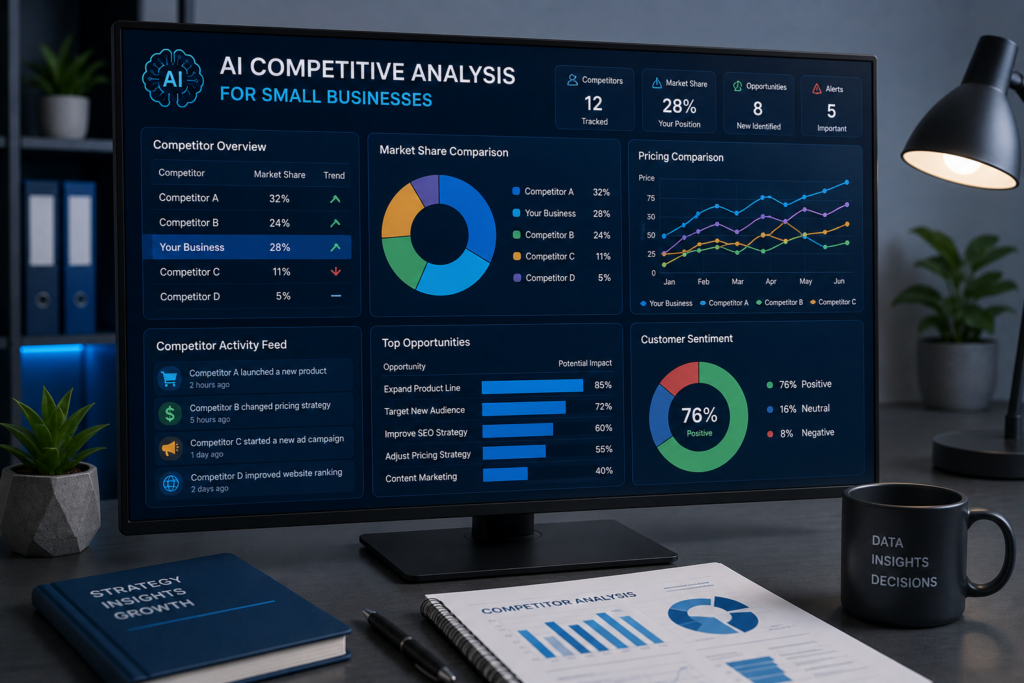
Artificial intelligence (AI) automates competitive analysis by collecting market data, tracking competitor activities, analyzing pricing strategies, monitoring customer sentiment, and identifying emerging industry trends. Instead of manually reviewing websites and reports, business owners receive real-time competitive insights that support smarter business decisions.
AI also helps businesses detect emerging market opportunities earlier, allowing them to respond more quickly than competitors.
In this guide, you’ll learn how AI improves competitive analysis for small businesses and why AI-powered market intelligence is becoming an essential business tool in 2026.
What Is AI Competitive Analysis?
AI competitive analysis uses artificial intelligence, machine learning, and business intelligence to automatically monitor competitors and evaluate market conditions.
AI can analyze:
- Competitor pricing
- Product offerings
- Marketing campaigns
- Customer reviews
- Website performance
- Search rankings
- Industry trends
Unlike traditional competitor research, AI continuously updates competitive insights in real time.
Why Competitive Analysis Matters
Without competitive analysis, businesses often experience:
- Missed market opportunities
- Poor pricing decisions
- Weak competitive positioning
- Slow market response
- Ineffective marketing strategies
- Reduced business growth
AI helps businesses stay informed about changing market conditions.
1. Monitoring Competitor Activity
AI continuously tracks competitor websites, pricing updates, product launches, and marketing campaigns.
Business owners receive automatic alerts whenever competitors make important changes.
2. Analyzing Pricing Strategies
AI compares pricing across multiple competitors and identifies pricing trends.
Businesses can develop more competitive pricing strategies without reducing profitability.
3. Tracking Market Trends
AI analyzes search trends, customer demand, and industry developments to identify new business opportunities before competitors.
4. Improving Marketing Strategies
AI evaluates competitor advertising campaigns, content marketing, SEO performance, and social media activity.
Businesses learn which marketing strategies generate the best results.
5. Understanding Customer Sentiment
AI analyzes customer reviews, ratings, and online discussions to understand what customers like or dislike about competitors.
These insights help improve products and customer experiences.
6. Supporting Strategic Decisions
Competitive intelligence allows business owners to make better decisions regarding expansion, pricing, product development, and marketing investments.
7. Building Competitive Advantage
Businesses that monitor competitors consistently can respond faster to market changes and maintain stronger market positions.
Businesses that consistently monitor competitor activities can adapt faster to industry changes, refine their products, improve customer experiences, and strengthen their long-term market position.
Comparison Table
| Traditional Competitive Analysis | AI Competitive Analysis |
|---|---|
| Manual research | Automated monitoring |
| Periodic updates | Real-time tracking |
| Limited data | Comprehensive analysis |
| Slow reporting | Instant insights |
| Historical analysis | Predictive analysis |
| Manual monitoring | Continuous automation |
Best Practices
To maximize AI competitive analysis:
- Monitor competitors regularly.
- Focus on meaningful business metrics.
- Combine AI insights with market research.
- Track customer feedback.
- Review competitive reports frequently.
Common Mistakes to Avoid
Avoid these mistakes:
- Monitoring too many competitors
- Ignoring customer reviews
- Copying competitor strategies directly
- Focusing only on pricing
- Failing to update competitive data
Challenges of AI Competitive Analysis
Although AI automates competitor monitoring, businesses should verify AI-generated insights, avoid copying competitors directly, and combine competitive intelligence with their own market research. AI delivers the best results when used to support strategic decision-making rather than replace human
Frequently Asked Questions
What is AI competitive analysis?
AI competitive analysis uses artificial intelligence to monitor competitors, analyze market trends, and support better business decisions.
Can small businesses use AI competitive analysis?
Yes. Many affordable AI tools provide competitive intelligence for startups and small businesses.
Does AI replace market research?
No. AI automates data collection and analysis, while business owners interpret the insights and make final decisions.
What are the benefits of AI competitive analysis?
Businesses gain better market visibility, faster competitor monitoring, improved pricing strategies, stronger marketing performance, and greater competitive advantage.
Conclusion
AI competitive analysis enables small businesses to monitor competitors more efficiently, identify emerging market opportunities, improve pricing strategies, and strengthen strategic planning. By combining real-time monitoring, predictive analytics, and business intelligence, AI helps organizations make faster, smarter, and more confident business decisions.
Businesses that adopt AI competitive analysis today will strengthen their competitive advantage, improve market positioning, and achieve sustainable growth throughout 2026.